
Budgets and the ten-year plan
Budgets and the ten-year maintenance plan, on the record
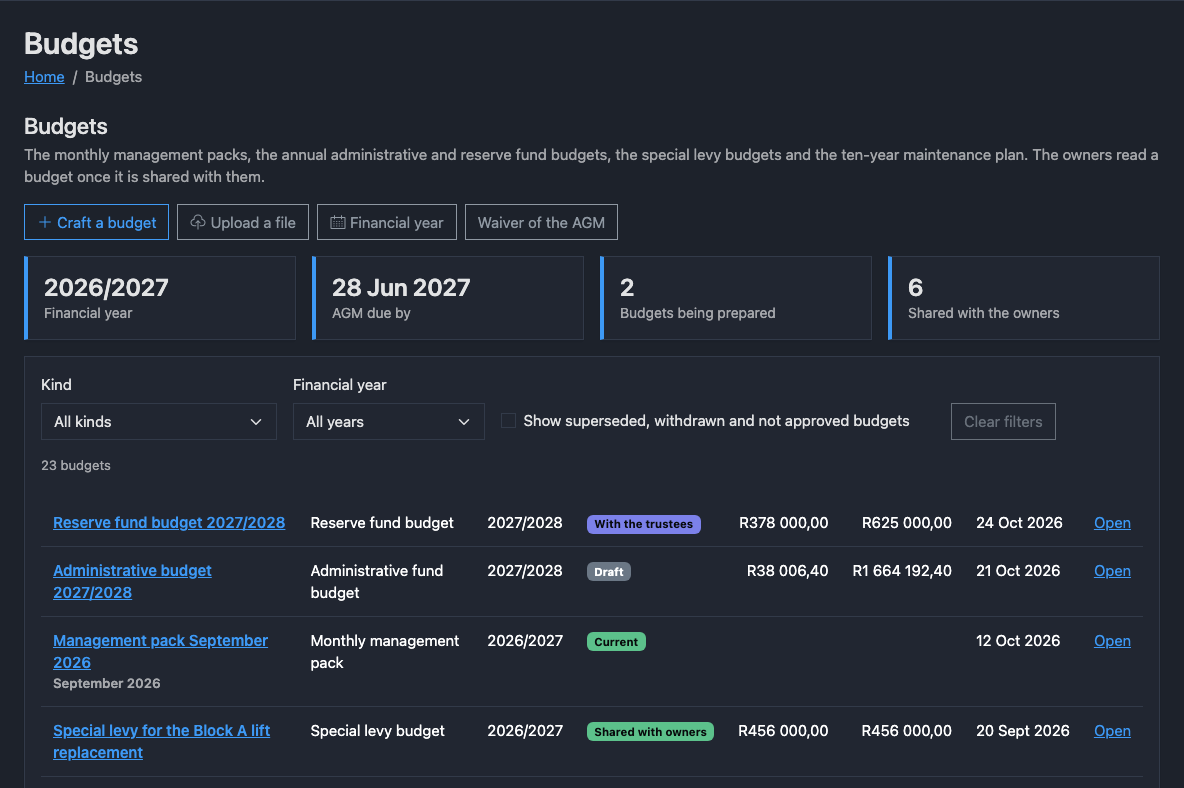
Estate Manager keeps a sectional title scheme's administrative and reserve fund budgets, special levy budgets and 10-year maintenance plan in one place. Build them from templates and export them to Excel, or upload the managing agent's own. Each is approved by resolution and shared with owners. The money stays in the agent's accounting system.
The ten-year plan
The 10-year maintenance plan for a sectional title scheme
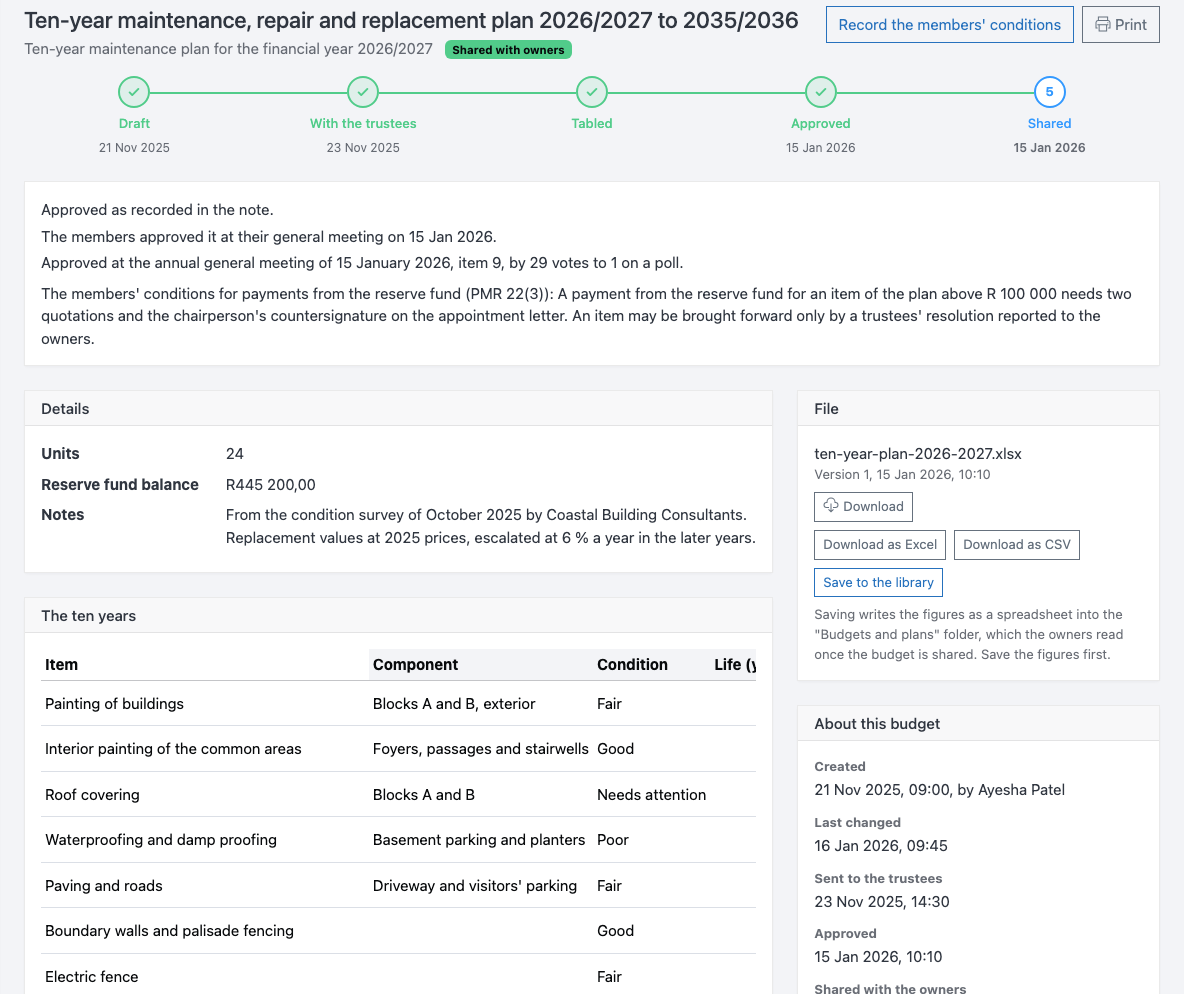
Rule 22 of the prescribed management rules asks every body corporate for a written plan of the major capital items of its common property that will need maintenance, repair or replacement within the next 10 years. Estate Manager's plan starts with twenty-five such items, from painting and roof coverings to lifts, gates and the pool, for the managers to adjust.
Each item carries its condition, its expected life, what replacing it costs and the amount planned for each of its 10 years, with a status and a progress note while the plan is a draft. Once the members approve a plan its items no longer change, so the trustees' report to the annual general meeting (AGM) on how far it was carried out is written outside it. The plan sums every year, works out the balance to raise from what the reserve fund holds, and gives the year's contribution that rule 22(2) sets, item by item, a year and a month at a time, in all and per unit.
Five conditions, from good to urgent, and a component for each item A reserve fund quote request names its plan item, or an urgent reason Exported to Excel or CSV, printed, or saved into the library
Annual budgets
Administrative and reserve fund budgets, line by line
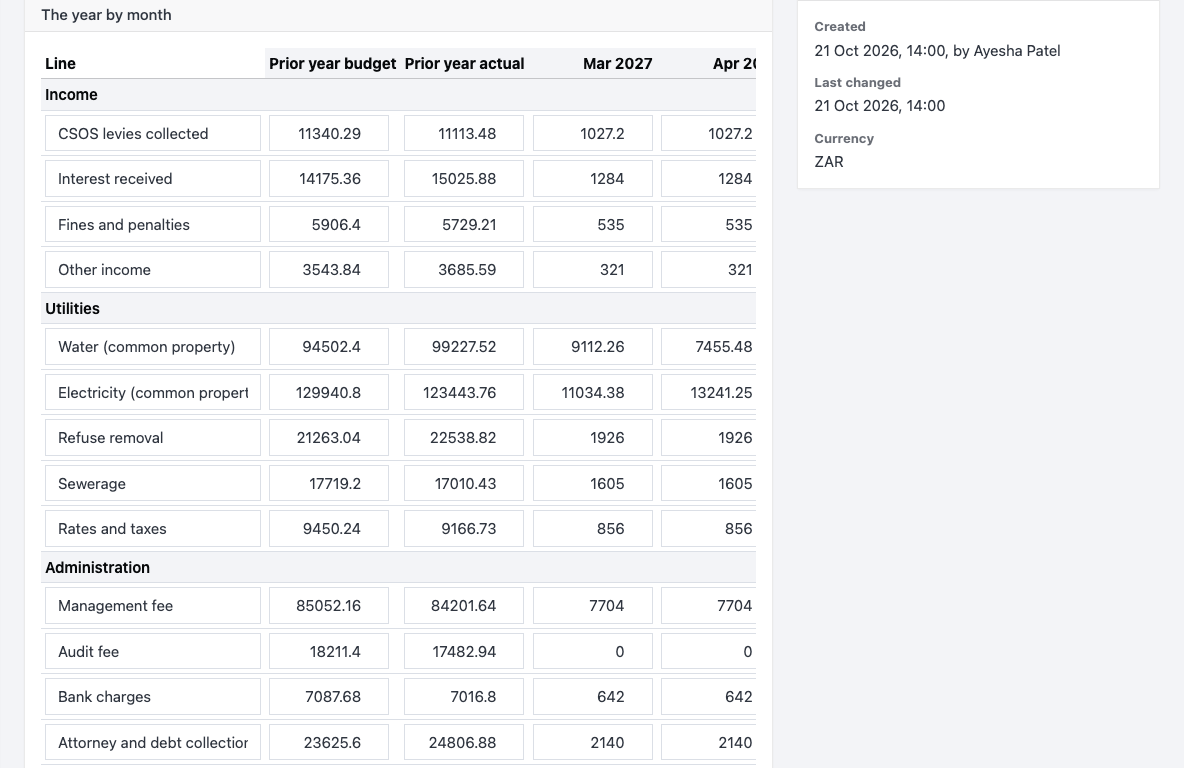
Rule 26 asks for itemised budgets of next year's income and expenses for both funds, for the AGM to approve. A budget built in Estate Manager starts from its template: the levies and other income, then expenditure grouped from utilities and administration to repairs and maintenance, staff and provisions.
Each line runs across the twelve months of the scheme's financial year, with last year's budget and actual figures beside it. The grid sums the months, the groups and the year, with the surplus or deficit and the expenditure per unit per month.
A budget from the managing agent's own model is uploaded as a file instead. The agent's monthly management packs are kept here for the trustees and never reach the owners.
Templates for the reserve fund and special levy budgets too The financial year and the day by which the AGM after it is due, above the list Closed budgets kept for 6 years, as rule 26(3) keeps financial records
From draft to owners
How a budget is approved and shared
Annual budgets, special levy budgets and the plan follow the same path, and each step is dated on the record.
- 01
Draft
Built from a template or uploaded, and changed freely by the managers.
- 02
With the trustees
Sent to the trustees to read and adjust.
- 03
Tabled
Linked to the general meeting and the resolution that approves it. When the chair closes that poll, the result approves the budget or marks it not approved.
PMR 17(6)(j)(iv) - 04
Approved
Approved by the poll, or recorded by hand with a resolution, the trustees' written resolution for a special levy, or a note of how. A budget not approved carries the members' reasons, which the managers record when a poll decides it, and stays open until it is revised and approved at another general meeting, as rule 17(8) requires.
PMR 17(8) - 05
Shared
Owners read it, download it or print it. A later approved budget of the same kind and year takes its place.
What the law says
The plan, the reserve fund and the budgets: the rules
Sections are those of the Sectional Titles Schemes Management Act 8 of 2011, and rules are the prescribed management rules of its 2016 regulations.
General information, not legal advice.
Two funds
Every body corporate keeps an administrative fund for the year's operating costs and a reserve fund reasonably sufficient for the future maintenance and repair of the common property, never less than the minimum the regulations prescribe.
The reserve fund minimum
If the reserve fund held less than 25 per cent of the year's administrative contributions at the year end, next year's reserve contribution must be at least 15 per cent of the budgeted administrative contribution. At 100 per cent or more, no minimum applies. In between, it must at least equal what the new budget sets aside from the administrative fund for repairs and maintenance of the common property. No minimum applies to the year budgeted for at the first general meeting.
What the plan holds
The major capital items expected to need maintenance, repair or replacement within 10 years, with their present condition, when the work will be needed, its estimated cost and the expected life afterwards. They include electrical, plumbing and drainage systems, lifts, roofing, painting and waterproofing, parking, roads and paving, security systems and recreational facilities.
The contribution for each item
The annual contribution to the reserve fund for each major capital item is its estimated cost, less the past contribution already in the fund for it, divided by its expected life.
Approval and the yearly report
The plan takes effect when the members approve it in general meeting, and they may set conditions for paying money out of the reserve fund. The trustees report to every AGM on how far the approved plan has been carried out.
Budgets for the AGM
The body corporate prepares the plan and itemised budgets of next year's income and expenses for both funds, and the AGM approves the budgets. A document it does not approve is revised and tabled again, with the reasons recorded.
Notice of the contributions
Within 14 days of the budgets' approval, each member receives written notice of the contributions due, with the due dates, any interest on overdue amounts and the way to dispute a charge.
Who decides what, and under which rule
The members approve the budgets and the plan. Between meetings, the trustees decide within limits.
| Decision | Who decides | Rule |
|---|---|---|
| The administrative and reserve fund budgets | The members, at the AGM | PMR 17(6)(j)(iv) |
| The ten-year maintenance plan | The members, in general meeting | PMR 22(3) |
| A special levy for a necessary expense that cannot wait for the next budget | The trustees, by written resolution | PMR 21(3)(a) |
| An increase of up to 10 per cent at the year end, until the next year's notice | The trustees, by written resolution | PMR 21(3)(b) |
| Paying from the administrative fund | The trustees, under the approved budget | PMR 24(4) |
| Paying from the reserve fund | The trustees, under the approved plan or for an urgent need | PMR 24(5) |
Urgent needs include an order of a court or adjudicator, safety, repairs the plan could not have foreseen and adequate insurance, and the trustees report such payments to the members.
Free template
Ten-year maintenance plan template in Excel
The workbook Estate Manager exports from a plan, with its twenty-five starting items, ready for your scheme's own figures.
Twenty-five major capital items, from painting and roofs to lifts and the pool Condition, expected life and replacement value for each item Ten yearly columns, with totals by item and by year The reserve fund balance, the balance to raise and the contribution that rule 22(2) sets, a year and a month at a time, in all and per unit
Free template
Sectional title budget template in Excel
The administrative fund budget workbook Estate Manager exports, with income and expenditure lines laid out the way managing agents table them.
Income lines for levies, interest, fines, insurance claims and the levies collected for the Community Schemes Ombud Service (CSOS) Expenditure grouped as utilities, administration, security, repairs and maintenance, staff, and taxation and provisions Last year's budget and actual figures beside each line Twelve monthly columns, the surplus or deficit and the expenditure per unit per month
What Estate Manager does not do with budgets
- Accounting. Levies, statements, arrears, interest and collections stay in the managing agent's accounting system.
- Levy notices and clearance certificates. Estate Manager does not issue them.
Questions
Questions about budgets and the ten-year plan
Anything else: ask us when you book a demo, or write to info@nanotech-computers.com.
How are body corporate levies worked out?
Can trustees raise a special levy without a general meeting?
What is the reserve fund, and how is its contribution worked out?
Does a body corporate need to be audited?
Is the ten-year plan part of the CSOS annual return?
Can we upload a budget prepared elsewhere?
Related
Related
AGMs and general meetings
The meeting that approves the budgets, with votes counted in value and in number.
Read moreQuotes and trustee approvals
Reserve fund work drawn from a plan item or for an urgent need, decided on the record.
Read moreDocuments and records
The budgets and plans folder, with every version kept.
Read moreSee a budget go from draft to the owners
A demo walks through a fictional scheme's budgets and ten-year plan, from the template to the AGM's resolution and the owners' copy.