
Quotes and trustee approvals
Body corporate quotes, decided on the record
A body corporate's spending decision is only as strong as its record. Estate Manager keeps every step: quotes compared against the estimate, the trustees' declarations of interest, their resolution and the signed appointment letter, with the managing agent's written spending limit and the notice that improvements to the common property need.
Quote requests
Three quotes, compared against the estimate
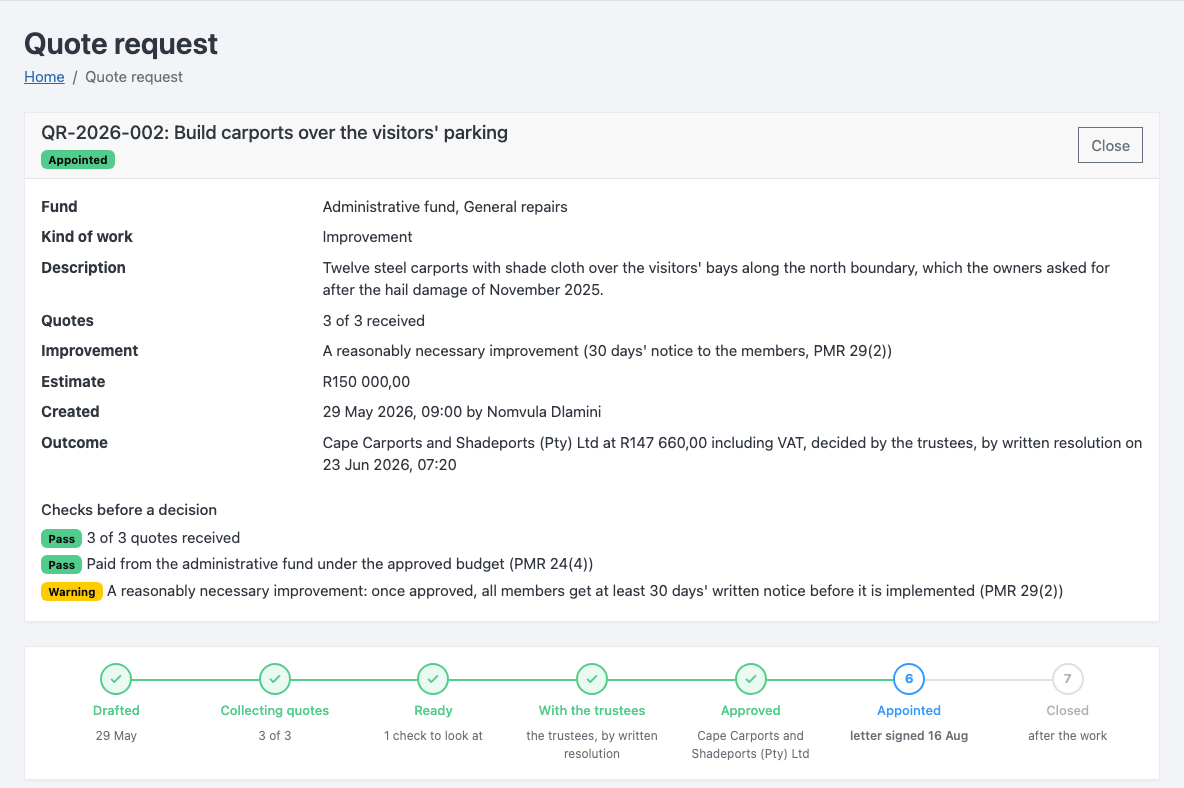
A quote request says what is needed, which fund pays, the budget or plan item it draws on, whether it is urgent and why, and whether it improves the common property. Each scheme sets how many quotes it wants, three unless it says otherwise, and deciding on fewer needs a recorded reason.
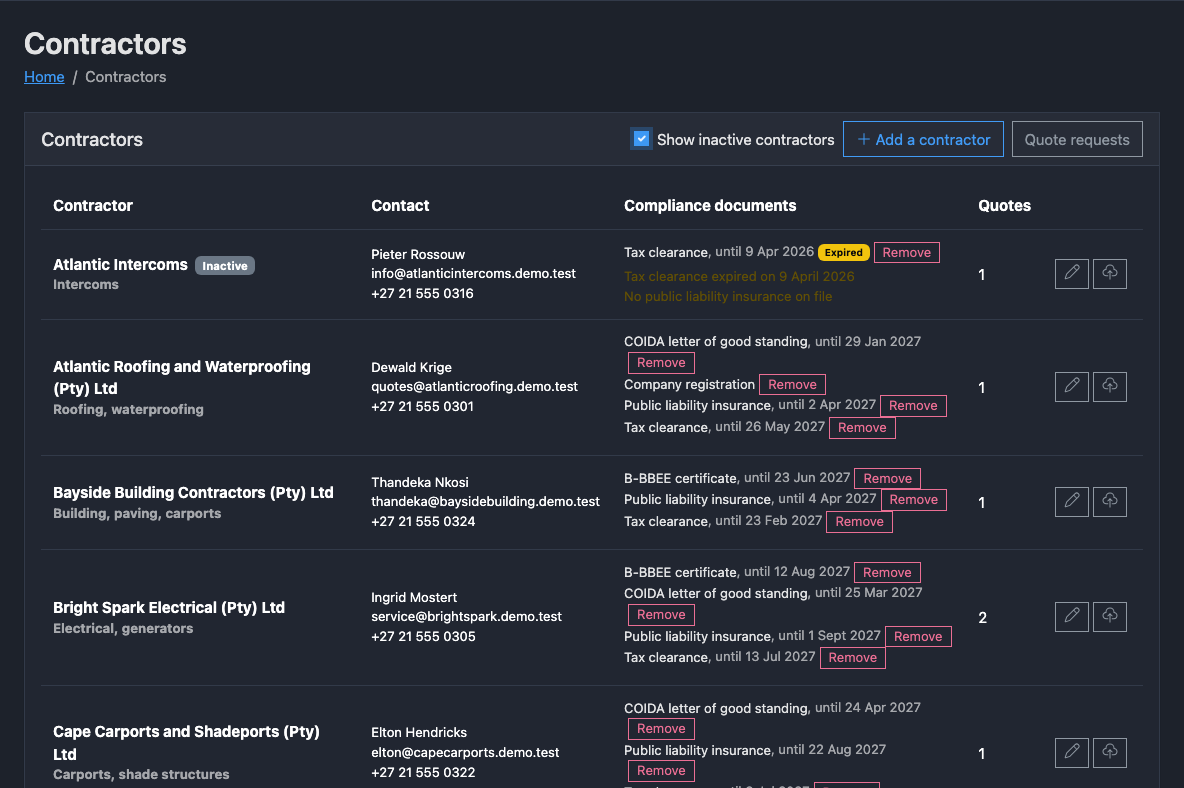
Each contractor's record holds its registration and VAT numbers and its compliance documents, such as tax clearance and public liability cover, each with its expiry date. The comparison draws the quotes as bars against the estimate and warns of an expired document, or a missing tax clearance or liability cover.
Each quote with its amounts, validity, lead time, scope and exclusions Checks before a decision: enough quotes, compliance and the fund's rules Quote documents filed in the library's quotes and contracts folder
The trustees' decision
Declared interests, then a resolution on record
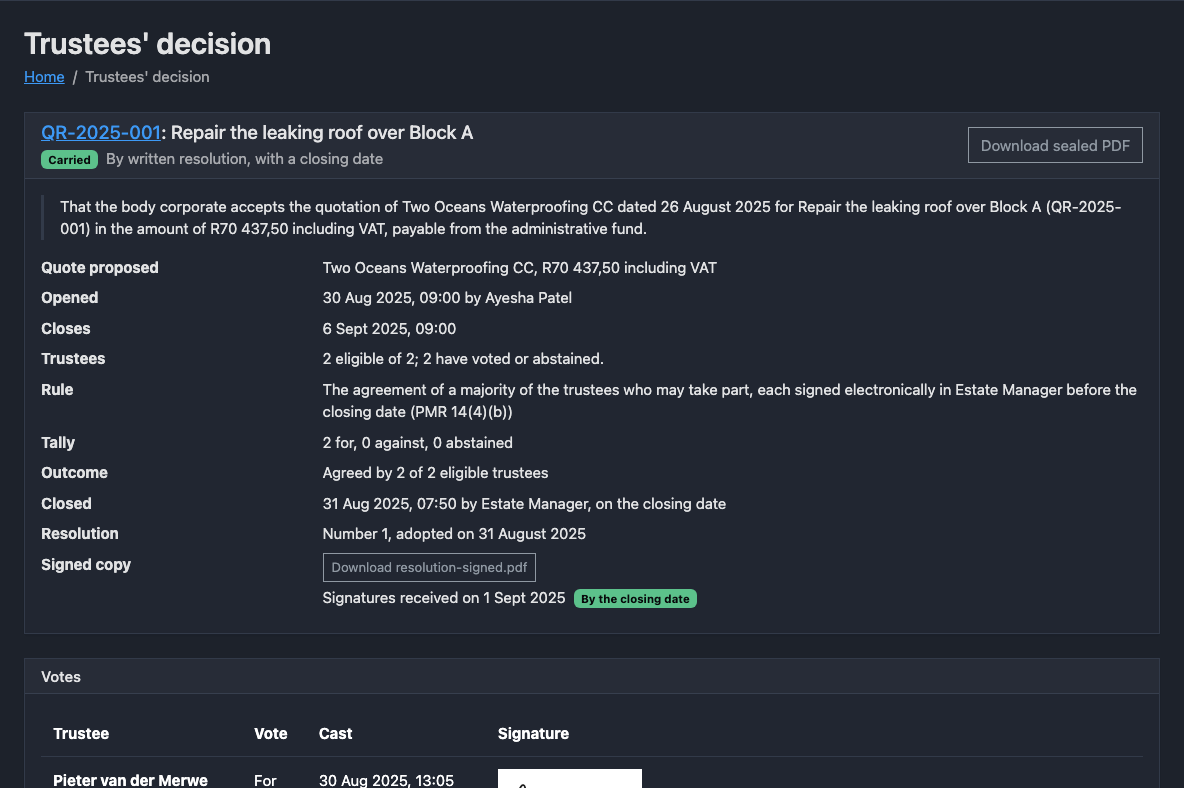
Each trustee first declares whether they have a direct or indirect personal interest in the request. A trustee who declares one must take no part, and Estate Manager takes away their preference and their vote. The other trustees may recuse a trustee who declared none, with a reason, and the record keeps who stood aside.
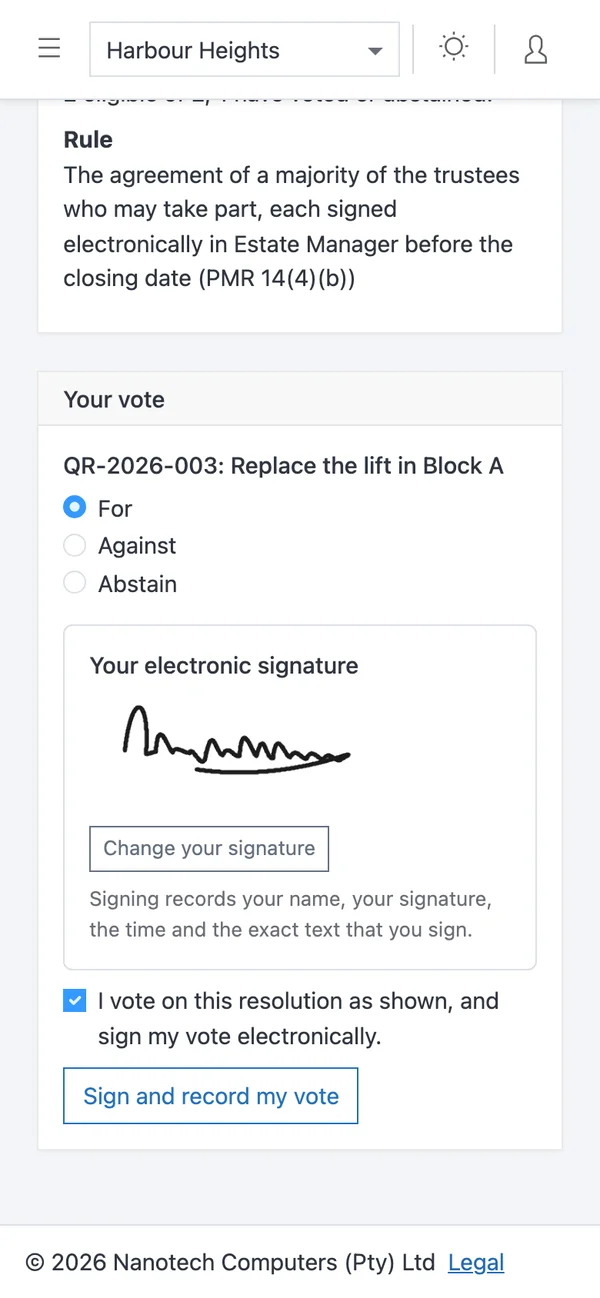
The trustees then decide at their meeting, or by written resolution with a closing date, 7 days unless the scheme sets another. Each trustee reads the resolution and the proposed quote and votes from a phone or a laptop, recorded with their name and the time. The tally stays hidden from a trustee who has not yet voted.
A majority of the trustees, with the chairperson's casting vote on a tie at a meeting A written resolution closes itself once a majority agrees The signed copy of the resolution filed beside the record
The agent's limit
Routine work within the managing agent's written limit
The trustees may delegate a power to the managing agent in writing, naming the power, the most that may be spent and any conditions. Estate Manager records the delegation with its limit including VAT, its wording, its dates and the signed resolution. A new delegation revokes the last, and the history stays.
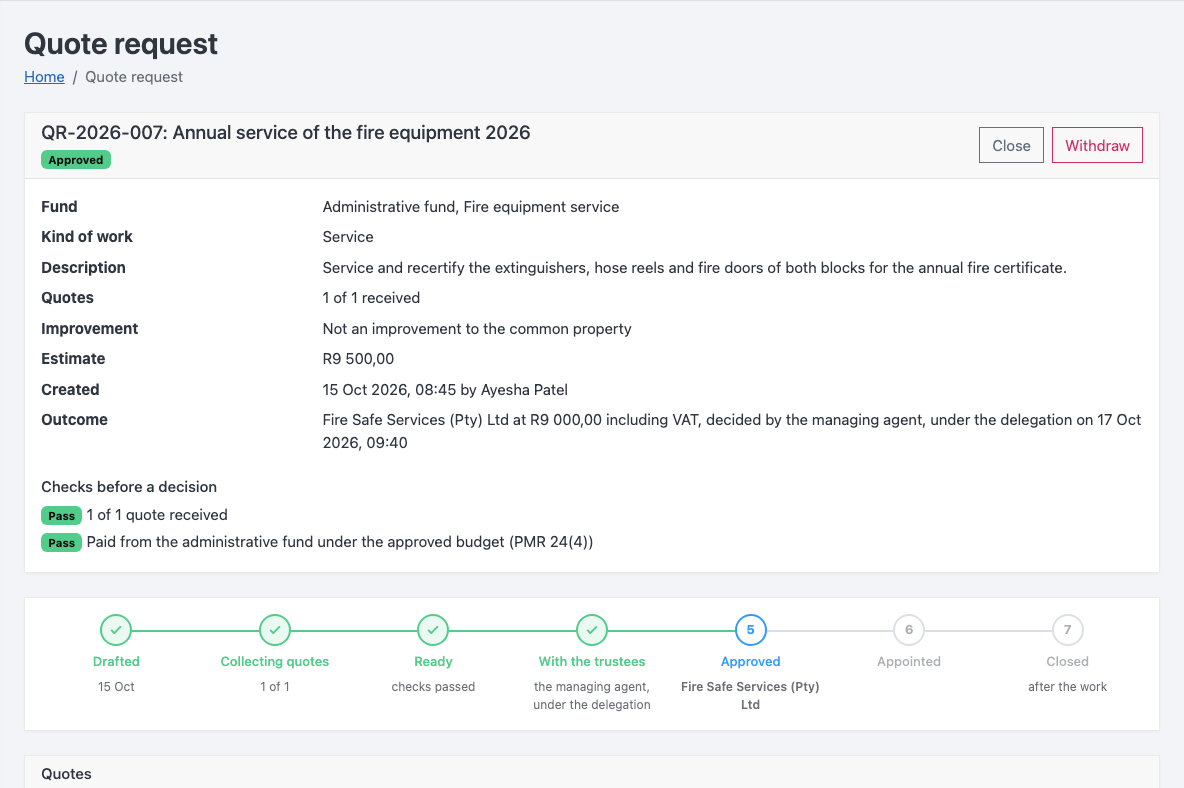
Under it, the managing agent alone approves a quote when the request is ready, the amount is within the limit, the work is not an improvement and any reserve fund payment draws on the plan. The trustees are emailed each approval, and anything larger goes to them.
Improvements to the common property
An improvement's 30 days, and the members' say
Rule 29 separates improvements that are reasonably necessary from those that are not. One that is not needs a unanimous resolution of the members, so Estate Manager sends it straight to a general meeting.
- Approval
The trustees approve it
A quote request marked as a reasonably necessary improvement is decided by the trustees, and the checks warn that notice must follow.
PMR 29(2) - Notice day
Written notice to every member
The estimated cost, how it will be paid for, including any special levy or loan, and the motivation with drawings. It is published to the owners and emailed to each owner with an email address. Members whom email does not give it in full get it by hand or by registered post, and the 30 days run until the last of them has had theirs.
PMR 29(2)(a) to (c) - Within 30 days
Any member may ask for a meeting
A member's written request for a general meeting, recorded by a manager, holds the work until the members decide.
PMR 29(2) - After 30 days
The approval stands
With no request, the trustees' approval stands, and the appointment letter can follow.
- At the meeting
A special resolution decides
The improvement goes ahead only if a special resolution approves it, with or without changes, and the poll's result decides the request.
PMR 29(2)
What the law says
Conflicts of interest, trustee decisions and spending: the rules
Neither the Sectional Titles Schemes Management Act 8 of 2011 nor its regulations set a number of quotes. They do set how trustees deal with their own interests, decide and spend.
General information, not legal advice.
Avoid conflicts, and disclose them
A trustee must avoid any material conflict between their own interests and the body corporate's, take no personal economic benefit from it or from anyone else, and tell every other trustee of any direct or indirect material interest in a contract of the body corporate as soon as they become aware of it.
No part in the decision
A trustee with a direct or indirect personal interest in a matter must not be present at, or play any part in, its consideration or decision, and may not vote on a contract or dispute with the body corporate to which they are a party.
How trustees decide
By majority, at a meeting with a quorum of half the trustees and never fewer than two, where the chairperson has a casting vote on a tie unless there are only two trustees. Or by a written notice of the resolution, which the trustees agree to by signature before its closing date.
Delegation in writing
The trustees may delegate powers to a trustee, member, agent or employee, specifying in writing the power, the maximum amount of the body corporate's funds that may be spent for a purpose and any conditions, and may revoke the delegation at any time.
Which fund pays
The administrative fund pays under trustee resolutions and the approved budget. The reserve fund pays under the approved maintenance plan, or for an urgent need the trustees resolve on, which they report to the members as soon as possible.
Improvements
An improvement to the common property that is not reasonably necessary needs a unanimous resolution. One that is reasonably necessary waits at least 30 days after written notice to all members, and needs a special resolution at a general meeting if any member asks for one.
Signed contracts
The body corporate enters into written and signed contracts. A document signed on its behalf binds it only when two trustees, or one trustee and the managing agent, sign it on the authority of a trustee resolution.
Free template
Appointment letter for a contractor
The letter Estate Manager writes from an approved quote, as a Word document for two trustees, or a trustee and the managing agent, to sign for the scheme.
The scheme, the date and the request's reference The contractor's name, registration and VAT numbers, contact and address The work, with the quotation's amounts, validity, lead time, scope and exclusions The authority: the trustees' resolution, the agent's delegation or the members' resolution Two signature blocks, as rule 10(1)(b) requires
Questions
Questions about quotes and trustee decisions
Anything else: ask us when you book a demo, or write to info@nanotech-computers.com.
Does the law require three quotes?
What must a trustee with a conflict of interest do?
Can trustees decide by email or WhatsApp?
Can the managing agent approve spending alone?
Can owners see the quotes?
How long are quote records kept?
What Estate Manager does not do with quotes
- Payments. Approving a quote records the decision. Paying the contractor stays with the scheme's accounting.
- Contractor sign-in. Contractors do not use Estate Manager. The managing agent or a trustee records each quote received, with its document.
Related
Related
See a quote go from request to appointment
A demo takes a fictional roof repair from three quotes to the trustees' resolution and the signed letter.