
Voting and resolutions
Body corporate voting, counted the way the Act says
A body corporate counts votes in value, by participation quota, and counts special and unanimous resolutions in number as well. Estate Manager runs the vote at the meeting: the chair opens one poll at a time, owners vote from a phone, proxies follow their instructions, and every result records the rule that decided it.
Ordinary, special and unanimous resolutions
What each resolution needs under the Act and the prescribed management rules. Value follows the participation quotas, and number is one vote per member.
| Resolution | Passes with | Counted in | Notice | Source |
|---|---|---|---|---|
| Ordinary | A majority of the votes of the members present and voting | Value | 14 days | PMR 20(1)(b), PMR 15(1) |
| Special | At least 75 per cent of the votes of the members represented | Value and number | 30 days, unless the rules provide for shorter notice | Section 1, section 6(2) |
| Unanimous | Every vote cast in favour, with at least 80 per cent of all the votes present or represented | Value and number | 30 days, unless the rules provide for shorter notice | Section 1, section 6(2) |
| Special, in writing | Agreed in writing by members holding at least 75 per cent of all the votes | Value and number | No meeting | Section 1 |
| Unanimous, in writing | Agreed in writing by all the members | All members | No meeting | Section 1 |
Estate Manager counts resolutions taken at a meeting. It leaves abstentions out of an ordinary resolution and counts them as not in favour of a special one. A tie is not a majority.
The chair's console
One screen for the chair, one poll at a time
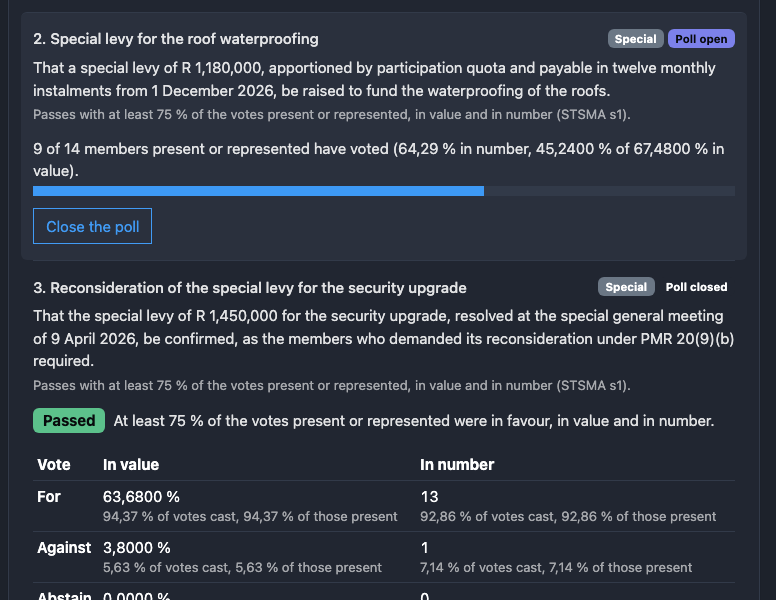
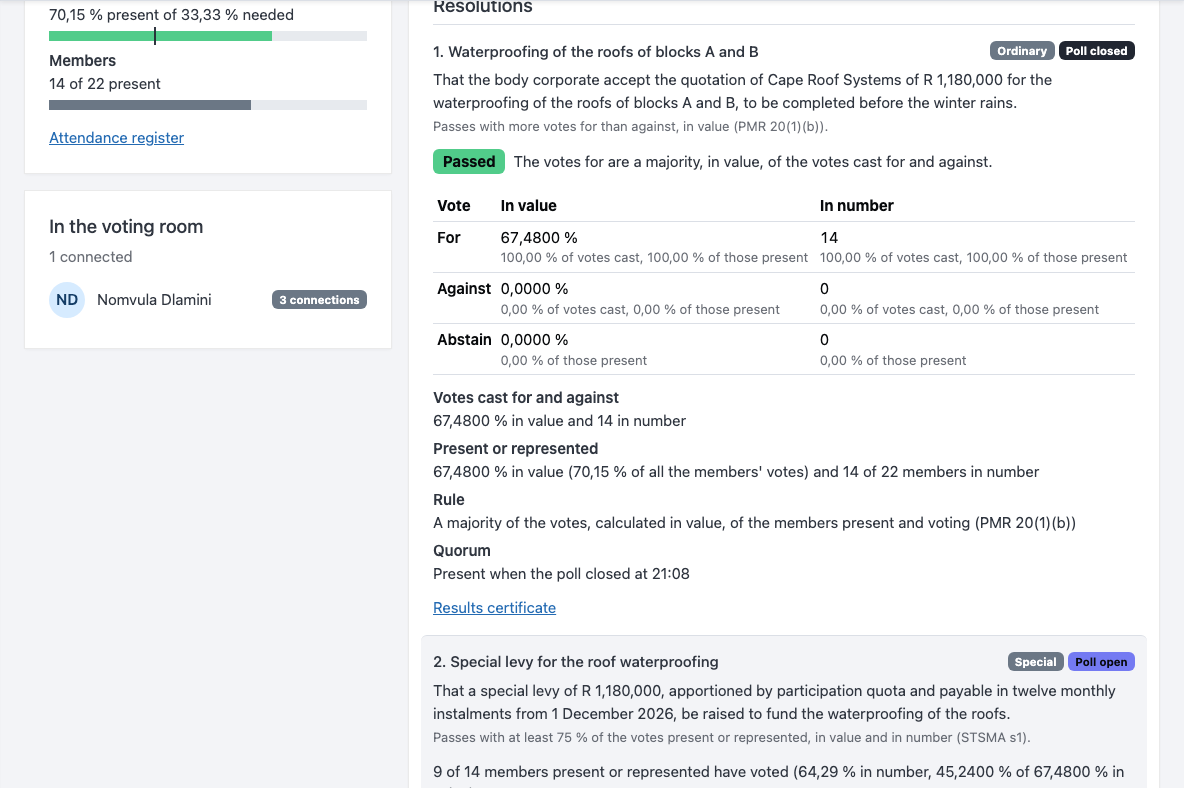
The console shows the live quorum, who is connected and every resolution on the agenda. Voting runs only while the meeting is in progress and quorate. The chair opens one poll at a time and sees how many members have voted, in value and in number, never how anyone voted.
Closing the poll counts the votes at once and records the votes for, against and abstaining, in value and in number, with the rule, the outcome and the reason. A meeting with an open poll cannot close or adjourn.
Voting from a phone
Owners vote from a phone, in the room or online
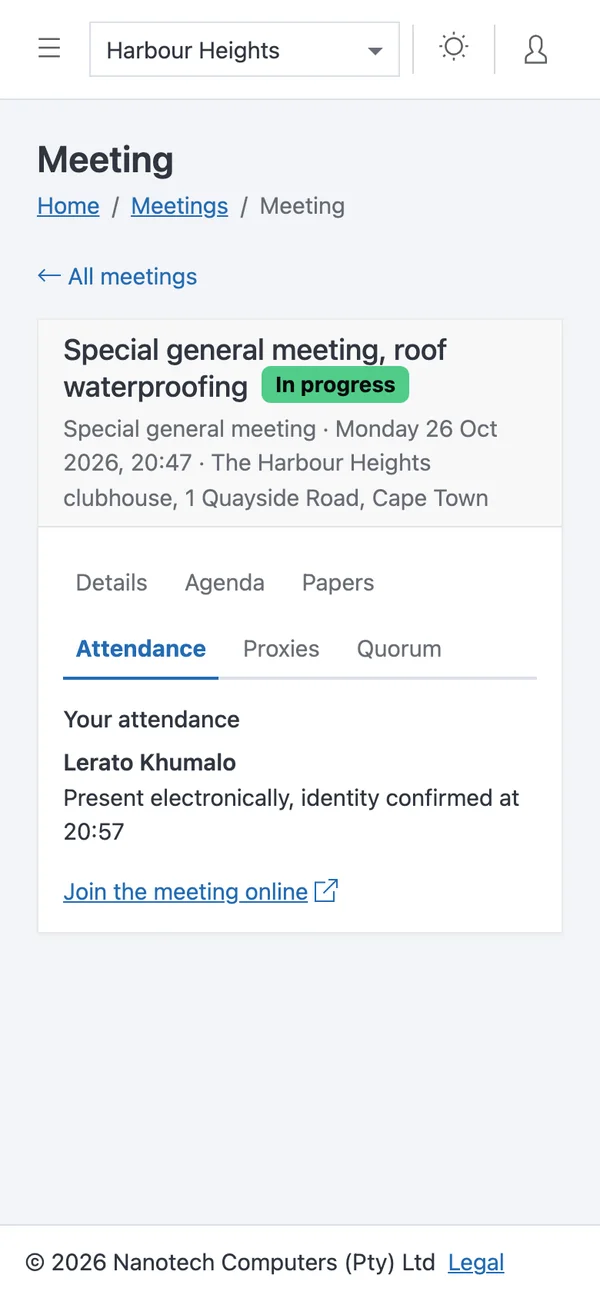
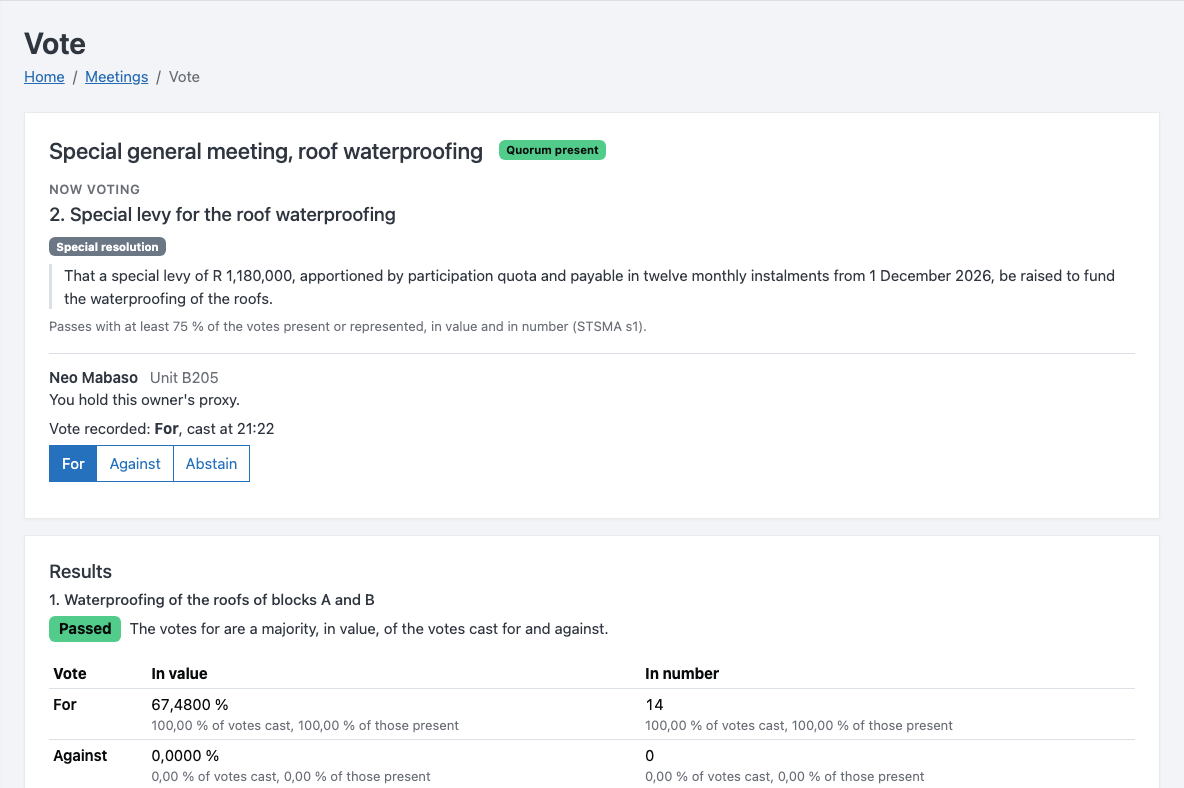
Estate Manager runs in the browser, with nothing to install. An owner attending online checks in for their own units and the proxies they hold, and votes once the chair has confirmed who they are. Owners in the room vote the same way.
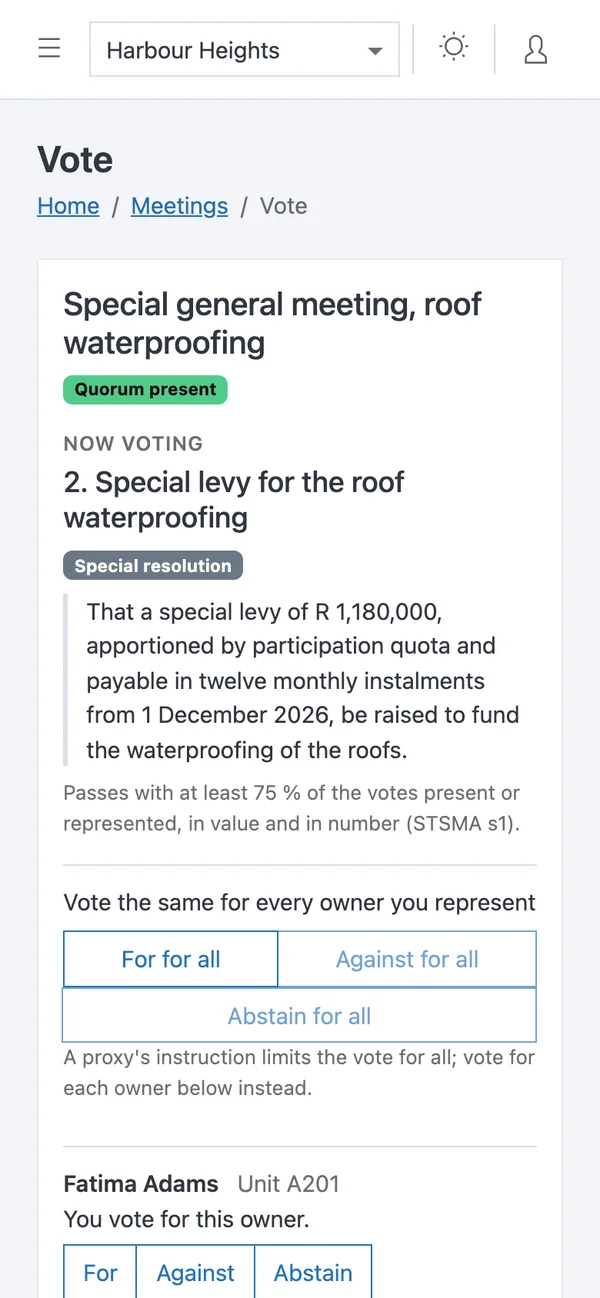
The ballot shows the resolution, its type and the rule that passes it. One choice can cover every owner the member represents. A vote can change until the poll closes, and then every owner sees the result in value and in number, with nobody's choice on it.
Proxy votes
Proxies vote as the owner instructed
A proxy holder votes for the owner they represent, with that owner's weight, and where the owner gave an instruction the ballot offers only that choice. While the register shows an owner represented by proxy, the owner's own vote is closed, so no owner counts twice.
Joint owners, companies and trusts have one vote, cast by the person the register names. A tenant votes only as an owner's proxy.
Results certificates
A certificate for every resolution
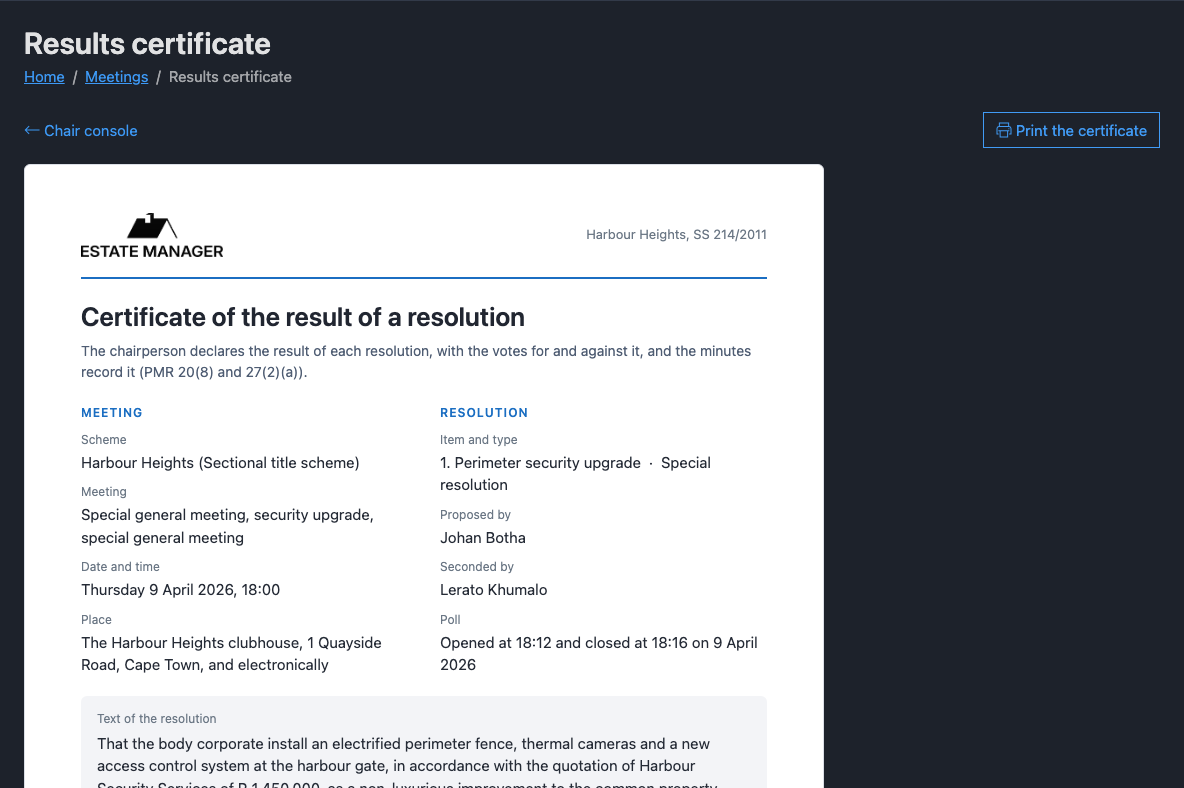
Each closed poll has a certificate: the scheme and meeting, the resolution's text, type, proposer and seconder, the votes for, against and abstaining in value and in number, the rule and its source, the outcome, and the chair who closed the poll. It prints on one A4 page with a line for the chair's signature.
Where a special resolution passed with members holding less than half of all the votes in value, the certificate notes the week's wait before it is acted on.
What the law says
How a body corporate votes
Votes follow sections 1 and 6 of the Sectional Titles Schemes Management Act and prescribed management rules 19 and 20. A scheme's own rules may differ where the law allows.
General information, not legal advice.
Value and number
In value, a member's vote is the total of the participation quotas of their sections, unless a rule made under section 10(2) sets another value. In number, each member has one vote.
Where quotas come from
In a scheme used only for residential purposes, a section's quota is its floor area over that of all the sections, each to the nearest square metre, as a percentage to four decimal places. A section of 90 square metres in a scheme whose sections total 1,800 square metres has 5.0000 per cent. In other schemes the developer sets the quotas, and in a partly residential scheme the total the developer gives the residential sections is shared among them by floor area.
Quorum first
No business without a quorum: members entitled to vote, present or represented, holding one third of all the votes in value, with at least two persons present, or two thirds in a scheme with fewer than four primary sections or members.
Ordinary resolutions
A motion needs no seconder. Unless it is a special or unanimous resolution, it passes by a majority of the votes, calculated in value, of the members present and voting.
Special and unanimous resolutions
Special: at least 75 per cent of the votes of the members represented, in value and in number. Unanimous: at least 80 per cent of all the votes present or represented, in value and in number, and all the members who cast their votes do so in favour.
The result, and the week's wait
The chair announces each result with the votes for and against. A special resolution passed by members holding less than half of all the votes in value waits a week, unless the trustees find immediate action needed for safety or to prevent significant loss, and within seven days members holding at least a quarter of all the votes in value may, by a written and signed request delivered to the body corporate, require a special general meeting to reconsider it.
Free tools
Check a quorum or a vote
Two small calculators apply the same rules Estate Manager applies at a meeting.
Free template
Results certificate
The certificate Estate Manager prints when a poll closes, as a blank to complete by hand. It records what rule 27(2)(a) asks the minutes to keep about each result, with a line for the chair's signature.
The scheme, its SS number and the meeting The resolution's number, text, type, proposer and seconder Votes for, against and abstaining, in value and in number The rule applied, the outcome and any note The chair's name, the time the poll closed and a signature line
Questions
Questions about body corporate voting
Anything else: ask us when you book a demo, or write to info@nanotech-computers.com.
What is the difference between an ordinary and a special resolution?
What is a participation quota, and what does it decide?
Can an owner in arrears vote?
Can owners vote before the meeting?
Can anyone see how an owner voted?
Can members pass a resolution in writing?
What it does not do
- Every voter uses their own sign-in. The chair cannot record a vote for an owner present without one, so invite owners before the meeting.
- The developer's votes are not left out of the count automatically. The body corporate, once the register marks it, neither attends nor votes. A member who lost the vote on ordinary resolutions under rule 20(2) is barred once the managers record the court's or adjudicator's order on the owner.
- Votes are weighed by participation quota, or by the values that a rule of the scheme under section 10(2) attaches to them, which the register records for each unit.
Related
More on meetings and votes
AGMs and general meetings
Notice, agenda, attendance, quorum and minutes drafted from the record.
Read moreProxies and Form C
Appointed online, accepted by the proxy, within the two-proxy rule.
Read moreRules: prescribed, drafted, adopted
Conduct rules change by special resolution, recorded step by step.
Read moreSee a vote counted in value and in number
A demo runs a poll on a fictional scheme from the chair's console, with owners voting from their phones and a proxy following its instructions.