
For homeowners' associations
Homeowners' associations, run by their own rules
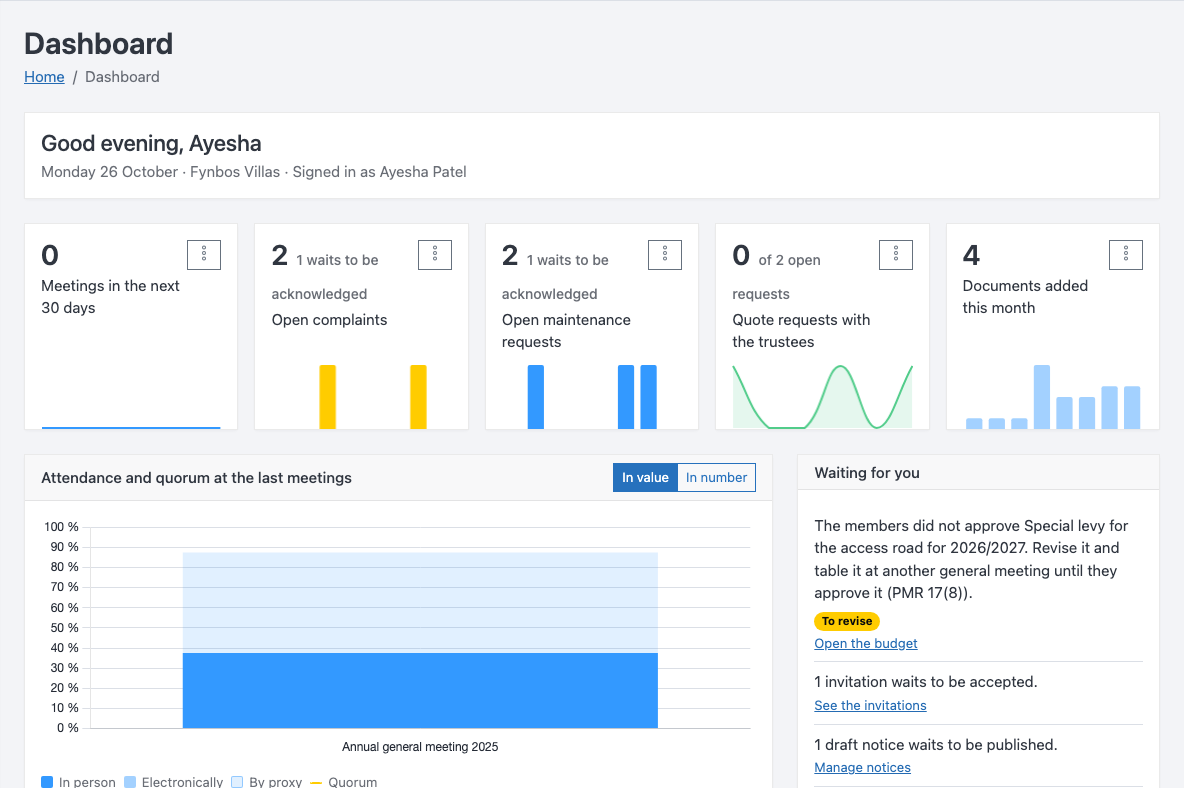
A homeowners' association (HOA) is not a body corporate. Its memorandum of incorporation or its constitution governs it, and its meetings follow them. Estate Manager sets an association up on its own terms: its own quorum rule, the notice the Companies Act sets, one vote per member instead of participation quotas, and rules kept under its own documents.

Body corporate or homeowners' association
Both are community schemes under the Community Schemes Ombud Service (CSOS) Act. What differs is where each comes from, and the law that runs its meetings.
| Topic | Body corporate | Homeowners' association |
|---|---|---|
| What it is | Exists by law once anyone other than the developer owns a unit, and every owner is a member (section 2(1)) | An association of the owners of separate properties, who must all belong to it (CSOS directive, definition 18) |
| Legal form | A body corporate under the Act. The Companies Act does not apply to it (section 2(6)) | A non-profit company under the Companies Act, or a common-law association, for which there is no specific legislation (definition 18) |
| Governing documents | The Act, its regulations and the scheme's management and conduct rules (section 10) | Its memorandum of incorporation or its constitution, which its meetings must follow (directive 3.19 and 5.12) |
| Votes | In value by participation quota, and in number, one per member (section 6(6) and 6(7)) | As its memorandum or constitution provides |
| Notice of a members' meeting | 14 days, or 30 for a special or unanimous resolution (PMR 15(1), section 6(2)) | For a non-profit company with voting members, 15 business days unless its memorandum sets another period (Companies Act s62). A common-law HOA follows its constitution |
| Quorum | A third of the votes in value, or two thirds in the smallest schemes, with two persons present (PMR 19(2)) | For such a company, 25 per cent of the voting rights unless its memorandum sets another share, and three members present when it has more than two (s64) |
| Rule changes | Lodged with CSOS and in force from the Chief Ombud's certificate (section 10(5)) | Submitting them to CSOS is voluntary, and not submitting them does not invalidate them (directive 7.2) |
| CSOS | Registers, pays the CSOS levy and files an annual return, and disputes may go to CSOS | The same (CSOS Act s1, s38 and s59, CSOS Regulations 18) |
A summary for orientation. Sections are of the Sectional Titles Schemes Management Act, PMR are its prescribed management rules, and the directive is CSOS Consolidated Practice Directive 1 of 2025. General information, not legal advice.
What the law says
What CSOS and the Companies Act say about HOAs
No single Act governs every HOA. These are the provisions that reach one.
General information, not legal advice.
A community scheme
The CSOS Act's community schemes include a home or property owners' association, however constituted, established to administer a property development.
A company or a common-law association
An HOA may be a non-profit company, which the Companies Act regulates in part, or a common-law association, for which there is no specific legislation. A company HOA follows its memorandum of incorporation in calling meetings and voting, and a common-law HOA follows its constitution.
The Companies Act's defaults
In a non-profit company with voting members, the Act's meeting sections apply to the members: 15 business days' notice, a quorum of 25 per cent of the voting rights, ordinary resolutions by more than half and special resolutions by at least 75 per cent of the votes exercised. The memorandum may vary these within the Act's limits.
Registration, levy and annual return
Every community scheme registers with CSOS and pays the CSOS levy every quarter, and it files an annual return, with its financial statements, within four months of its financial year end.
Rules, lodged by choice
An HOA may submit its rules to CSOS for quality assurance. That is voluntary, and not doing so does not invalidate them. CSOS lists rules it regards as undesirable in an HOA, such as one that takes disputes outside its process or forces an owner to evict a tenant.
Disputes and unreasonable rules
Anyone who is a party to, or materially affected by, a dispute about the scheme's administration may apply to CSOS. An application may ask for an order declaring a rule invalid or unreasonable, and requiring the association to remove or replace it.
How it is set up
An association on its own terms
Each estate is set up as a sectional title scheme or a homeowners' association. An association's register lists its erven and members without participation quotas, so its votes and its quorum are counted by member, one vote each unless its memorandum gives one for each erf or sets each erf's votes, never in value.
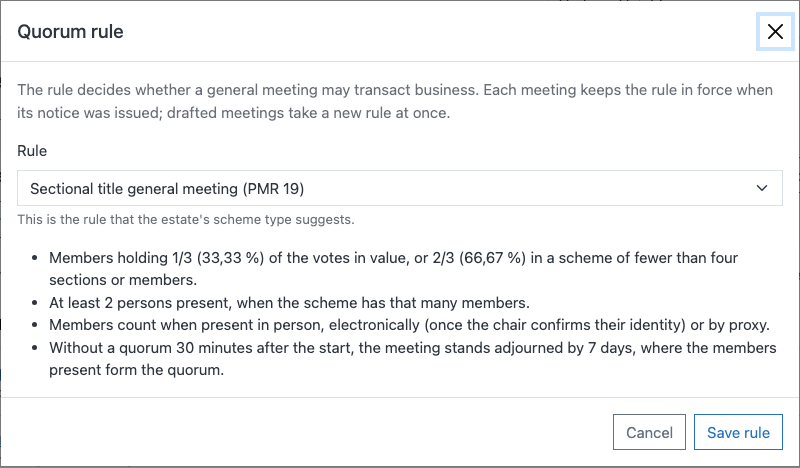
Its members' meetings take the notice the Companies Act sets for a non-profit company with voting members: 15 business days, counted without weekends and public holidays. Its quorum rule starts from the Act's preset, and where the memorandum or constitution sets its own quorum, the managers enter it as a custom rule.
The preset: 25 per cent of the members and three present, an hour's wait, then a week's adjournment A custom rule: a share in number, the persons present, the wait and the adjournment, from your own documents Each meeting keeps the rule in force when its notice was issued Notice packs in neutral wording, with a plain proxy form instead of the sectional title Form C
Meetings and votes
General meetings, counted for an association
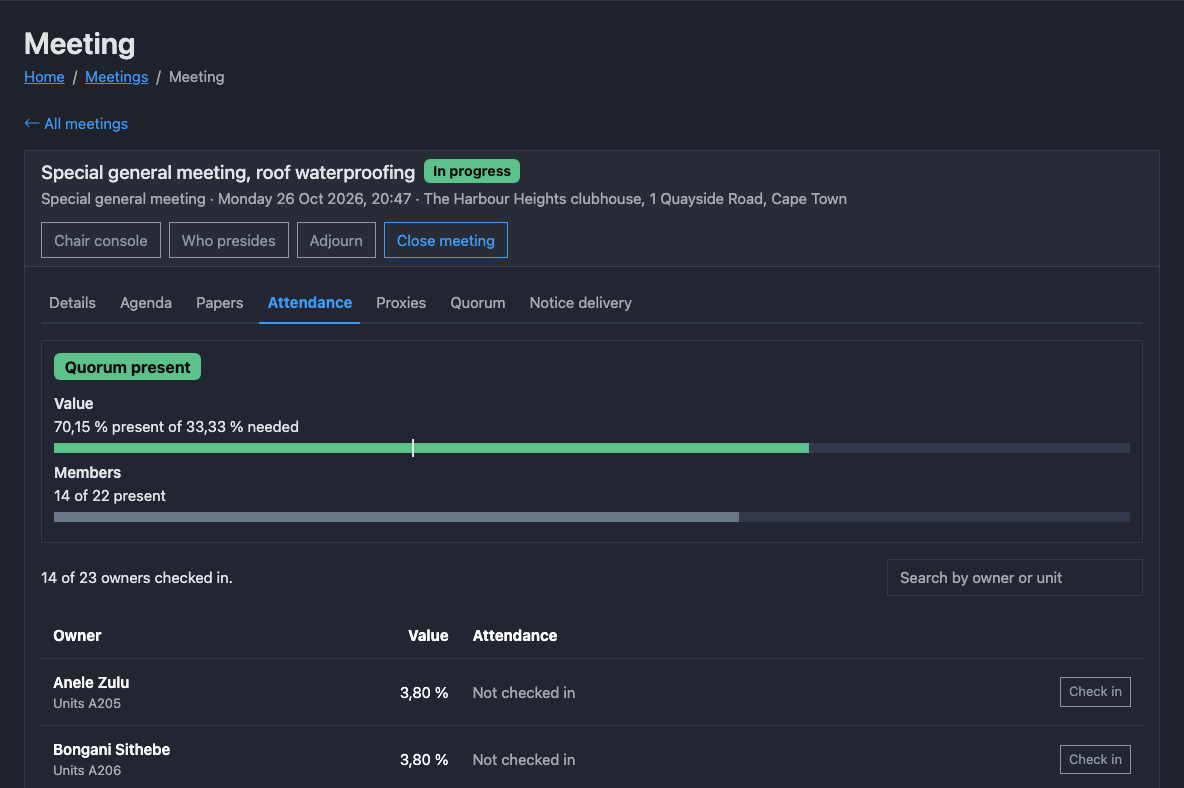
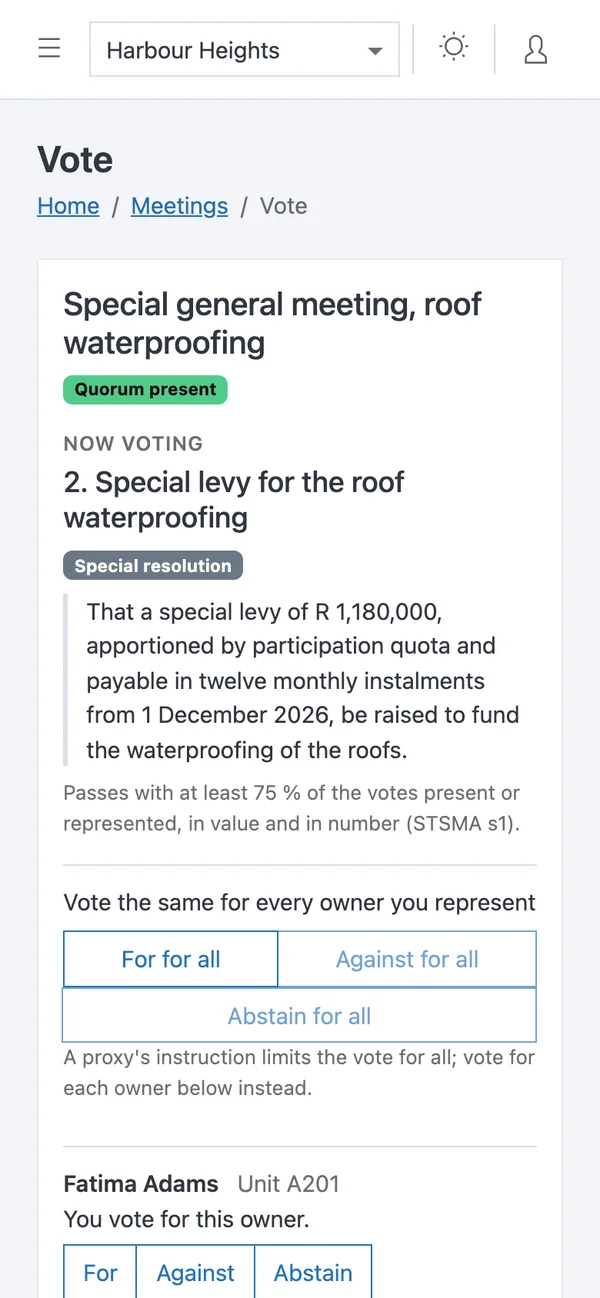
General meetings run as they do for a body corporate: the notice pack and its delivery report, proxies online, check-in in person, online or by proxy, a live quorum against the association's rule, and voting from a phone, one poll at a time from the chair's console.
Ordinary resolutions pass with more than half of the votes exercised, and special resolutions with at least 75 per cent, as the Companies Act sets them, one vote per member. Each result gets a results certificate, and the minutes are drafted in Word from the record.
Rules
Association rules, under your own documents
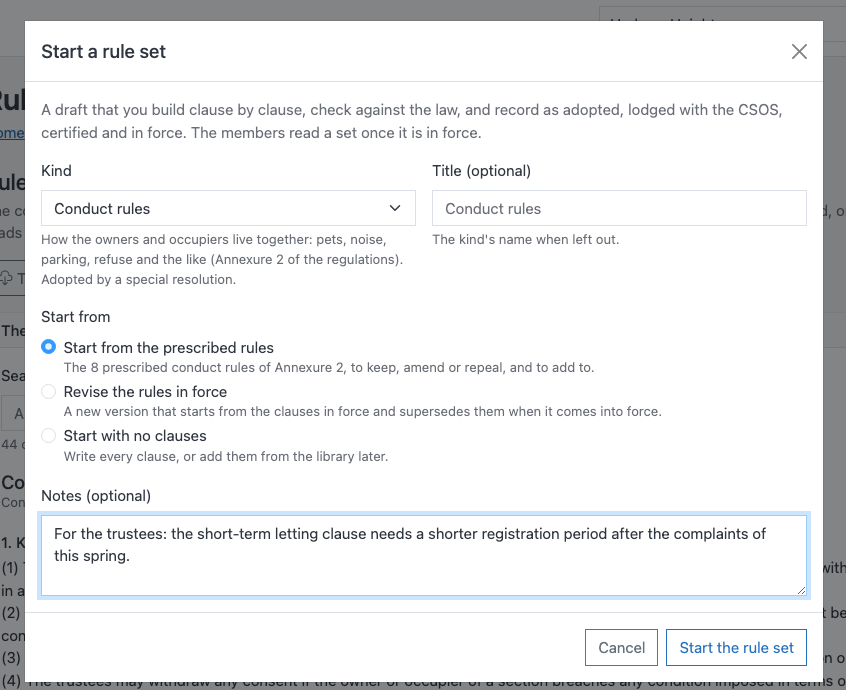
The rules builder keeps an association's rules as their own kind of set, under its constitution or memorandum. Draft them from the rules in force or from nothing, record the resolution that adopted them, and record a lodgement with CSOS if you choose to make one.
An association's rules come into force without a Chief Ombud's certificate, which only a sectional title scheme needs. Members search the rules in force on a phone and never see a draft.
The rest of the estate
Requests, complaints, decisions and budgets
The rest works for an association as it does for a body corporate, with these differences.
Maintenance and access requests
A gate that will not close, a pothole, a new remote: residents report it and follow it to done. Access requests carry what the agent types on the installer's portal.
Read moreComplaints
Filed against the estate's own conduct rules, handled on the record, with 30 days for the reporter to dispute the outcome.
Read moreQuotes and board decisions
The board decides by a majority of the votes cast at its meeting, or by the written consent of a majority of the directors, and a chair who did not vote may break a tie. The appointment letter follows.
Companies Act s73(5), 74(1)Read moreBudgets
Built or uploaded, approved under your own constitution with a note of how, shared with the members and exported to Excel.
Read moreWhat is built for associations, and what is not yet
- Votes are counted one per member, one per erf or as your memorandum sets them for each erf. Votes weighed by value are not modelled.
- Resolutions are decided by the Companies Act's percentages, or the ones that your memorandum or constitution sets, which the managers record. One percentage applies to every special resolution.
- Members' meetings take the Companies Act's 15 business days' notice, or the period that your memorandum or constitution sets, which the managers record with its clause.
- Proxies follow the Companies Act: a member may appoint any individual, with or without a sign-in for the estate, the managing agent included, a proxy may act for any number of members, and appointments stay open until the meeting opens. A cut-off or a most members for one proxy that your own documents set is a setting.
- No levy billing or collection, and no gate or intercom integration.
Questions
Questions about homeowners' associations
Anything else: ask us when you book a demo, or write to info@nanotech-computers.com.
What is the difference between a body corporate and an HOA?
Does CSOS cover homeowners' associations?
When must an HOA hold its AGM?
How are an HOA's levies handled?
Can tenants vote at an HOA meeting?
Can one agent run the HOA and the schemes inside it?
Do we need a managing agent?
Related
Read next
AGMs and general meetings
The meeting cycle step by step, from the notice to the minutes.
Read moreRules: prescribed, drafted, adopted
The rules builder, its checks and the record of adoption.
Read moreFor managing agents
Sectional title schemes and associations side by side, behind one sign-in.
Read moreSee an association's meeting run
A demo walks through a general meeting on a fictional estate: the notice, the proxies, check-in, the quorum, the vote and the paperwork that follows. Bring your questions about your own association.