
Product
One place for the whole scheme
Estate Manager is a body corporate management system for sectional title schemes, homeowners' associations and their managing agents. Meetings and votes, rules, complaints, requests, budgets, quotes and documents sit in one place, and each role sees what it should. It runs in the browser, so it works on a phone with nothing to install.
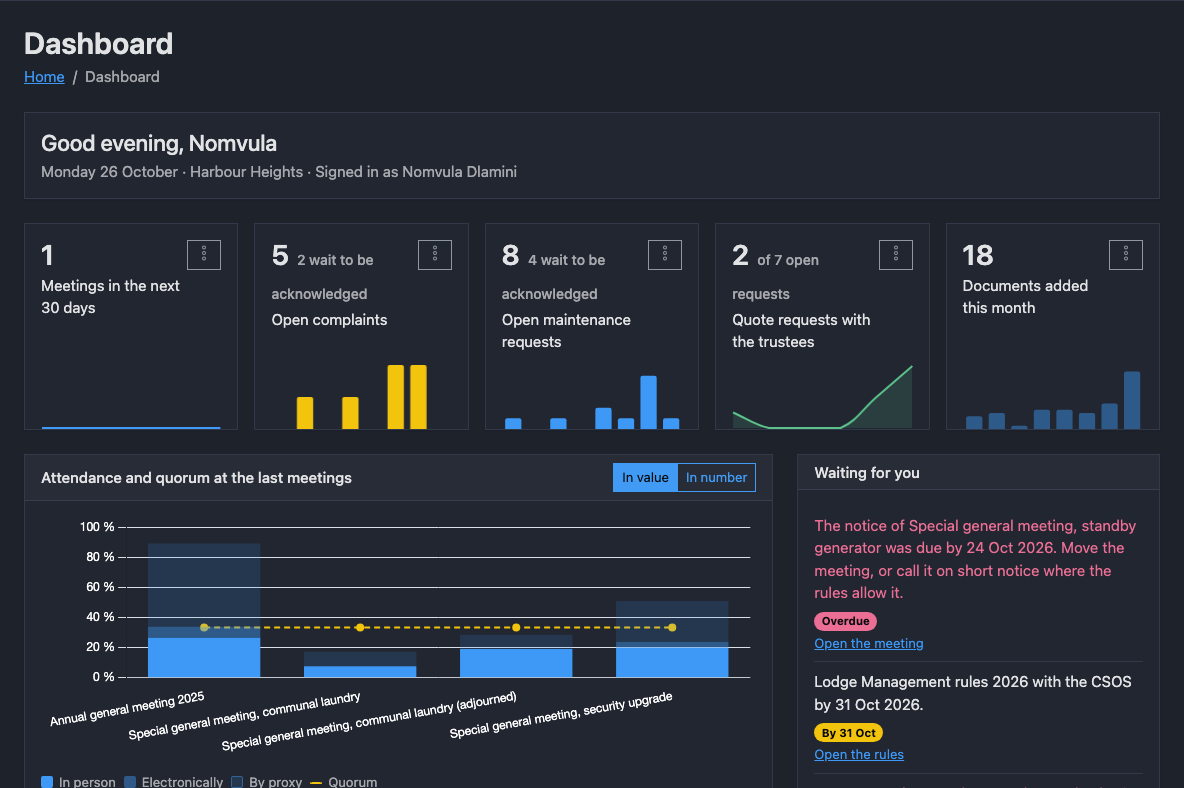
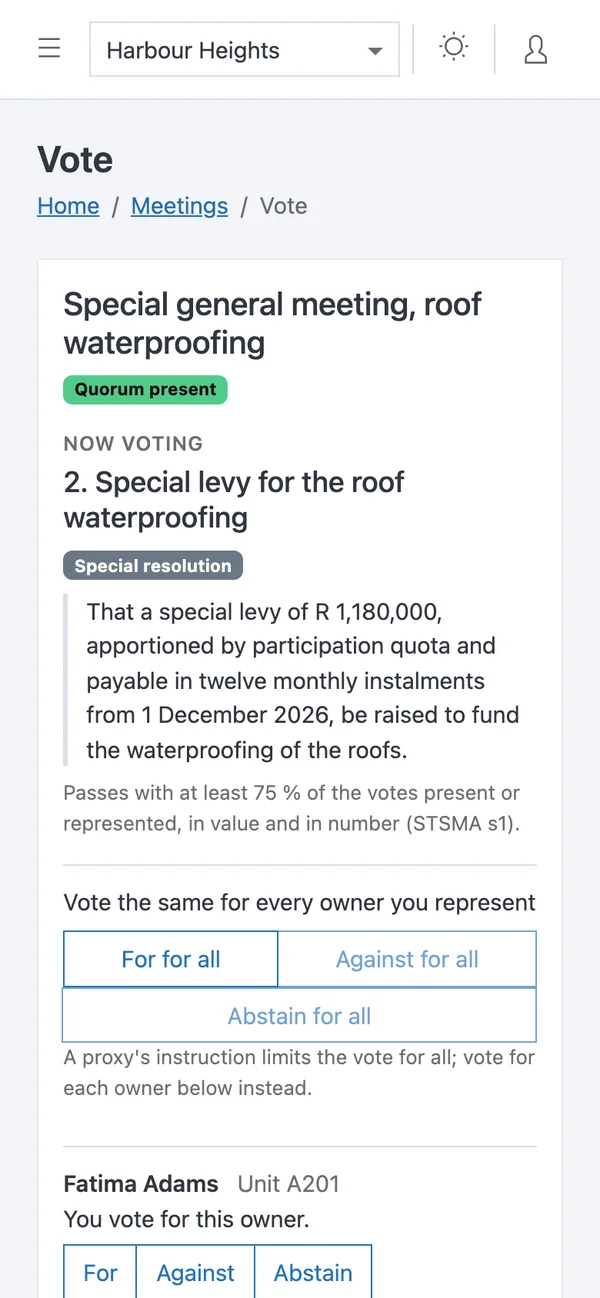
Meetings and votes
General meetings, votes and rules, by the book
The cycle of a general meeting, from the notice to the minutes, and the rules the members adopt.
AGMs and general meetings
Notice periods counted, the pack emailed and any delivery by hand or registered post recorded, the attendance register, a live quorum and adjournment, and minutes drafted in Word from the record.
PMR 15(1)Read moreVoting and resolutions
Voting from a phone, one poll at a time from the chair's console, counted in value and in number as the Act requires for each resolution type, with a results certificate for each.
Section 1Read moreProxies and Form C
Proxies appointed online or on the prescribed Form C, at most two members per proxy holder, open until an hour before the meeting, and never the managing agent.
Section 6(5)Read moreRules
The 39 prescribed rules word for word, sixteen drafted templates, checks against the law, and the record of adoption, lodgement with the Community Schemes Ombud Service (CSOS) and the certificate.
Section 10Read moreHow a meeting runs
From notice to minutes, on one record
Five steps, each kept on the record as it happens. Section numbers refer to the Sectional Titles Schemes Management Act and PMR to its prescribed management rules. General information, not legal advice.
- 01
Notice
The period is counted: 14 days for a general meeting, or 30 when a special or unanimous resolution is on the agenda. The Act allows shorter notice of such a resolution where the scheme's rules provide for it, which the managers record with the rule that provides it. The pack goes by email with a prefilled proxy form, and each delivery is reported. For a special or unanimous resolution, each owner's notice by hand or by registered post is recorded too, as the Act requires.
PMR 15(1), section 6(2) - 02
Proxies
Owners appoint a proxy online or on Form C. Nobody holds proxies for more than two members, the managing agent is never offered, and appointments close an hour before the meeting.
Section 6(5), PMR 20(5), 20(6) - 03
Check-in and quorum
Owners attend in person, online or by proxy, and the chair confirms who is taking part online. The quorum is measured live, in value and in persons.
PMR 17(10), 19(2) - 04
Vote
The chair opens one poll at a time. Owners vote from a phone for their own units and the proxies they hold, and each resolution is counted in value and in number.
Section 1, PMR 20(1)(b) - 05
Certificate and minutes
Closing a poll records the result with the rule that decided it. Each resolution gets a results certificate, and the minutes are drafted in Word from the record.
PMR 20(8), 27(2)(a)
Between meetings
The rest of the year, in the same place
Everything that happens between general meetings, from the notice board to the budgets, kept on the same record and shown to the right people.
Complaints and CSOS disputes
Filed against a rule, acknowledged and answered on the record, with 30 days for the reporter to dispute the outcome. Only the managers see who filed it.
Read moreMaintenance and access requests
A passage light, a leaking pipe, a new remote: residents report it once and follow it to done, and a board of open faults stops the same report twice.
Read moreBudgets and the ten-year plan
Administrative and reserve fund budgets and the ten-year maintenance plan, built or uploaded, approved by resolution, shared with owners and exported to Excel.
PMR 22(1)Read moreQuotes and trustee approvals
Three quotes side by side, declared interests, the trustees' decision or the agent's written limit, and the appointment letter for two signatures.
PMR 21(3)(g)Read moreDocuments and records
A library with folders, versions and the right readers for each, with certificates, minutes drafts, proxy forms and letters produced by the app.
Read morePrivacy, POPIA and security
Two-factor sign-in for everyone who manages an estate, each estate's records kept apart in the database, a privacy centre for the Protection of Personal Information Act (POPIA) and an append-only audit trail.
Read moreRoles
One sign-in, the right view for each role
A person belongs to one or more estates and switches between them without signing in again. Each estate's records are kept apart by row-level security in the database, and everyone who manages an estate signs in with an authenticator app as a second factor.
Units, participation quotas and owners come in from a spreadsheet, with a preview before anything is saved, and an invitation by email links each owner to their unit.
Managing agents: every scheme they run, behind one sign-in The chair and trustees: the console, their decisions, the agent's packs and the audit trail Owners: their own portal for votes and proxies, the rules, documents, complaints and requests Tenants: notices and rules for residents, and a vote only as an owner's proxy
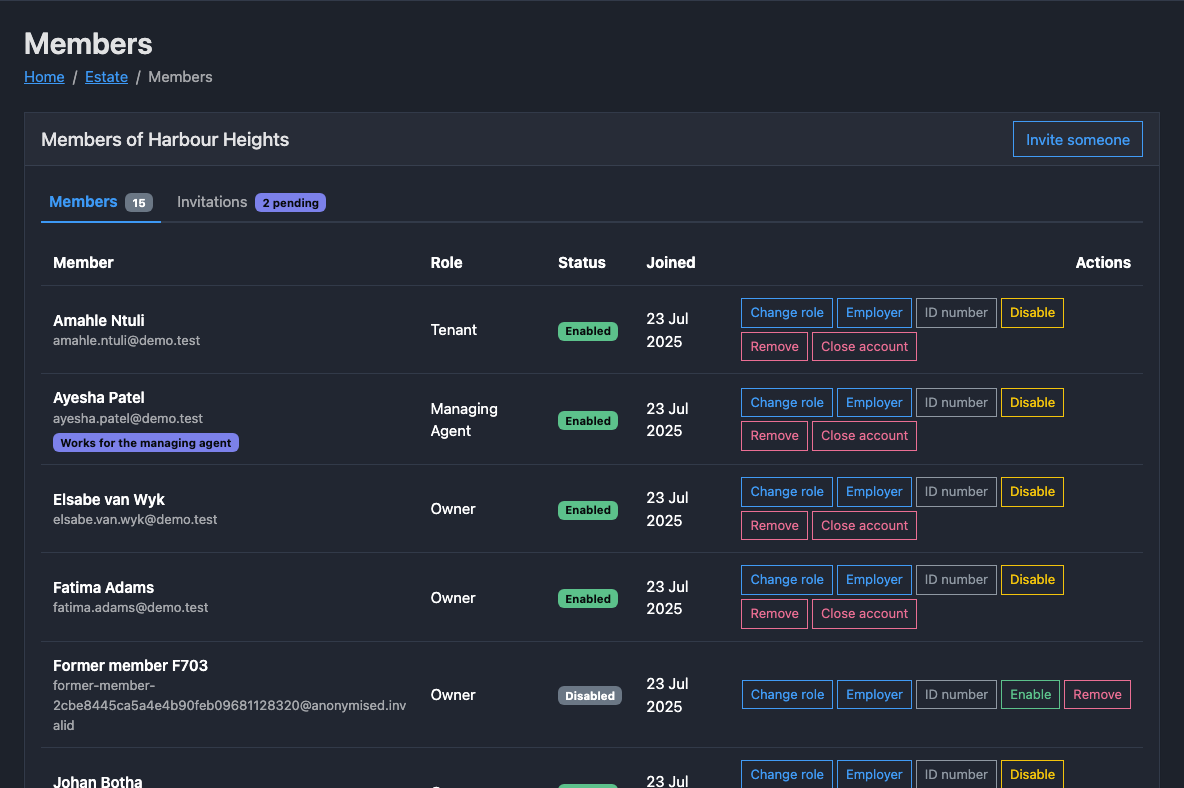
On a phone
Made for the phone in an owner's hand
Estate Manager runs in the browser on a phone, a tablet or a computer, so there is no app to install. The meeting and voting pages work from 375 pixels wide, and automated accessibility checks find no WCAG 2.2 A or AA failure on them.
An owner sees the next meeting with a countdown and when proxies close, votes for their own unit and the proxies they hold, reports a fault and reads the rules, in a light or dark theme or the one their device uses.
What Estate Manager does not do
- Accounting. No levy billing, statements, arrears or collections. They stay in the managing agent's accounting system.
- Legal advice. Estate Manager is built around the Act and the regulations, and its checks are a reading aid for the scheme's attorney. Decisions remain the body corporate's.
- An app store app. It is a web application that works on phones.
- Gate and intercom integration. Access requests carry what the managing agent types on the installer's portal.
- Hosting the video call. Put your call's link in the meeting, and owners join the call and vote in Estate Manager at the same time.
Questions
Questions about Estate Manager
Anything else: ask us when you book a demo, or write to info@nanotech-computers.com.
What is a body corporate management system?
Is there a body corporate app to install?
Can a self-managed body corporate use it?
Does it work for homeowners' associations?
Who sees what?
Where is the data hosted?
What does it cost?
Related
Who it is for
For managing agents
Every scheme you run behind one sign-in, through AGM season and between meetings.
Read moreFor trustees and self-managed schemes
What trustees must do, and how every decision stays on the record.
Read moreFor homeowners' associations
An association on its own terms: its quorum rule, its notice and its rules.
Read moreSee a meeting run, from notice to minutes
A demo walks through a general meeting on a fictional scheme: the notice, the proxies, check-in, the quorum, the vote and the paperwork that follows. Bring your questions about your own schemes.