
For trustees and self-managed schemes
Meetings, votes and rules, done the way the Act says
Body corporate trustees exercise the body corporate's powers and owe it a duty of good faith. Estate Manager helps them run meetings, count votes, adopt rules and decide on quotes the way the Sectional Titles Schemes Management Act requires, with a record of every decision, with a managing agent or without one.

What the law says
What body corporate trustees must do
The Act gives the body corporate's powers to its trustees, the scheme's executive committee. The prescribed management rules (PMR) and the regulations of the Community Schemes Ombud Service (CSOS) set how they use them.
General information, not legal advice.
They run the body corporate
The trustees perform the body corporate's functions and exercise its powers, subject to the Act, the rules and any restriction or direction of a general meeting. They act on the resolutions of general and trustee meetings, and spend within the budgets the members approved.
A fiduciary duty
Each trustee stands in a fiduciary relationship to the body corporate: acting honestly and in good faith, for its benefit, never without or beyond their powers, and taking no personal economic benefit from it or anyone else. A trustee in breach is liable for the loss caused or the benefit received.
Conflicts of interest
A trustee tells every other trustee of any material interest in a body corporate contract as soon as they know of it, and takes no part in, and casts no vote on, a matter in which they have a direct or indirect personal interest.
Informed, present and independent
A trustee must take reasonable steps to learn about the scheme, its affairs and the law and documents it runs under, and to get enough information and advice on every matter to be decided, attend the trustee meetings and the AGM unless the chair excuses them on reasonable grounds, form an active and independent opinion and exercise due diligence. The duties bind every scheme executive, the directors of a homeowners' association included.
Meetings and decisions
A trustee meeting needs seven days' written notice with an agenda, or reasonable shorter notice when urgent. Half the trustees, and at least two, form a quorum. Decisions are by majority, at a meeting or by a round-robin written resolution signed before a closing date, and the chairperson has a casting vote unless there are only two trustees.
Minutes and reports
The trustees send out the minutes of every trustee and general meeting as soon as reasonably possible, and within 7 days. Each AGM receives a report the trustees adopt on the year, a report of their activities and decisions, and a report on how far the maintenance plan has been carried out.
Nomination, removal and pay
Any member may nominate anyone, in writing with the nominee's written consent, delivered to the body corporate's service address at least 48 hours before the AGM. A trustee may resign by written notice, and a general meeting may remove one by ordinary resolution if its notice said so. Trustees who are members are unpaid unless a special resolution decides otherwise.
What trustees may decide, and what needs the members
Where the Act and the prescribed management rules place some of the decisions trustees are asked about.
| Decision | Who decides | Source |
|---|---|---|
| A special levy for a necessary expense that cannot wait for next year's budget | The trustees, by written resolution | PMR 21(3)(a) |
| An increase in contributions of up to 10 per cent at the end of a financial year | The trustees, by written resolution, with notice to the members | PMR 21(3)(b) |
| The administrative and reserve fund budgets | The members, at the AGM | PMR 17(6)(j) |
| A change to the conduct rules | The members, by special resolution, in force on the Chief Ombud's certificate | Section 10(2)(b), 10(5) |
| A change to the management rules | The members, by unanimous resolution, in force on the certificate | Section 10(2)(a), 10(5) |
| Appointing a managing agent | The body corporate, if the trustees so resolve, and it must if the members resolve so or a registered bondholder of 25 per cent in number of the primary sections requires it | PMR 28(5) |
| Cancelling the agent's agreement on two months' notice | The members, who approve it first by special resolution | PMR 28(7)(a) |
| An improvement that is not reasonably necessary | The members, by unanimous resolution | PMR 29(1) |
| A reasonably necessary improvement | The trustees, after 30 days' written notice, unless a member asks for a general meeting, which then decides by special resolution | PMR 29(2) |
A summary for orientation. A scheme's own rules may differ where the law allows. General information, not legal advice.
General meetings
A meeting run properly, and votes counted the way the Act says
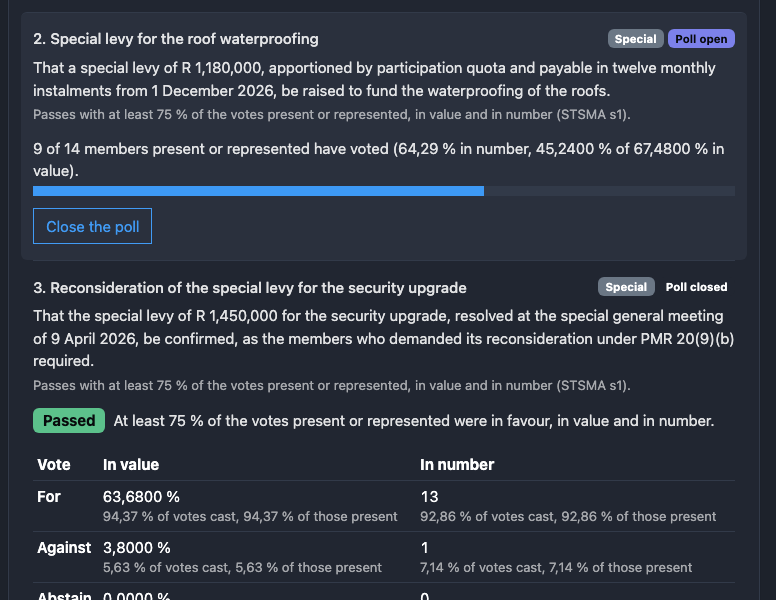
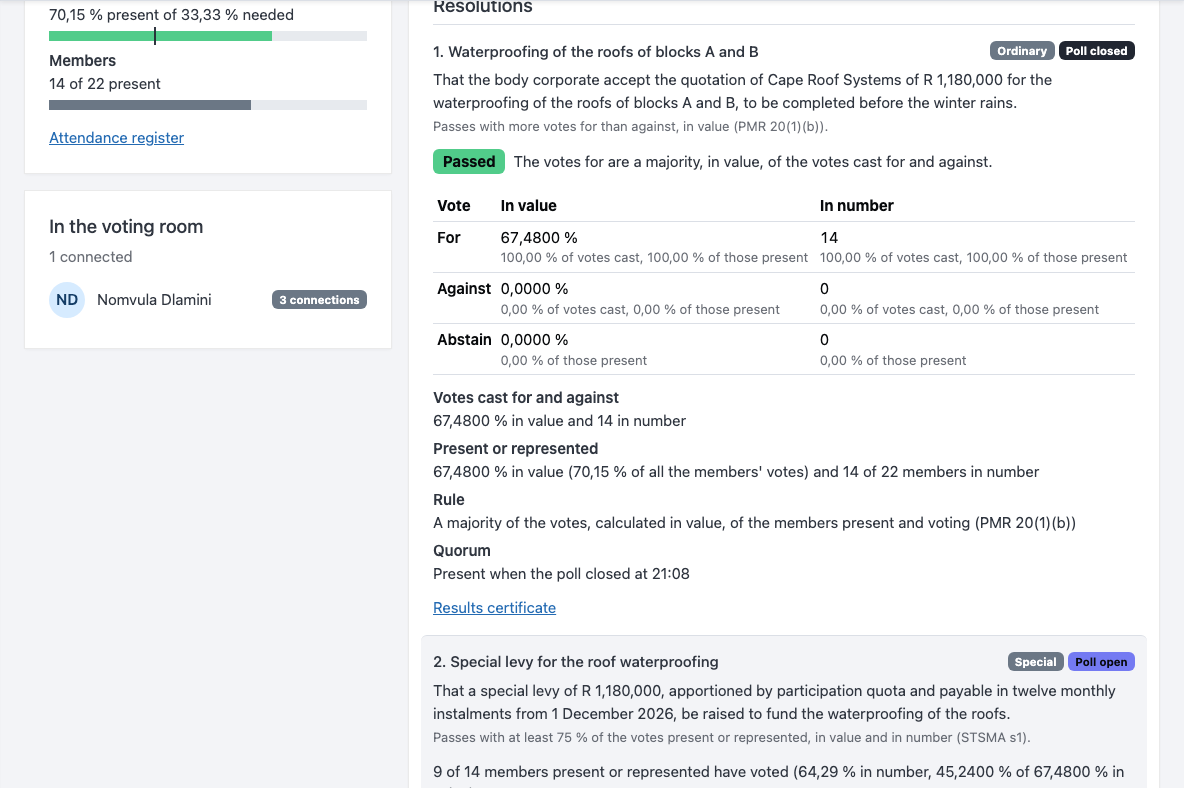
The chair's console shows the live quorum against the scheme's rule, and voting runs only while the meeting is in progress and quorate. The chair opens one poll at a time and sees how many members have voted, never how anyone voted.
Each resolution is counted in value and in number, as the Act requires for its type. A special resolution needs at least 75 per cent of the votes of the members represented, on both counts, and an ordinary resolution a majority of the votes in value of the members present and voting.
Between meetings
Quotes decided on the record, interests declared first
Three quotes by default sit side by side against the estimate, with each contractor's compliance documents. Each trustee declares whether they have an interest before voting. A trustee with an interest takes no part and casts no vote, and the other trustees may recuse one who declared none, with a reason.
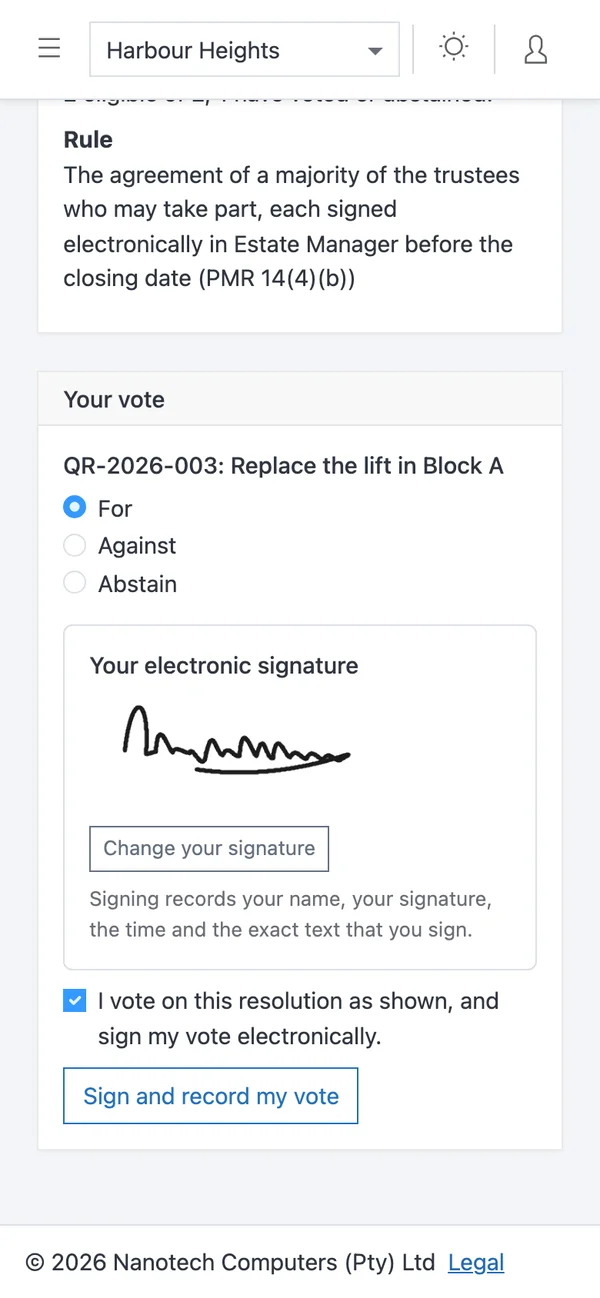
Trustees vote on a round-robin written resolution from a phone, or decide at their meeting. The tally stays hidden from a trustee who may vote and has not yet voted, and a carried resolution keeps the tally, each trustee's vote with its time and the rule applied. The appointment letter follows, for two trustees, or a trustee and the managing agent, to sign.
Rules
Rules adopted correctly
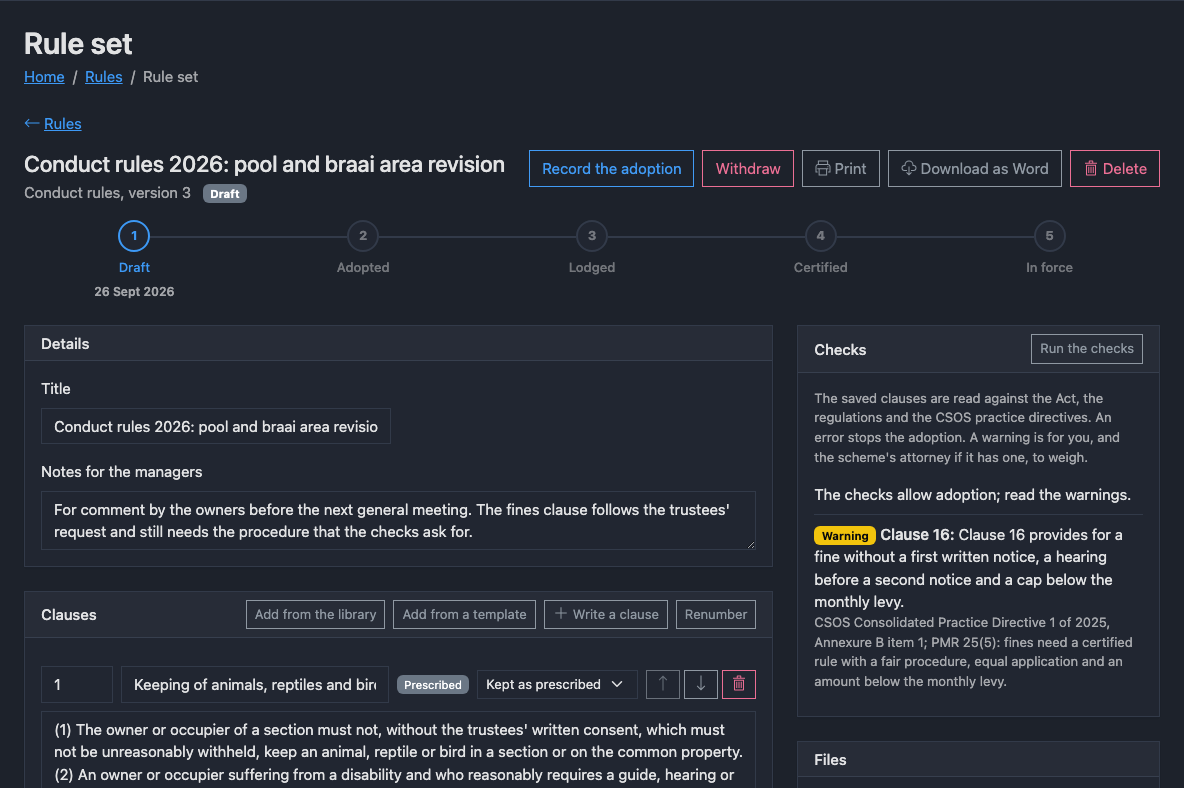
Trustees cannot change the rules on their own. Conduct rules change by special resolution and management rules by unanimous resolution, and a change takes effect only when the Chief Ombud certifies it.
Start from the 39 prescribed rules, add the scheme's own from drafted templates, check the draft against the Act and the CSOS directives, and record the adoption, the lodgement and the certificate. Members search the rules in force, and never see a draft.
Complaints
Complaints that go somewhere
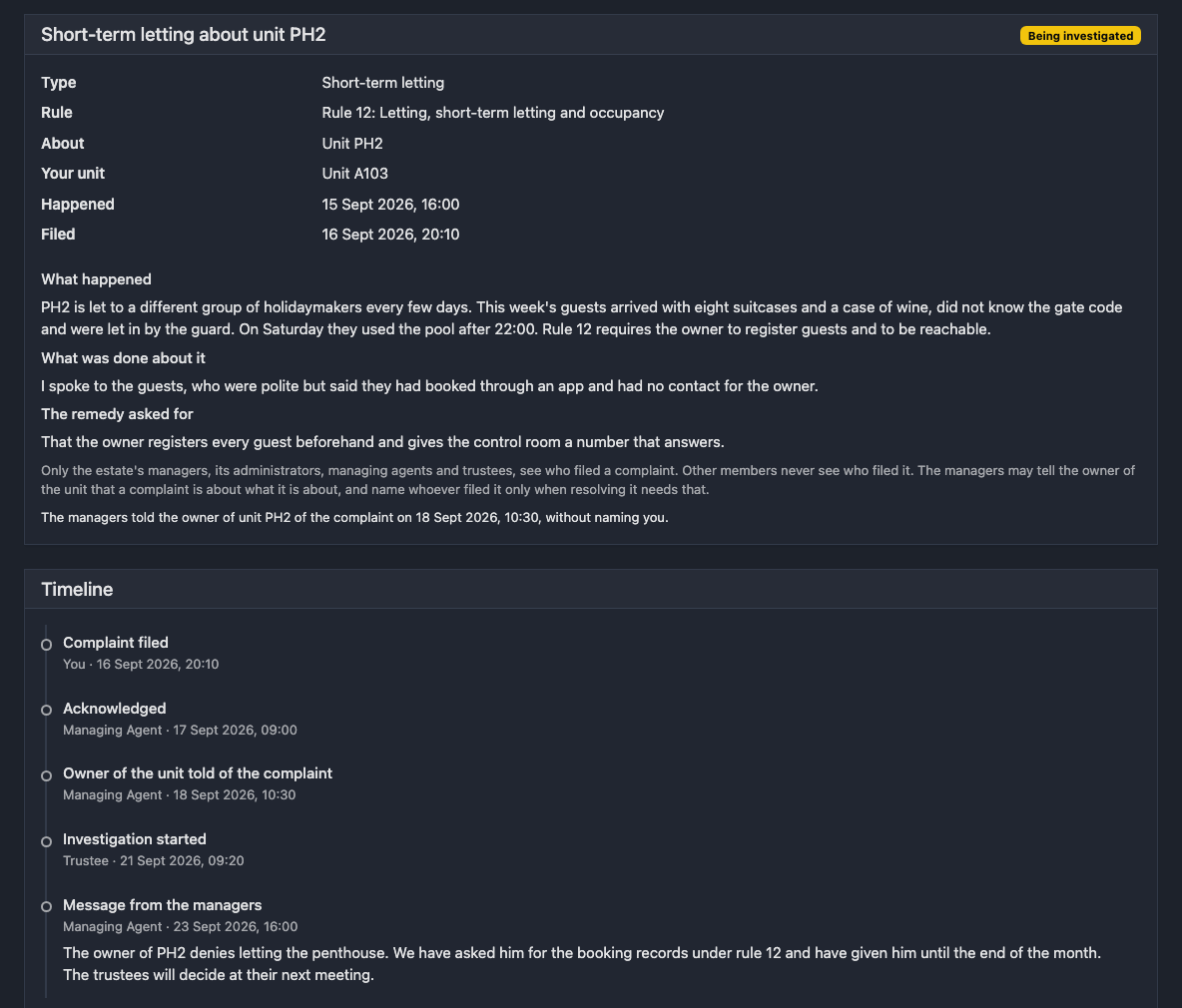
Owners and tenants file a complaint about a unit and the rule it concerns. It is acknowledged and answered on the record, internal notes stay with the managers, and the reporter has 30 days to dispute the outcome. Who filed it stays confidential to the managers.
CSOS asks applicants to try to resolve a dispute within the scheme first, and to prove that any internal process the scheme's rules prescribe was exhausted. The complaint's dated timeline shows the attempt. A step the rules prescribe that the app does not run, such as a hearing of both sides, needs its own record.
Oversight
Oversight, without chasing the agent
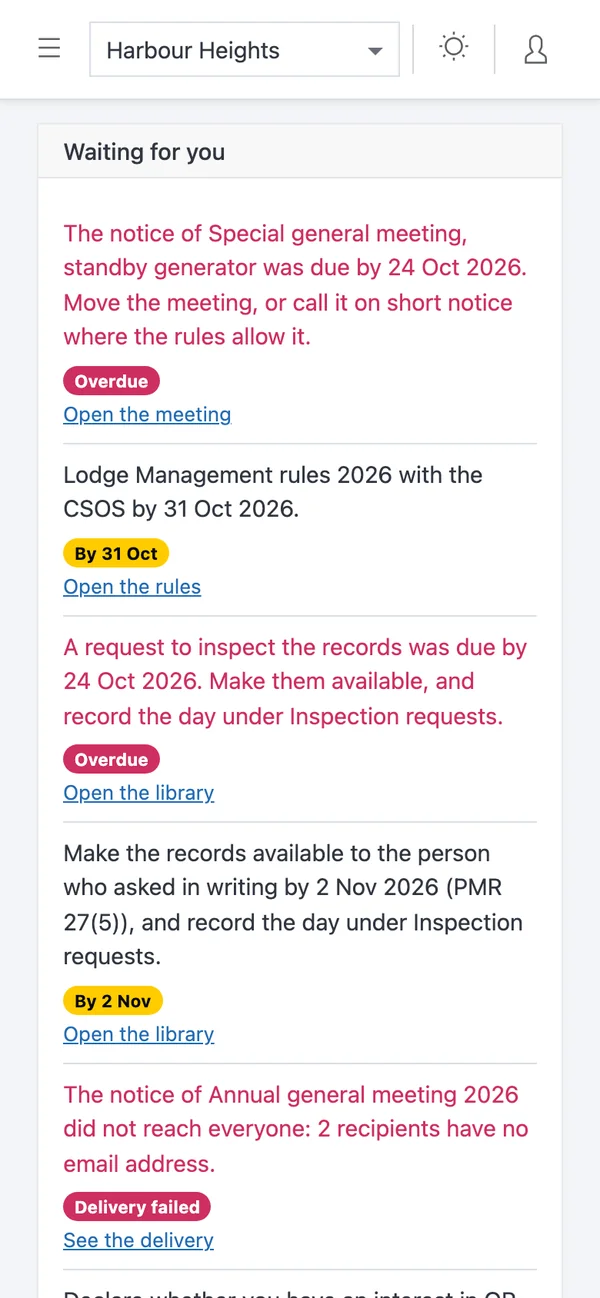
The dashboard lists what waits for each trustee: a declaration to make, a resolution to vote on by its closing date, quote requests ready for a decision and requests waiting to be acknowledged. The managing agent's monthly packs are kept for the trustees, never for owners.
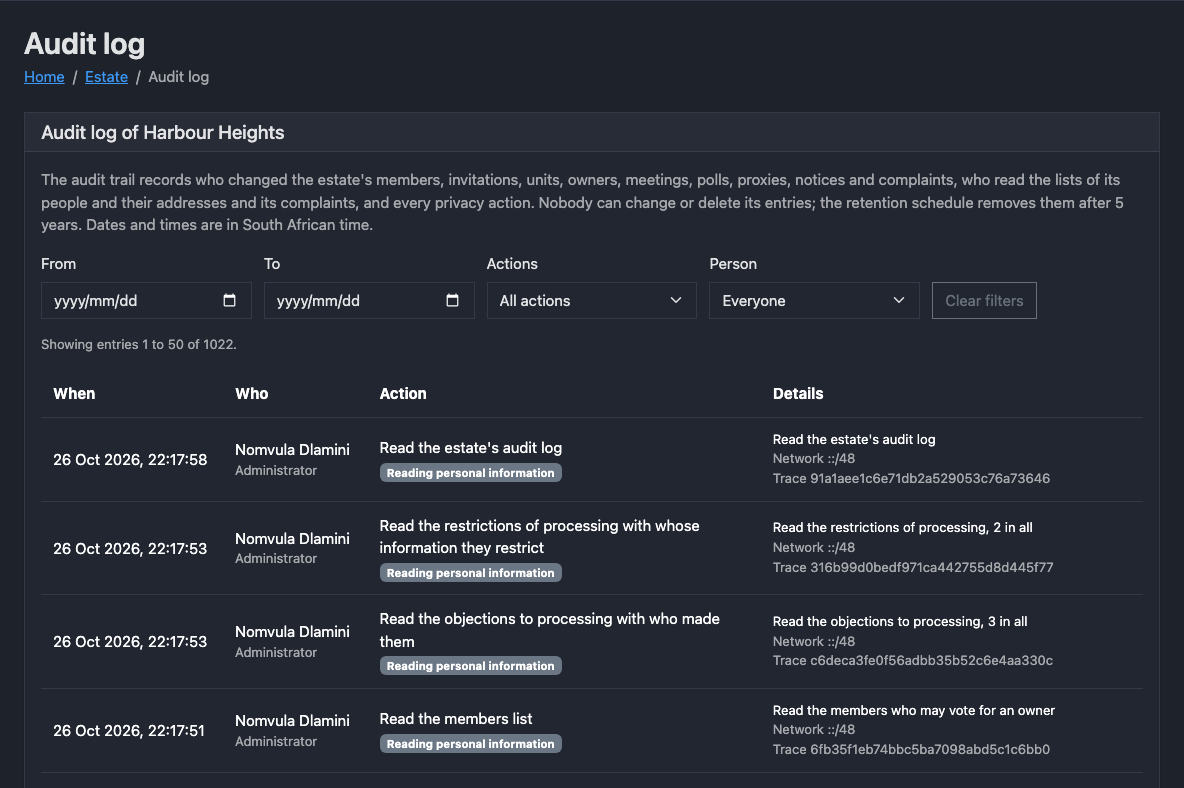
The audit trail records every change, who made it and when, and each read of the register, the members and the complaints, among other records that hold people's details, in a trail nobody can edit. Budgets and the ten-year plan are tabled with their resolutions, and a draft plan keeps each item's status and a progress note for the trustees' report to the AGM.
Self-managed schemes
For schemes the trustees run themselves
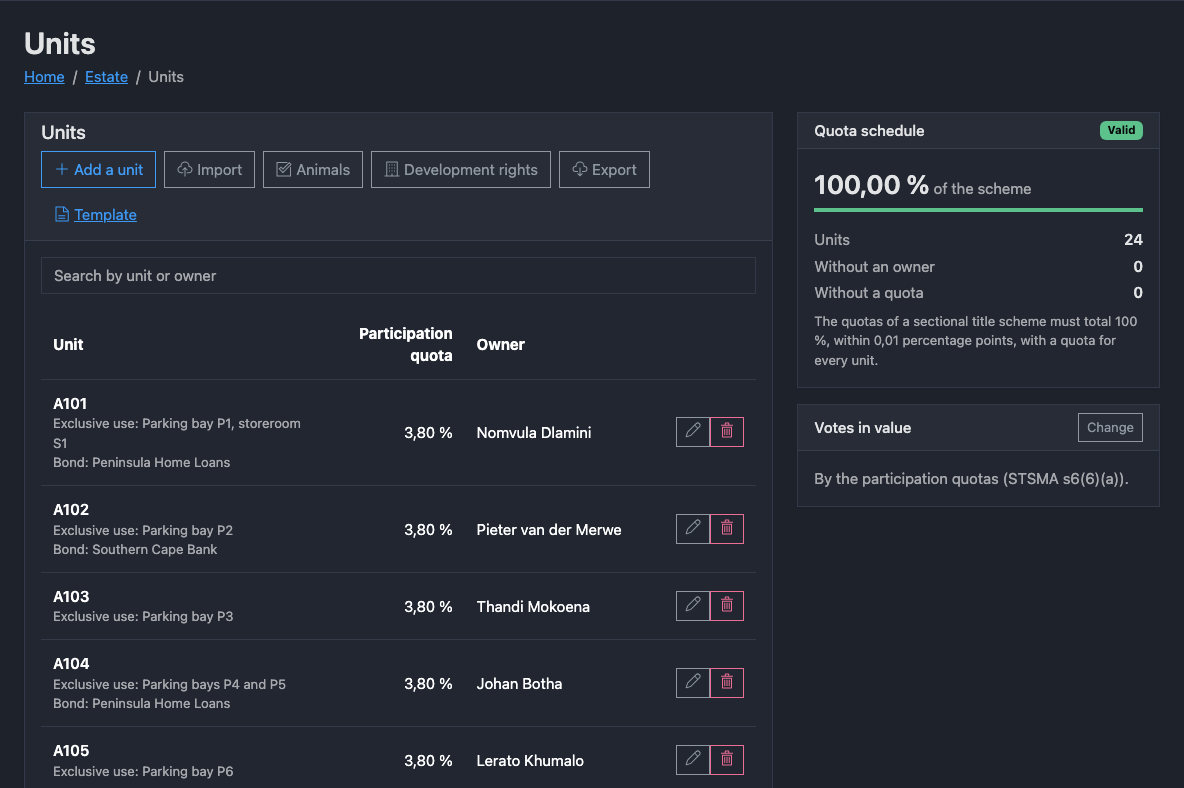
A body corporate may appoint a managing agent if its trustees so resolve, and must appoint one if the members resolve so or a registered bondholder of 25 per cent in number of the primary sections requires it. Without an agent, the chair and trustees do the agent's work: the register, the notices, the meetings and the records.
Estate Manager gives them the same tools an agent would use, from importing the register to drafting the minutes. It keeps no accounts, so a self-managed scheme keeps its books the way it does today.
Questions
Questions trustees ask
Anything else: ask us when you book a demo, or write to info@nanotech-computers.com.
Do we need a managing agent to use Estate Manager?
Do trustees have to decide unanimously?
How is a trustees' meeting run?
Does a body corporate have to have a chairperson?
Is there a code of conduct for trustees?
What can owners do if trustees exceed their powers?
Is a vote cast online valid?
What does it cost?
Related
Read next
See a meeting run the way the Act says
A demo walks through a general meeting on a fictional scheme: the notice, the proxies, check-in, the quorum, the vote and the paperwork that follows. Bring your questions about your own scheme.