
Maintenance and access requests
Body corporate maintenance requests residents can follow
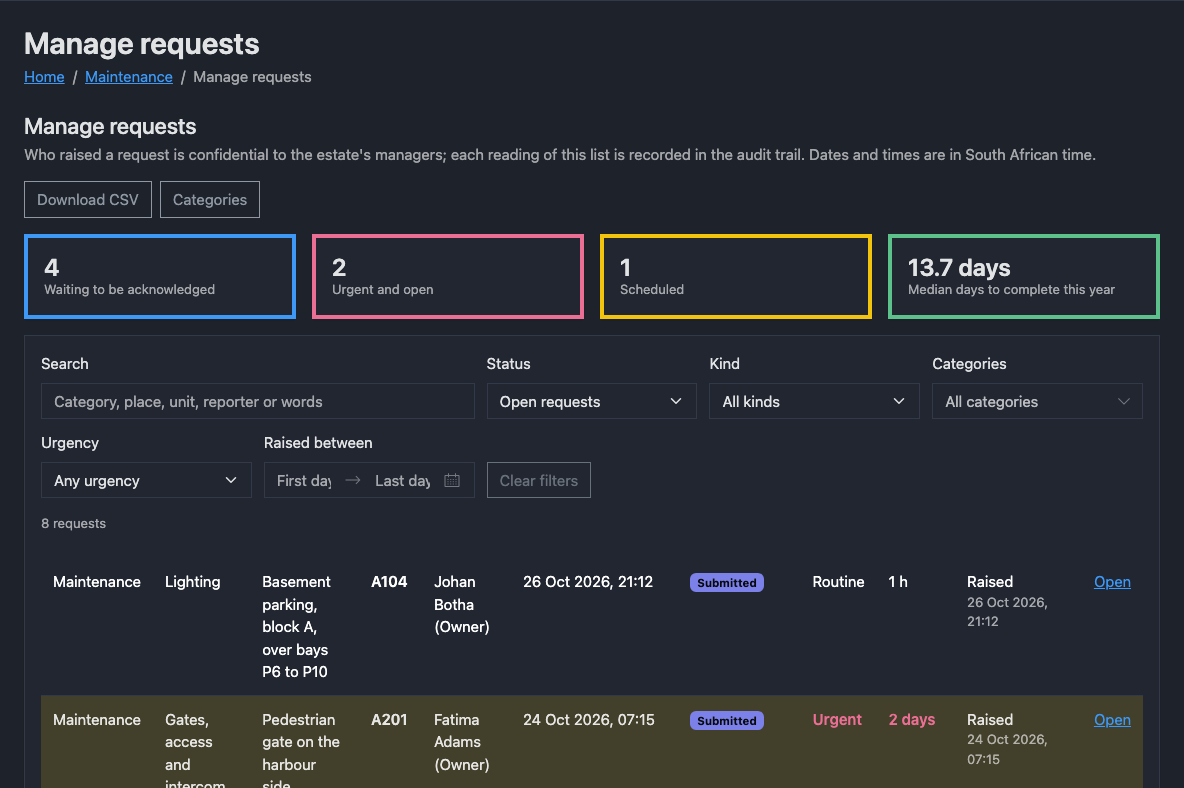
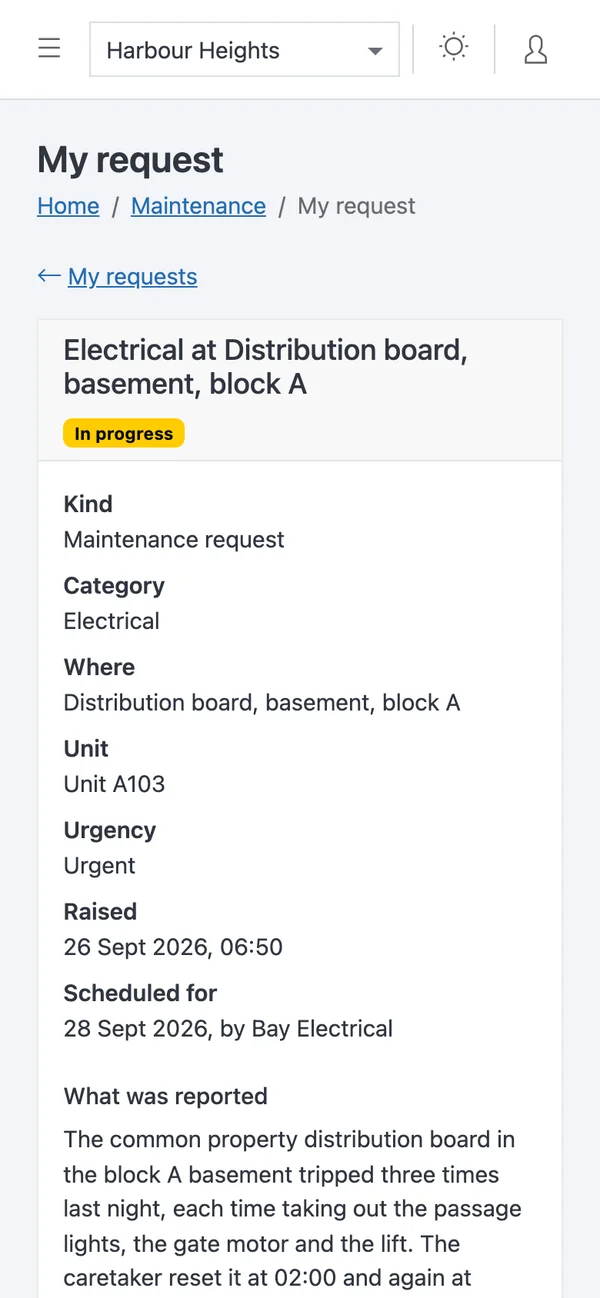
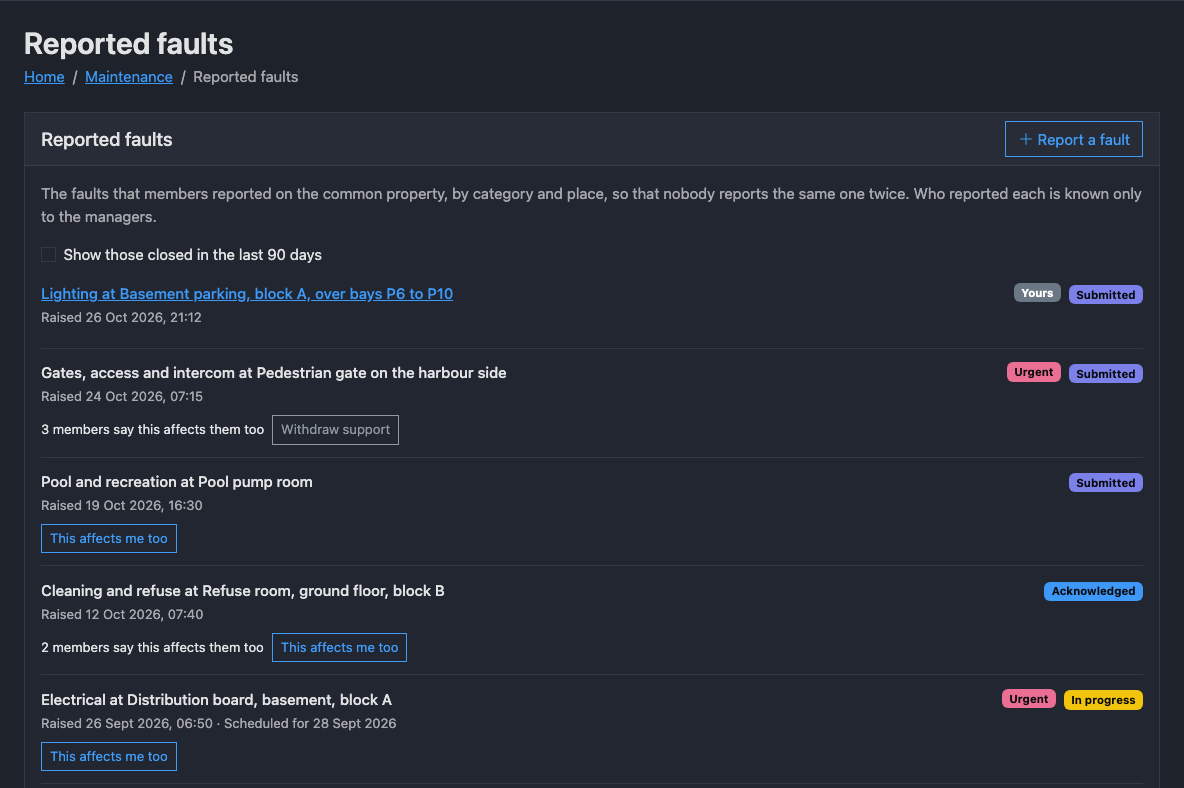
Residents report a fault on the common property once, with the place, the urgency and photos, then follow it from acknowledged to scheduled and done. Neighbours add their support instead of a second report. Access and intercom requests and suggestions sit beside them, and the managers see every fault and access request in one table.
Report a fault
One report, with what the repair needs
A resident reports a fault on the common property, such as a passage light, a leak or the lift: the category, where it is, the unit nearest to it, whether it is urgent, what is wrong and up to five photos. Urgent means a danger, a loss of access or damage that spreads, such as a burst pipe or a gate stuck open.
The form asks about faults on the common property. Where a fault is the owner's own to repair, such as one in a section's own fittings, the managers decline the request with a note that says why, though shared pipes, wires, cables and ducts inside a section stay the body corporate's.
The scheme's own categories, from lighting and lifts to roofs and the pool Photos checked by their content, not their name
One report per fault
This affects me too
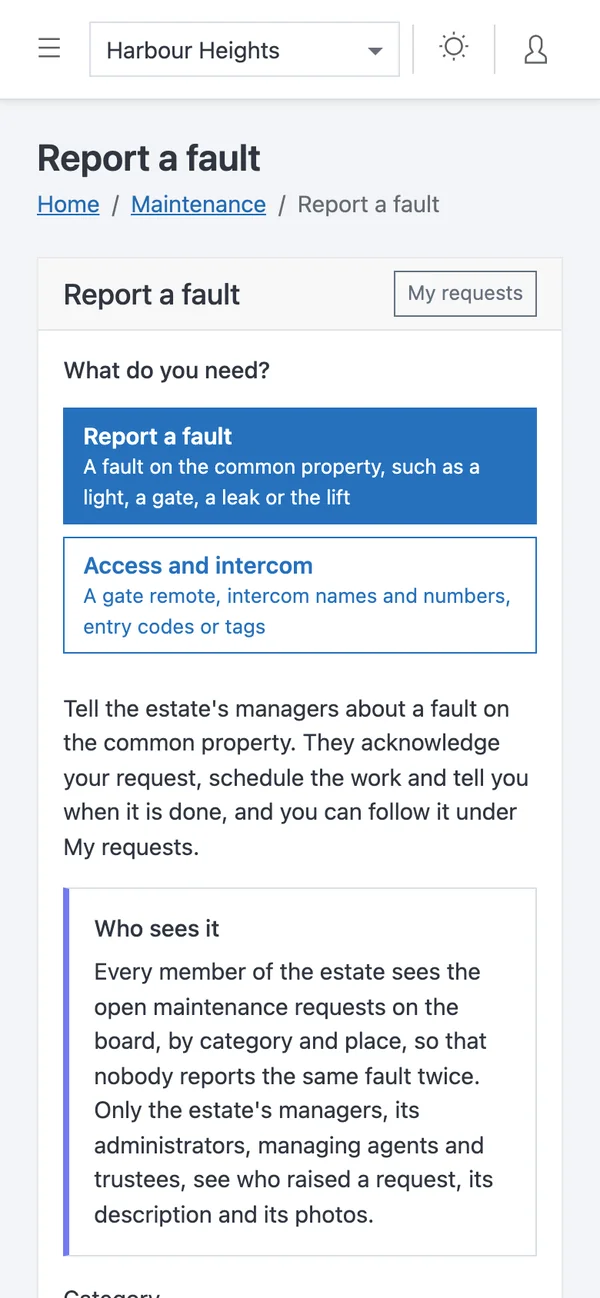
Every member sees the open faults by category, place, unit, urgency and status, so nobody reports the same light twice. A neighbour taps "This affects me too" instead, and the managers see how many people each fault affects.
The board names no reporter and shows no photo or description. Access requests, which carry names and mobile numbers, never appear on it.
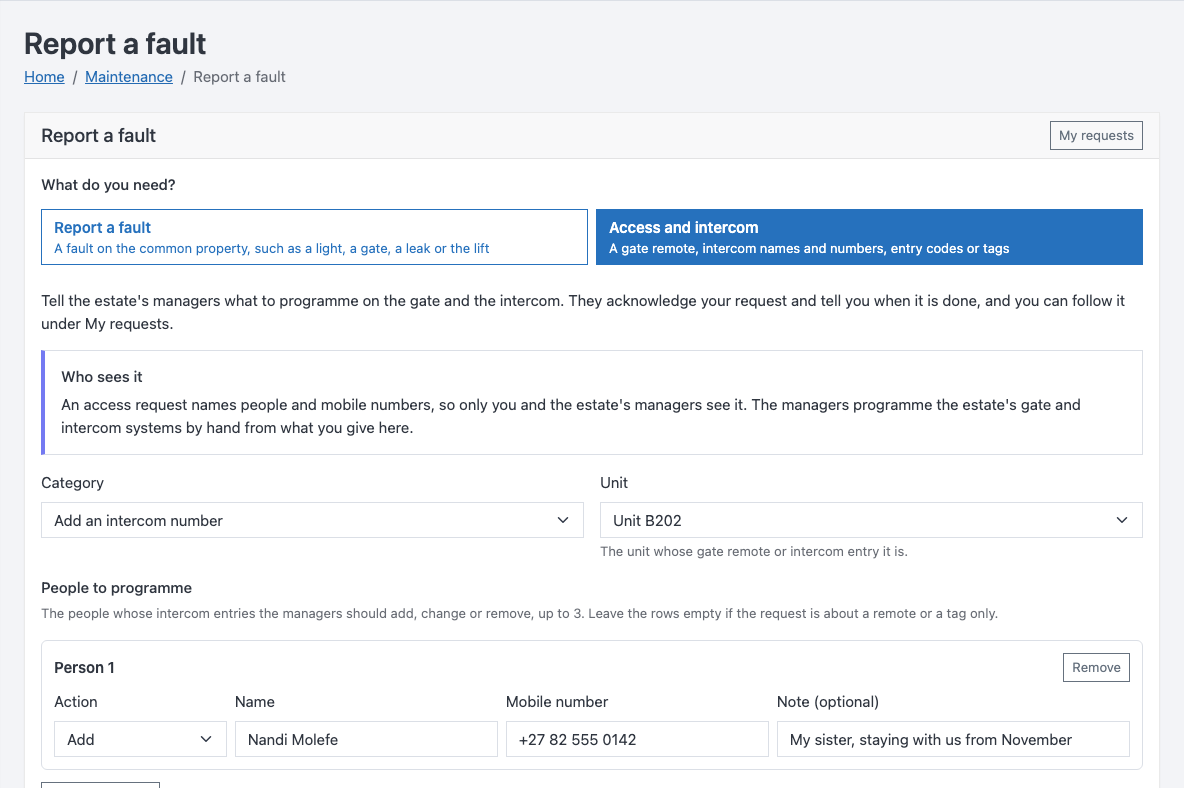
Access and intercom
Remotes and intercom numbers, ready to programme
Residents ask for a new or replacement remote, a lost one deactivated by its serial number, an entry code or tag, or up to three people to add to, change on or remove from the intercom, each with a name and mobile number.
The request carries exactly what the managing agent then types on the installer's portal. Estate Manager does not connect to gate or intercom systems: the agent's office programmes them by hand, from a request that already holds the right names and numbers.
Names and numbers seen only by the resident and the managers
Suggestions
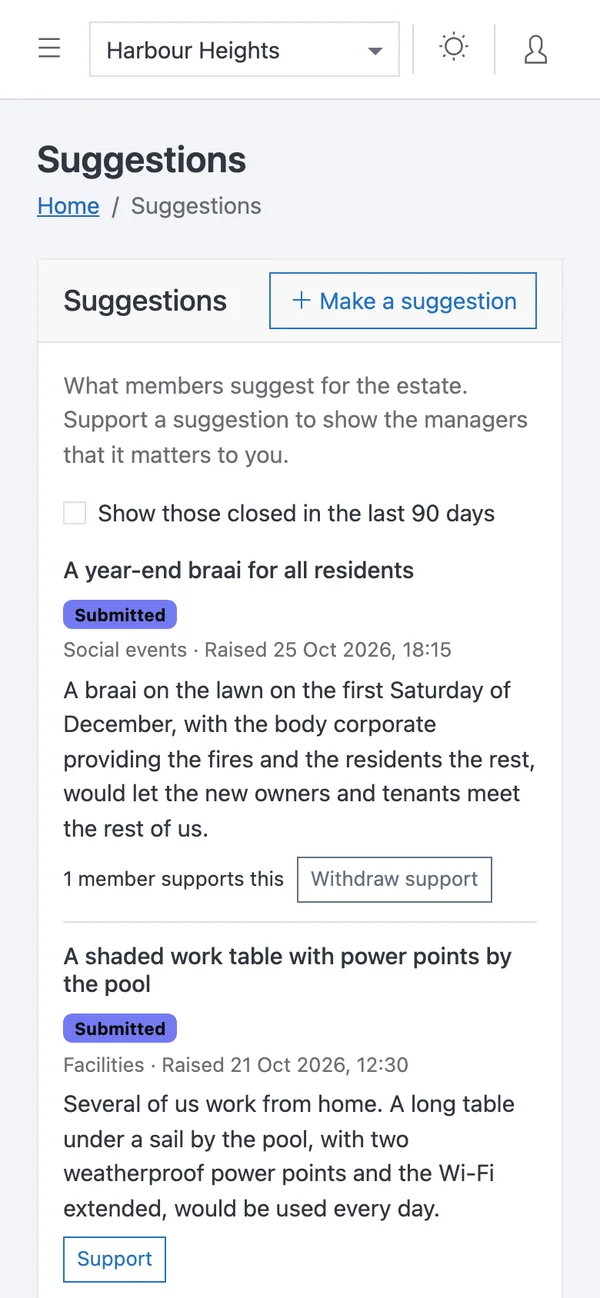
Ideas the trustees can weigh
Members propose improvements, with a title, a category and the idea itself, and support each other's, so the trustees see what residents care about most before their meeting. A suggestion is acknowledged, then accepted and implemented, or declined with a note that says why.
From report to repair
How a request runs
The reporter sees each of the managers' steps on the request's page and hears of it by email, which never carries the description, a note or a name.
- 01
Reported
Every manager is emailed, and an urgent request says so. Who raised it is on the request's page, never in the email.
- 02
Acknowledged
The managers confirm they have seen it. Their internal notes never reach the reporter.
- 03
Scheduled and started
A day is set, with whoever does the work, such as the caretaker or one of the scheme's contractors, and the work is then marked in progress. The timeline reads, for example, Scheduled for 20 October 2026, to be done by the caretaker.
- 04
Completed or declined
With a note of what was done, or of why not, such as a fault that is the owner's own to repair. A photo of the finished work can be added.
- 05
Reopened, if needed
Within 30 days of the outcome the reporter can reopen the request with a reason, which puts it before the managers again.
What the law says
Who maintains what in a sectional title scheme
What the Act and its prescribed rules say. The sectional plan and the scheme's rules show what is a section, an exclusive use area or common property.
General information, not legal advice.
Common property and exclusive use areas
Common property is the land in the scheme, the parts of the buildings not included in a section, and land the body corporate buys to extend it. An exclusive use area is a part of the common property for the exclusive use of the owner or owners of one or more sections.
The body corporate's duty
The body corporate must keep all the common property in good and serviceable repair, with the plant, machinery, fixtures and fittings used with the common property and sections, and, subject to the municipality's rights, the pipes, wires, cables and ducts that serve more than one section or the common property, or one section over the common property.
The owner's duty
An owner must keep their section in good repair and an exclusive use area clean and neat. They must let in a person authorised in writing by the body corporate, during reasonable hours and on notice, though no notice is needed in an emergency, to inspect the section and repair shared pipes, wires, cables and ducts, or to check that the Act and the rules are observed.
The geyser
A water-heating installation is common property insured by the body corporate, but the member it serves must maintain, repair and replace it, sharing the cost pro rata where it serves more than one. A member pays the insurance excess on damage to any part of the buildings they must maintain, and must give the body corporate the insurer's written proof of payment within seven days of a written request.
When an owner does not act
If an owner ignores a written demand to carry out work on their section that a competent authority ordered, or to repair their section, and the failure threatens the stability of the common property or the safety of the building, or materially prejudices the scheme, the body corporate must remedy it and recover the reasonable cost. In an emergency no demand is needed.
If repairs are not done
An adjudicator of the Community Schemes Ombud Service (CSOS) may order the body corporate to have repairs and maintenance carried out, or order a person to carry out specified repairs or to reimburse the applicant for them.
Who repairs what, at a glance
Common faults, who carries the repair, and where the law says so. The scheme's rules and sectional plan can change the answer.
| The fault | Who repairs it | Where the law says so |
|---|---|---|
| A passage light, the gate or the communal garden | The body corporate | Section 3(1)(l) |
| The lift or a gate motor | The body corporate | Section 3(1)(q) |
| A leak from a pipe serving more than one section | The body corporate | Section 3(1)(r) |
| A leak from a section's own taps or fittings | The owner | Section 13(1)(c) |
| A burst geyser | The owner it serves, who also pays the insurance excess | PMR 31(1), PMR 23(2)(b) |
| An exclusive use garden | The owner keeps it clean and neat, and bears its costs by an extra contribution or under the rules | Section 13(1)(c), section 3(1)(c) |
PMR means a prescribed management rule. General information, not legal advice.
Questions
Questions about maintenance in a scheme
Anything else: ask us when you book a demo, or write to info@nanotech-computers.com.
Who fixes a leak in a sectional title scheme?
What is an exclusive use area in a sectional title scheme, and who maintains it?
Do I need the body corporate's approval to renovate?
Does Estate Manager connect to our gate or intercom?
Can other residents see who reported a fault?
What Estate Manager does not do
- It does not connect to gate or intercom systems. Access requests carry what the managing agent types on the installer's portal.
- It does not run approvals for renovations. The rules builder's drafted template on alterations and building works sets out a consent procedure for the scheme's rules.
- It does no accounting. Contractors' invoices and recoveries from owners stay in the managing agent's system.
Related
Related
See a request followed from report to repair
A demo reports a fault on a fictional scheme, schedules it for the caretaker, completes it with a note and shows what the resident sees at each step.