
Complaints and CSOS disputes
Body corporate complaints with a paper trail
Owners and tenants file a complaint against the scheme's own rules and follow every step. The trustees and the managing agent acknowledge it, investigate, keep internal notes and answer with a note the reporter reads. Before the Community Schemes Ombud Service (CSOS) takes a dispute, it asks what was tried within the scheme first. The timeline keeps that record.
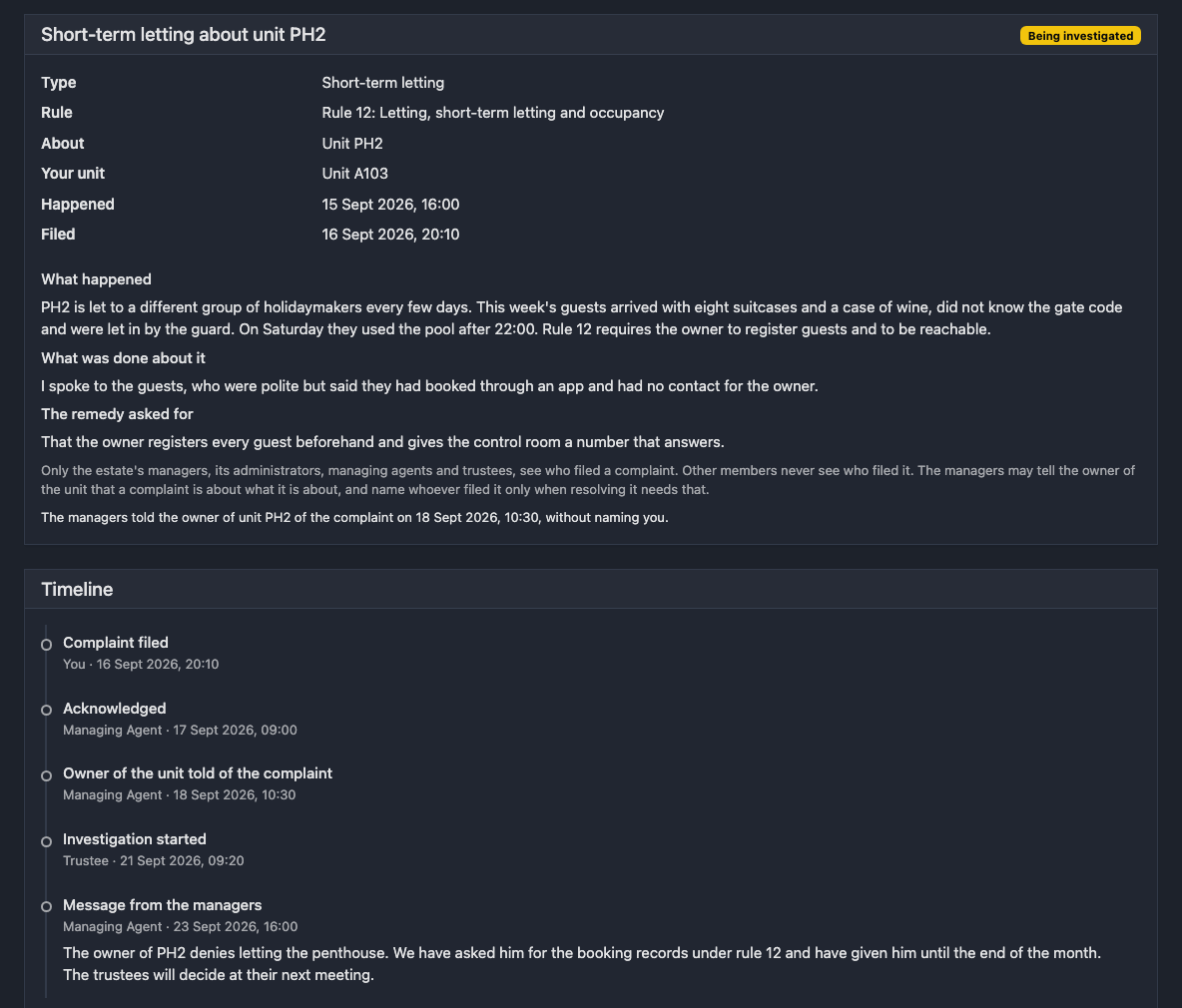
Filing
Filed against the scheme's own rules
A resident files from a phone or a computer: the type of complaint, the rule broken where one applies, the unit concerned, when it happened and what happened. They confirm it is true to the best of their knowledge, and that they may have to be named if it goes further.
The managers keep the catalogue of types and rules. Every scheme starts with noise, parking, pets, refuse, damage and other, and when new conduct rules come into force in the rules builder, the catalogue follows them.
No name to type: the reporter is the member signed in The managers are emailed at once, and the email names nobody A rule in use is retired, not deleted, so old complaints keep their meaning
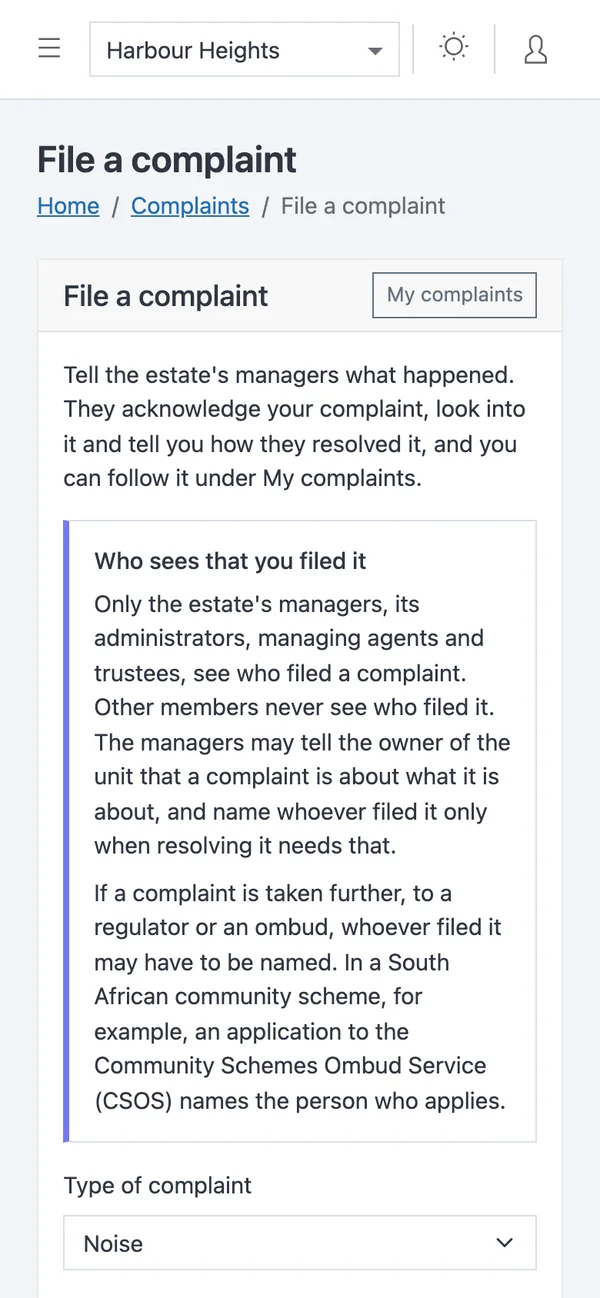
Handling
Acknowledged, investigated, answered
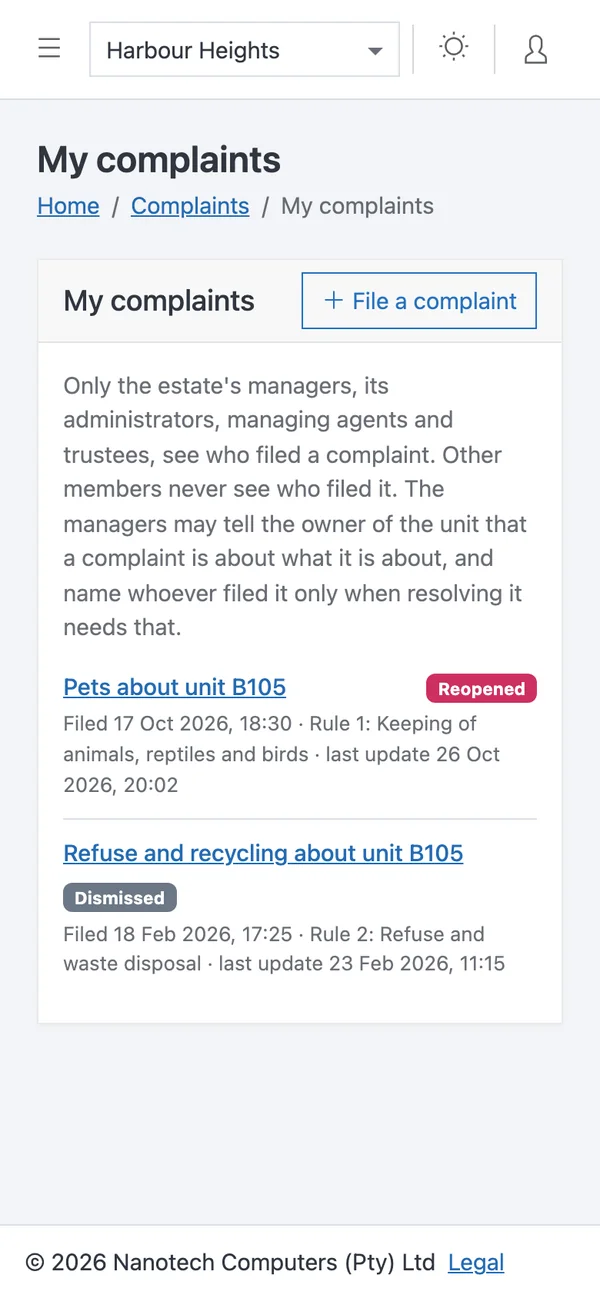
The managers acknowledge the complaint, investigate it, and resolve or dismiss it with a note the reporter reads. Internal notes stay with the managers. Messages reach the reporter on the complaint's page, with an email to say one is waiting. Every step lands on a dated timeline that shows the reporter the manager's role, never their name.
The scheme's complaints sit in one table, with figures above it for those waiting to be acknowledged, being investigated or reopened, and the median time to resolve this year.
Resolving or dismissing needs a note to the reporter Filters by status, type and the days filed A CSV download without the reporters' names Every step, and the managers' reads of who filed, in the audit trail
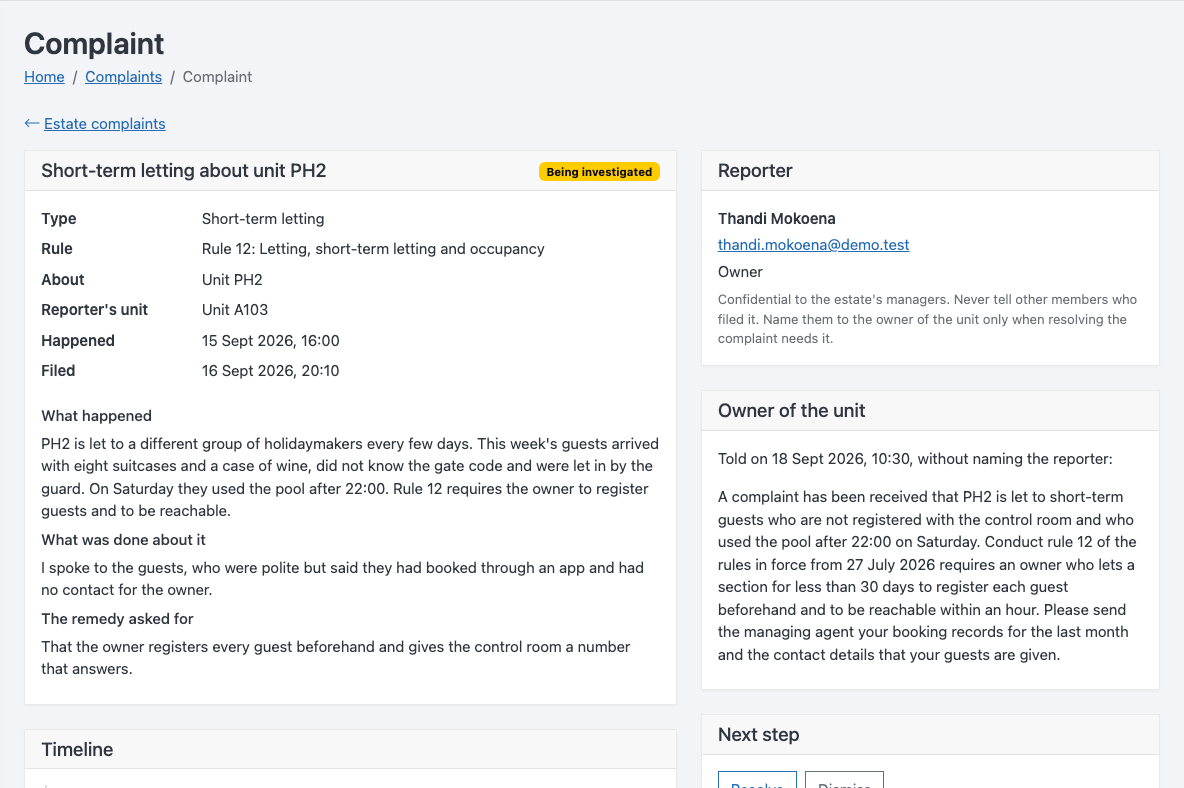
Confidential, and open to dispute
Named only to the managers, with 30 days to dispute
Only the scheme's managers, the trustees and the managing agent, see who filed a complaint. Other members never do, and the managers name whoever filed it to the owner of the unit it concerns only when resolving it needs that. There are no anonymous complaints, because handling one fairly means knowing who made it.
A resolved or dismissed complaint can be disputed within 30 days, with a reason, which reopens it for the managers. The 30 days are Estate Manager's workflow, not a period the Act sets.
From complaint to CSOS
How a complaint should run
What the regulations' complaint form and the CSOS practice directive expect, in order. General information, not legal advice.
- 01
Try to settle it directly
Where it is safe, speak to the person concerned first. The complaint form in the regulations asks what was done to resolve the matter, who was spoken to and what they offered.
Regulations, Annexure 4 - 02
Complain in writing
Name the rule or section breached, describe what happened with dates and times, and say what remedy you want. Keep a copy and proof of delivery. In Estate Manager the complaint and every step after it are dated.
Regulations, Annexure 4 - 03
The scheme decides
The trustees hear both sides and decide, with reasons. The regulations' record of a body corporate decision notes the outcome and tells each party that they may apply to CSOS if they are not satisfied. Estate Manager tells the reporter the outcome and that right, and the owner of the unit complained about too, once the managers have told them of the complaint.
Regulations, Annexure 4 - 04
Apply to CSOS
Since 1 April 2026 CSOS asks for new disputes on CSOS Connect, by its notice of 27 March 2026, though its directive and the regulations still allow other ways of delivery. The application asks how internal remedies were exhausted, the relief sought and the supporting documents. The directive says no application fee is payable. The CSOS Act and its fee regulations still prescribe R50 on application and R100 for adjudication.
CSOS notice of 27 March 2026, directive 15.4 and 15.34 to 15.39 - 05
Conciliation, then adjudication
Where a settlement looks possible, CSOS refers the dispute to conciliation. If that fails, an adjudicator decides. An order may be appealed to the High Court on a question of law only, within 30 days after its delivery.
CSOS Act, sections 47, 48 and 57
What the law says
Complaints, disputes and CSOS
What the Act, the Community Schemes Ombud Service Act 9 of 2011 and the 2025 CSOS practice directive say.
General information, not legal advice.
The scheme first
Every applicant must first try to resolve the dispute within the scheme and submit proof that any prescribed internal process was exhausted. That falls away if the applicant proves that the respondent refused to take part or rejected an invitation, or that the scheme has no functioning executive committee, and it never stops an application for urgent interim relief.
A process in the rules
CSOS expects an internal dispute resolution process for owners to be embedded in the rules, so that owners are heard fairly before a matter reaches it. A rule that sends disputes to private arbitration instead is undesirable.
Who may apply, and for what
Any person who is a party to a dispute, or materially affected by it, may apply. The relief must fall within section 39, such as an order that behaviour is a nuisance and must stop, that a rule is invalid or unreasonable, that a resolution is void, or that a managing agent comply with its appointment.
Noise and nuisance
An owner must not use a section or exclusive use area, or permit it to be used, in a way that may cause a nuisance to any occupier, and the conduct rules forbid noise likely to interfere with another's peaceful enjoyment. The body corporate must take all reasonable steps to stop such a nuisance.
Trustees within their powers
Each trustee must act honestly and in good faith, in the body corporate's interest, never without or beyond their powers, and avoid conflicts of interest. An application to have a decision of the trustees, or of the body corporate, declared void must reach CSOS within 60 days, unless CSOS condones a late one on good cause shown.
Not confidential at CSOS
CSOS must give notice of an application to the scheme and every person materially affected, so what an applicant submits is not treated as private. Personal information is redacted.
Questions
Questions about body corporate complaints
Anything else: ask us when you book a demo, or write to info@nanotech-computers.com.
How do I complain to my body corporate, and is there a form?
What does CSOS expect a scheme to have tried first?
Is there an ombudsman for sectional title complaints and disputes?
How do I lodge a dispute with CSOS?
Can a complaint be anonymous?
What can be done about a noisy neighbour?
What if the trustees abuse their powers?
Is registration with CSOS compulsory, and what is the annual return?
What is the CSOS levy, and how is it worked out?
What Estate Manager does not do
- It keeps the scheme's own record. It does not file with CSOS: an application goes in on CSOS Connect from the person or scheme that makes it.
- Complaints go to the trustees and the managing agent, so a complaint about the trustees reaches them too.
- It gives no legal advice, and the 30 days to dispute an outcome are its own workflow, not the law.
Related
Related
See a complaint handled, start to finish
A demo files a complaint on a fictional scheme, takes it through acknowledgement, notes and messages to an outcome, and shows what the reporter sees.