
For managing agents and portfolio managers
Every AGM in your portfolio, run by the book
Estate Manager is software for managing agents who run sectional title schemes and homeowners' associations. It runs each body corporate's general meetings the way the Sectional Titles Schemes Management Act prescribes, keeps the record of every step as it happens, and puts every scheme you manage behind one sign-in, with each scheme's records kept apart.

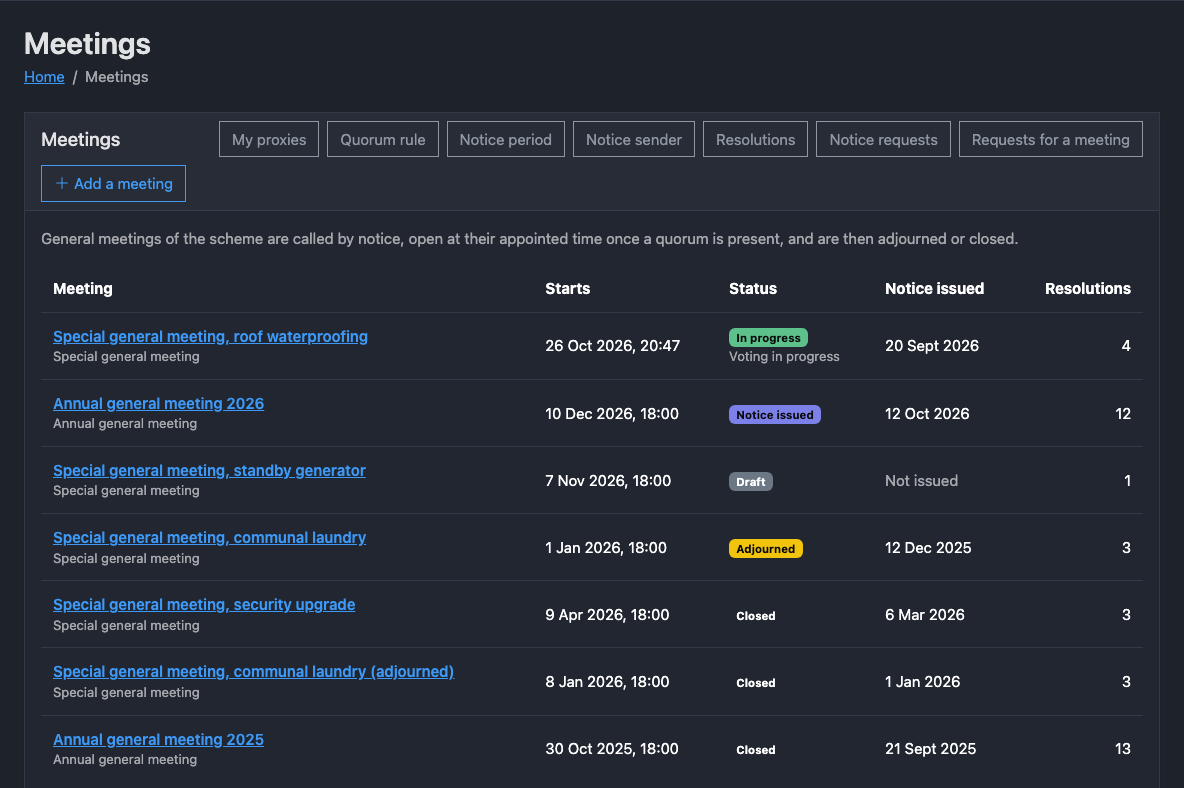
Your portfolio
One sign-in for every scheme you run
Switch between schemes from the header without signing in again. Every page reloads for the scheme you choose, and each scheme's records are kept apart by row-level security in the database as well as by the application.
Sectional title schemes and homeowners' associations sit side by side, each with its own quorum rule and notice periods. A scheme's register comes in from a spreadsheet, with a preview of every change before anything is saved.
How an association is set up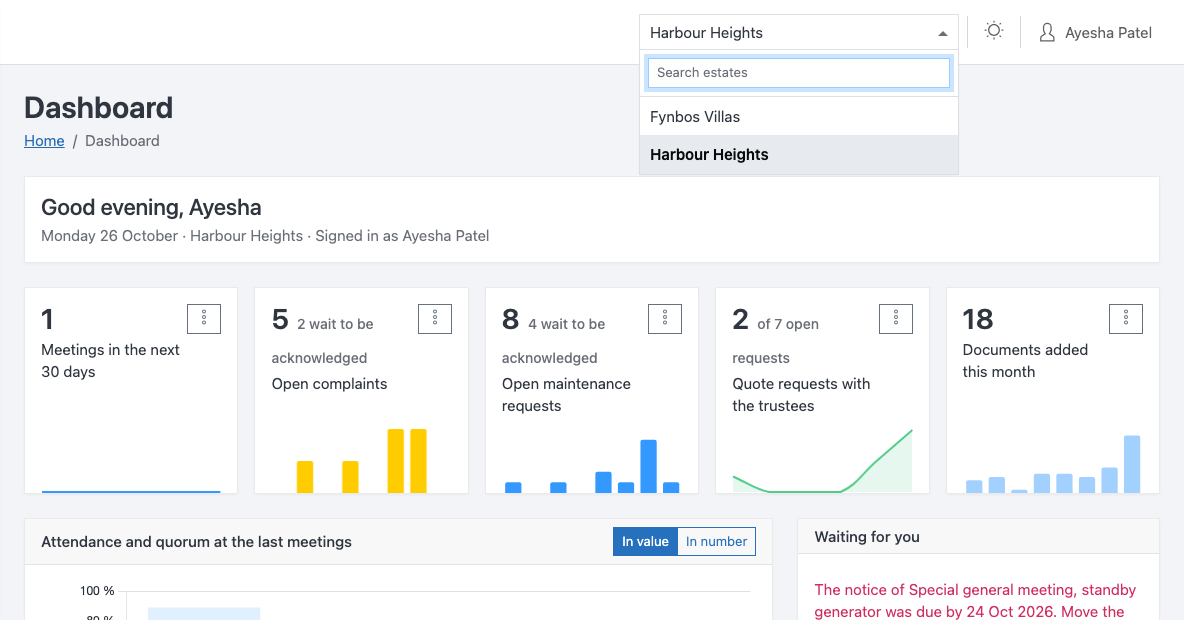
AGM season
Each scheme's AGM, on its own clock
Estate Manager runs each scheme's year from October to September, the financial year that rule 21(1) sets unless the members resolve otherwise, and the managers can set another. It shows when each scheme's annual general meeting (AGM) after the current year is due, warns of an AGM set after that day, and counts the notice each meeting needs. Rule numbers are of the prescribed management rules (PMR).
- Year end
Four months to the AGM
The AGM is held within four months of the financial year end. Each scheme's budgets page shows the date by which the AGM after its current financial year is due.
PMR 17(1) - 30 days before
Special and unanimous resolutions
At least 30 days' written notice of a meeting that will take a special or unanimous resolution, unless the rules provide for shorter notice.
Section 6(2) - 14 days before
Notice of the meeting
At least 14 days' written notice to the members, registered bondholders, holders of future development rights and the managing agent, with the agenda, the papers and a proxy form.
PMR 15(1), 15(3) - 48 hours before
Proxies close
Proxies reach the body corporate 48 hours before the meeting, or are handed to the chair before or at its start.
PMR 20(5) - On the night
Quorum, votes and results
A third of the votes in value, or two thirds in the smallest schemes, with two persons present. The chair announces each result, with the votes for and against.
PMR 19(2), 20(8) - Within 7 days
Minutes out
The minutes reach everyone entitled to notice as soon as reasonably possible, and within 7 days. Estate Manager drafts them when the meeting ends.
PMR 9(e) - Within 4 months of year end
The CSOS annual return
Filed with the Community Schemes Ombud Service (CSOS), with the signed financial statements, the draft AGM minutes and the approved levy schedule.
CSOS directive 14.2, 14.3
Notices and proxies
Notices checked, proxies within the limits
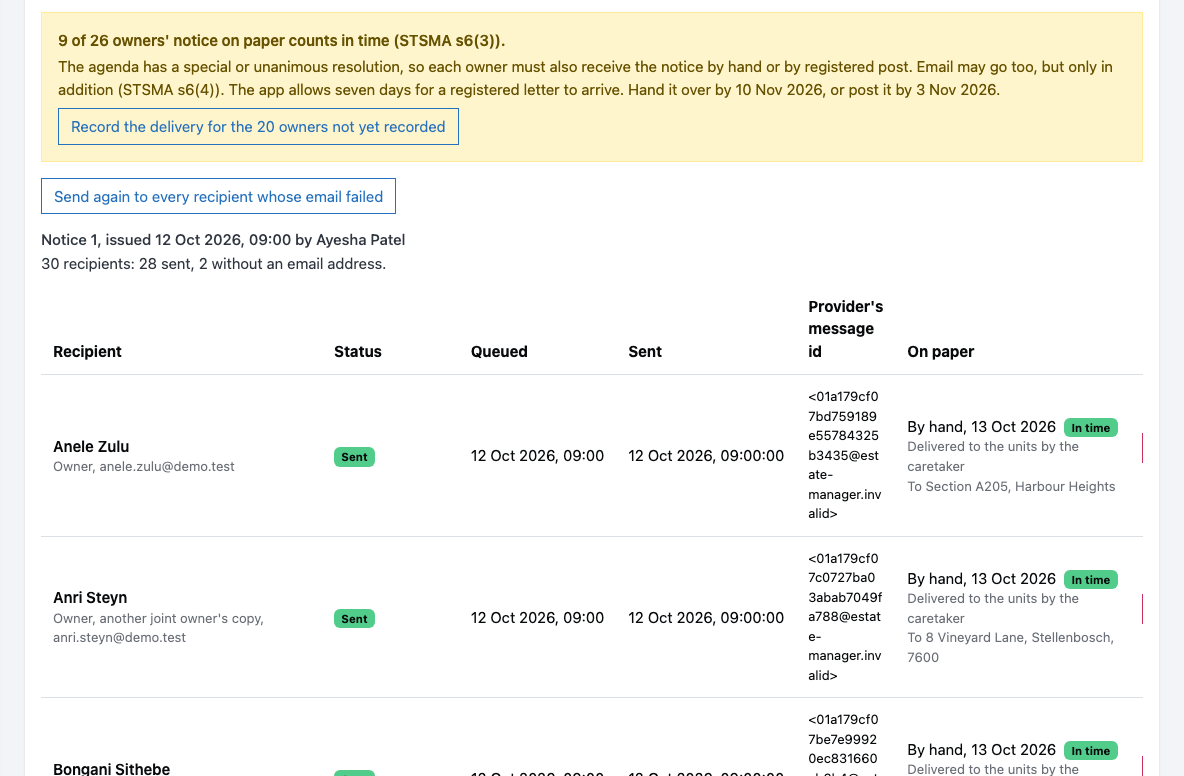
Estate Manager counts the period each meeting needs, marks a meeting called at shorter notice and keeps the reason for going ahead. Issuing the notice emails the pack, with the agenda and a prefilled proxy form, to every owner and the managing agent, and the delivery report shows each recipient, the address used and when it went, with a resend for failures.
Owners appoint a proxy online or on the prescribed Form C, and anyone who already holds proxies for two members is marked. You are never offered as one: the regulations bar the managing agent and its employees, and Estate Manager leaves out anyone who signs in as the agent or whom the managers record as its staff.
A missed notice does not invalidate a vote where a reasonable attempt was made, and the report is the record of it
On the night, and after
The chair's console, and minutes from the record
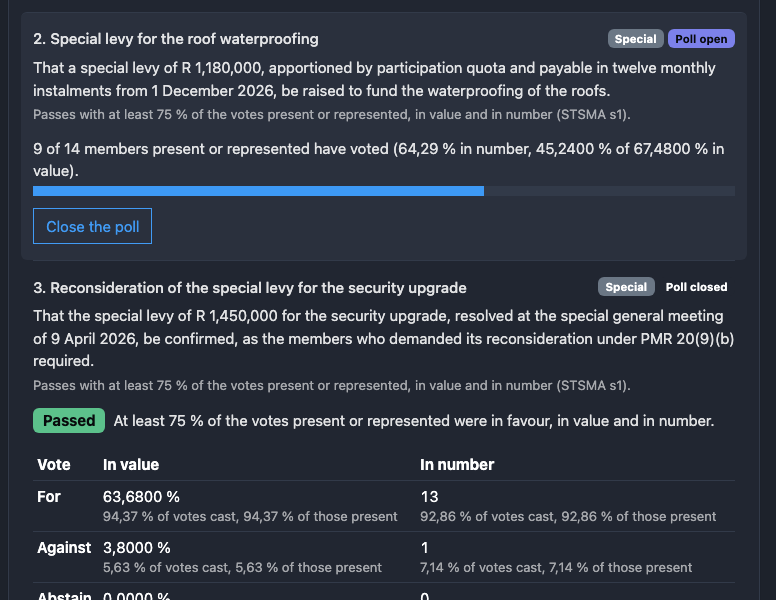
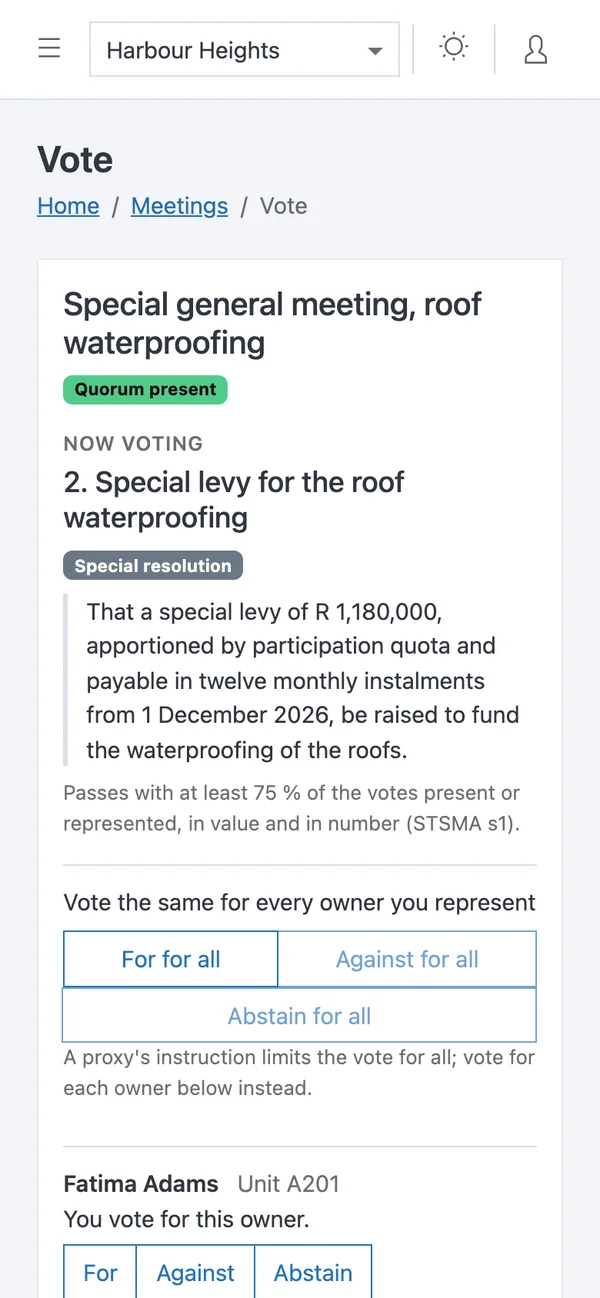
The quorum meter moves with every check-in, in person, online or by proxy, and voting opens only while the meeting is quorate. The chair opens one poll at a time and sees how many have voted, never how anyone voted. Closing it records the result in value and in number, with the rule that decided it.
When the meeting ends, the minutes are drafted in Word from the record: the notice, the attendance with how each proxy was lodged, the quorum and every result. You edit a draft instead of writing up notes, ready to go out within the 7 days the rules allow.
As the agent you may attend and speak, but may not propose a motion or vote, and the chair of the trustees presides unless the members decide otherwise. You can keep the register and run the console for the chair.
Between meetings
Packs, requests, quotes and budgets, scheme by scheme
The work between AGMs sits in the same place, so the trustees see it and the owners see what is meant for them.
Packs and documents
Your monthly packs are kept for the trustees, never the owners. Certificates, minutes drafts, proxy forms and letters are produced as Word or PDF, and the library keeps every version you file.
Read moreComplaints residents can follow
Filed against a rule and answered on the record. The dated timeline shows the attempt to resolve a dispute within the scheme that CSOS asks for.
CSOS directive 15.34Read moreRequests with a status
A passage light, a leaking pipe, a new remote: reported once and followed to done. Access requests carry what you type on the installer's portal.
Read moreQuotes within your written limit
Within the trustees' written delegation, you approve a quote and they are told. Above it, the trustees declare their interests and decide, and the appointment letter follows.
PMR 21(3)(g)Read moreBudgets and the ten-year plan
Budgets and the ten-year plan, built from templates or uploaded from your system, tabled with the resolution that approves them and shared with owners once approved.
PMR 17(6)(j)Read moreAn audit trail for the trustees
Every change, and each read of the register, the members, the complaints and the requests, among other records that hold people's details, in a trail nobody can edit, so the trustees see what was done without asking.
Read moreYour accounting stays where it is
- No scheme accounting. Levies, statements, arrears and collections stay in your accounting system, and Estate Manager holds the governance around them.
- No gate or intercom integration. Access requests carry what you type on the installer's portal.
- No legal advice. Estate Manager is built around the Act and the regulations, and decisions remain the body corporate's.
What the law says
What a managing agent does, under the rules
The prescribed management rules say how a body corporate appoints a managing agent, what the agent may do and where the role stops.
General information, not legal advice.
Services under the trustees' supervision
If the trustees so resolve, the body corporate may appoint a managing agent for specified financial, secretarial, administrative or other management services, under the trustees' supervision. It must appoint one if a resolution of the members, or a registered bondholder of 25 per cent in number of the primary sections, requires it.
Three years at most
A management agreement runs for three years at most. The body corporate may cancel it on two months' notice once a special resolution approves the cancellation, or end it on its own terms, or not renew it, by ordinary resolution.
Records back within 10 days
When the body corporate ends the contract, the agent delivers the scheme's records that it holds within 10 days. The rule binds an employee whose contract the body corporate ends in the same way.
At the meeting, not in the vote
The agent receives notice of every general meeting and may attend and speak, but not propose a motion or vote as the agent. Neither the agent nor its employees may act as a proxy.
A trustee only as an owner
A managing agent, or an employee of the agent or of the body corporate, may be a trustee only if that person is a member of the body corporate.
Spending within a written delegation
The trustees may delegate powers in writing, naming the power, the maximum amount and any conditions. Documents bind the body corporate when two trustees, or a trustee and the managing agent, sign them on a trustee resolution.
The executive managing agent
By special resolution a body corporate may appoint an executive managing agent to do the trustees' work, and members holding a quarter of the quotas may ask CSOS to appoint one. That agent carries a trustee's duties, arranges for the common property to be inspected at least every six months and reports to every member at least every four months.
Pricing
One rate for the portfolio, on one invoice
One plan with every feature, priced per unit per month by the size of the scheme: R12.50 per unit per month for the first six months and R15.00 after that for a scheme of up to 100 units, with lower rates for larger schemes.
Your whole portfolio is counted together for the rate, on one invoice itemised per scheme, so each scheme can be recharged its own line. No VAT is charged, residents are never charged, and every scheme can try it free for 10 days.
See the rates by bandOne plan, every feature
R12.50
per unit a month
For a scheme of up to 100 units, for the first six months. Then R15.00. Nothing is added for VAT.
| Units | First six months | After that |
|---|---|---|
| 1 to 100 | R12.50 | R15.00 |
| 101 to 300 | R10.50 | R12.50 |
| 301 to 1,000 | R8.50 | R10.00 |
| More than 1,000 | R8.50 | R8.50 |
Pilot
Pilot schemes wanted
Before launch, we are inviting a few schemes with a general meeting coming up to run it on Estate Manager, with us alongside: importing the register, drafting the agenda and the notice, and setting up proxies. We agree each pilot's terms on a call, and a pilot scheme pays the published rates, like every other scheme.
Ask for the pilot details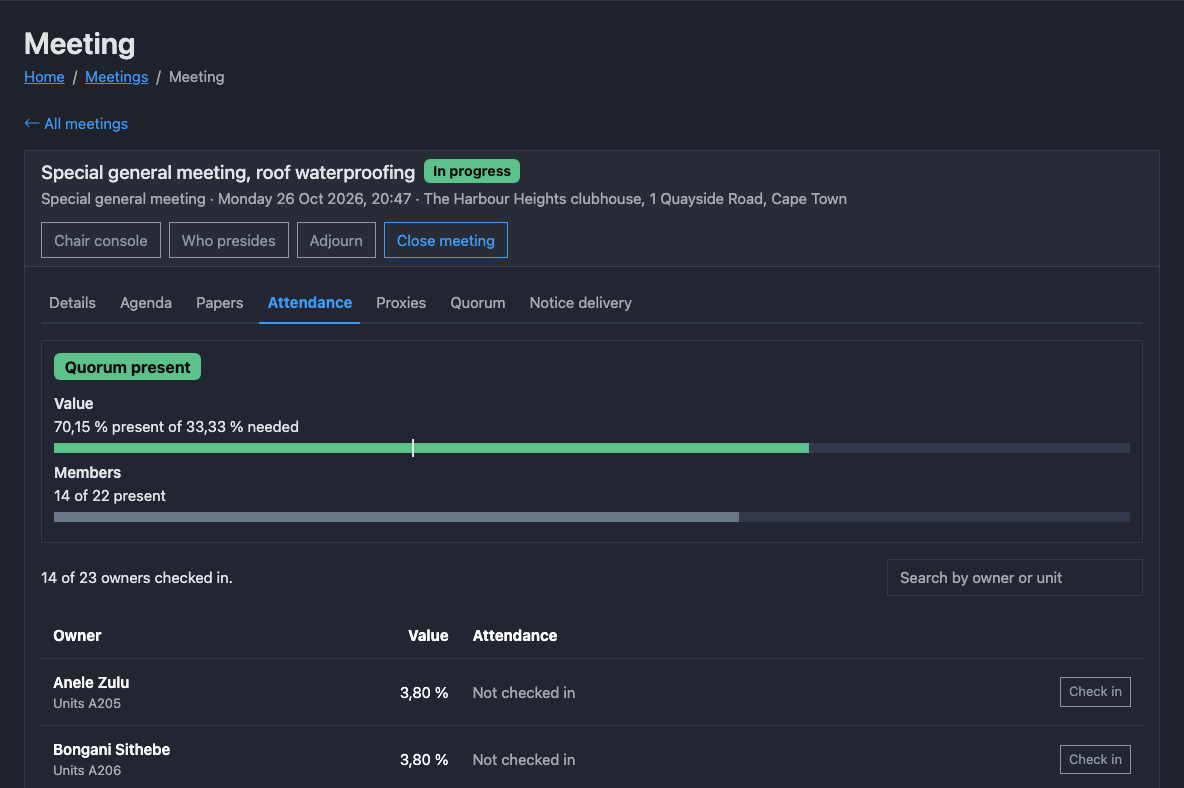
Questions
Questions managing agents ask
Anything else: ask us when you book a demo, or write to info@nanotech-computers.com.
What is a managing agent, and how does it differ from the body corporate?
What does a managing agent do at an AGM?
Can a managing agent be a trustee?
Does it replace our accounting package?
Can the trustees change the managing agent?
What happens in Estate Manager when a scheme changes agent?
Who deals with a complaint about a managing agent?
Related
Read next
AGMs and general meetings
The meeting cycle step by step, from the notice to the minutes.
Read moreQuotes and trustee approvals
Three quotes, declared interests, the written delegation and the appointment letter.
Read moreFor trustees
What the trustees you answer to must do, and what they see in Estate Manager.
Read moreSee your next AGM run on Estate Manager
A demo walks through a general meeting on a fictional scheme: the notice, the proxies, check-in, the quorum, the vote and the paperwork that follows. Bring your questions about your own schemes.