
Rules
Body corporate rules, built from the regulations
Start the scheme's management and conduct rules from the 39 prescribed rules, word for word. Add the scheme's own from drafted templates, check the draft against the Act and the directive of the Community Schemes Ombud Service (CSOS), and record the adoption, the lodgement and the Chief Ombud's certificate. Members read the rules in force.
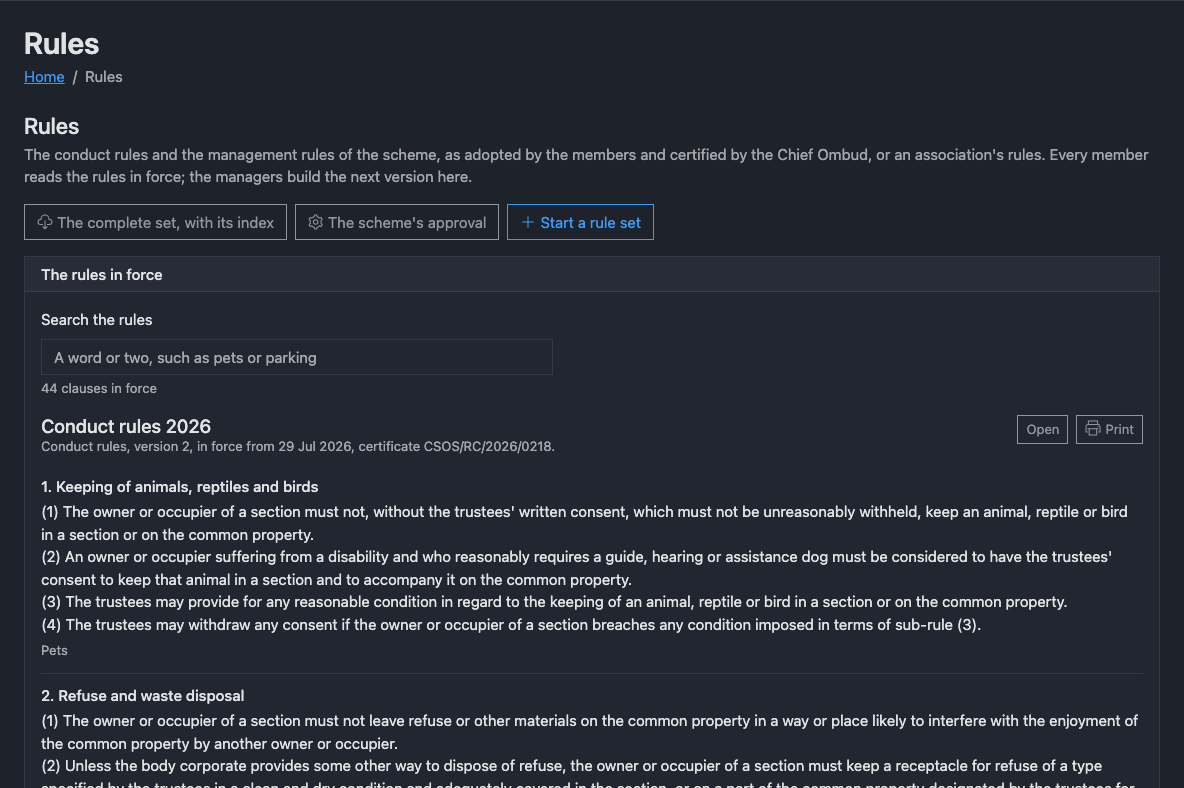
The prescribed rules
The 39 prescribed rules, word for word
Every sectional title scheme has management rules and conduct rules (section 10(2) of the Act). The 2016 regulations prescribe 31 management rules and 8 conduct rules, which apply unless the scheme has changed them by the resolution the Act requires.
Estate Manager holds all 39 as gazetted on 7 October 2016. A draft starts from them, from the set in force or from nothing, and every clause shows whether it is kept, amended, repealed or added.
Annexure 1: trustees, meetings, money, records and the property Annexure 2: animals, refuse, vehicles, damage, appearance, storage, behaviour and pests
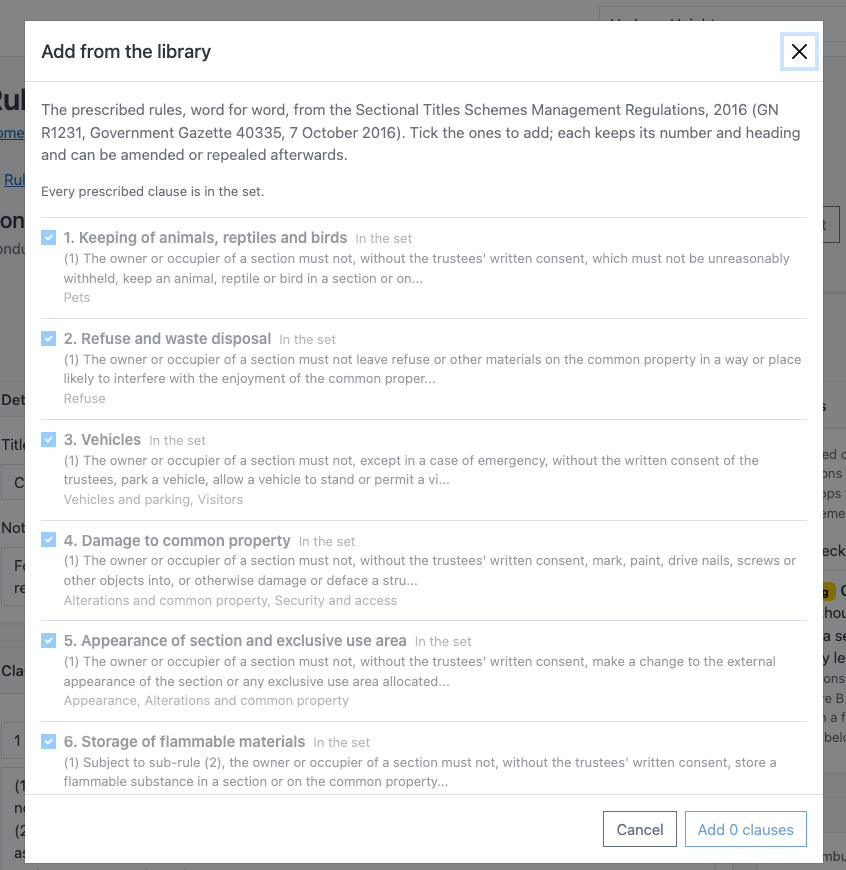
Drafted templates
Templates for what the prescribed rules leave open
Sixteen drafted templates cover what schemes add: noise and quiet hours, security, the pool, braai areas, visitors, children, short-term letting, fines, domestic employees, drones, complaints, gardens, vehicles, alterations, storage and owner maintenance. Pets need none, because prescribed conduct rule 1 covers them.
Type in the times, days and amounts, and the clause reads back in full before it is added. The templates are drafts for the scheme's attorney to review, and say so.
Noise: quiet hours, hours for building work and notice of a gathering Fines: a written notice first, a hearing, and a fine below the monthly levy Complaints: an internal step first, with the way to CSOS left open
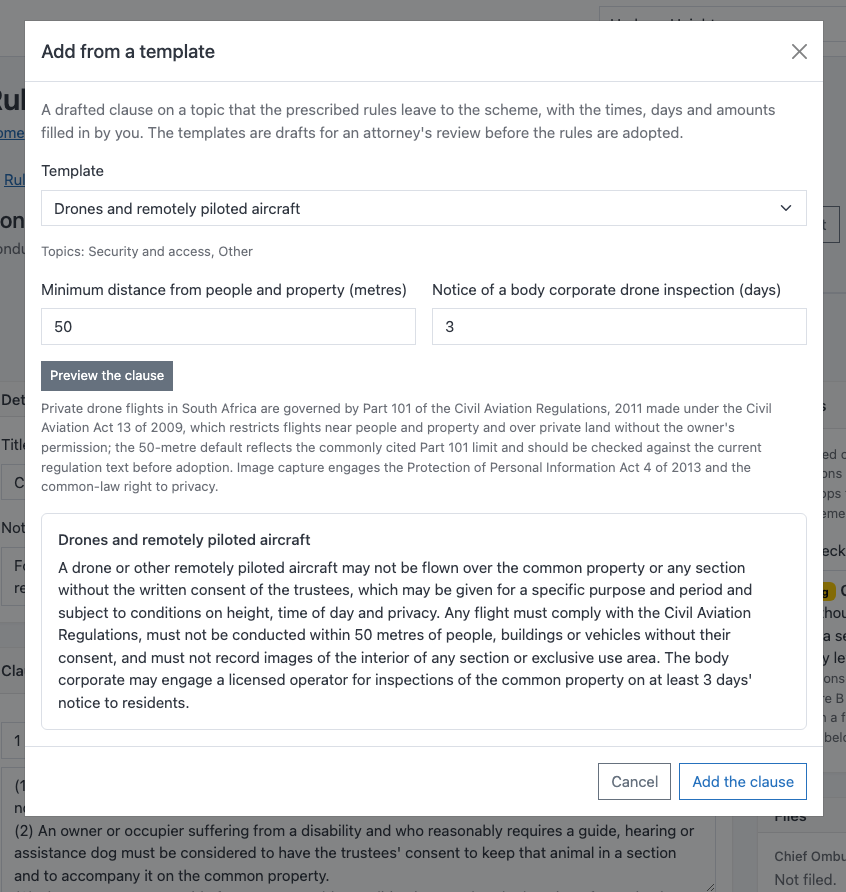
Checks as you go
Checks against the Act and the CSOS directive
The builder reads the saved clauses against the Act, the regulations and the CSOS practice directive. An error, such as two clauses with one number, stops the adoption. A warning is for the managers, and the scheme's attorney if it has one, to weigh.
A fine without a first notice, a hearing and a cap below the levy Access, a remote, a vote or a service withheld over arrears Towing a vehicle, or forcing an owner to evict a tenant Animals restricted with no room for assistance animals or pets already kept Disputes sent to private arbitration instead of CSOS A management matter written into the conduct rules A charge debited to an owner without consent or an order Domestic employees restricted beyond registration, or ritual slaughter forbidden
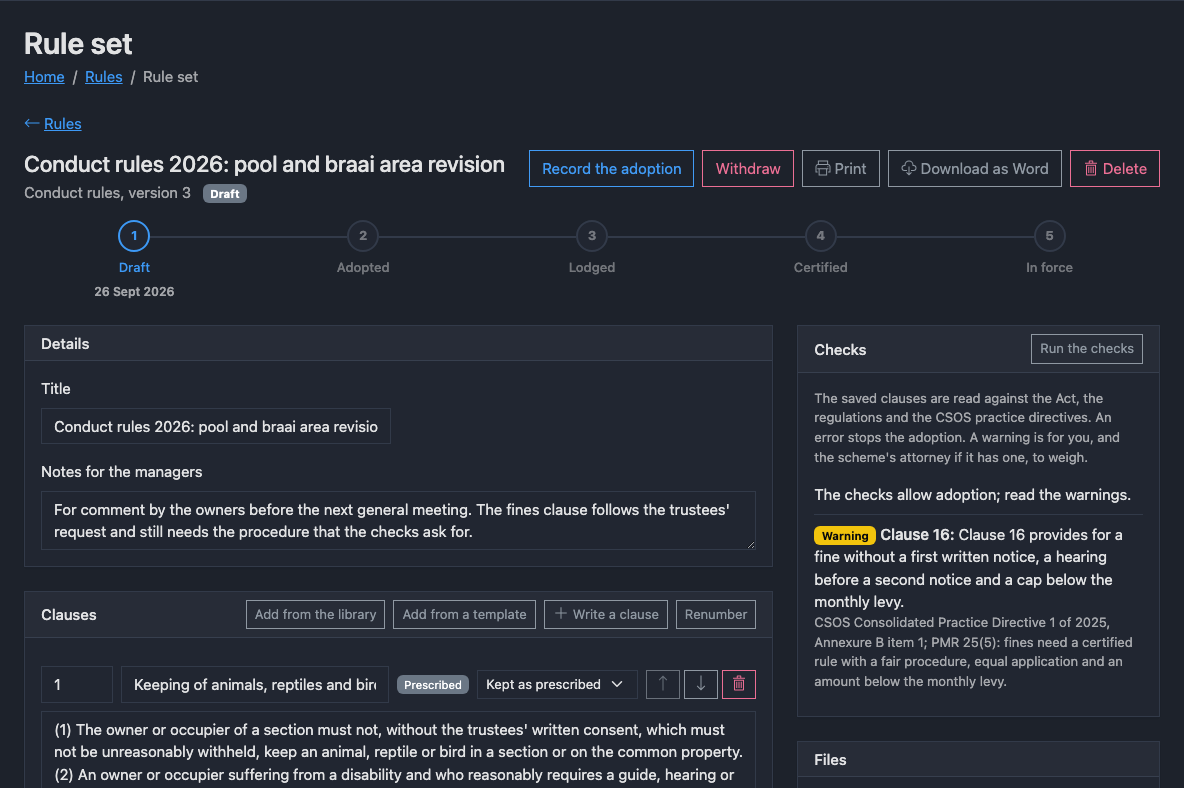
How a rule change becomes a rule
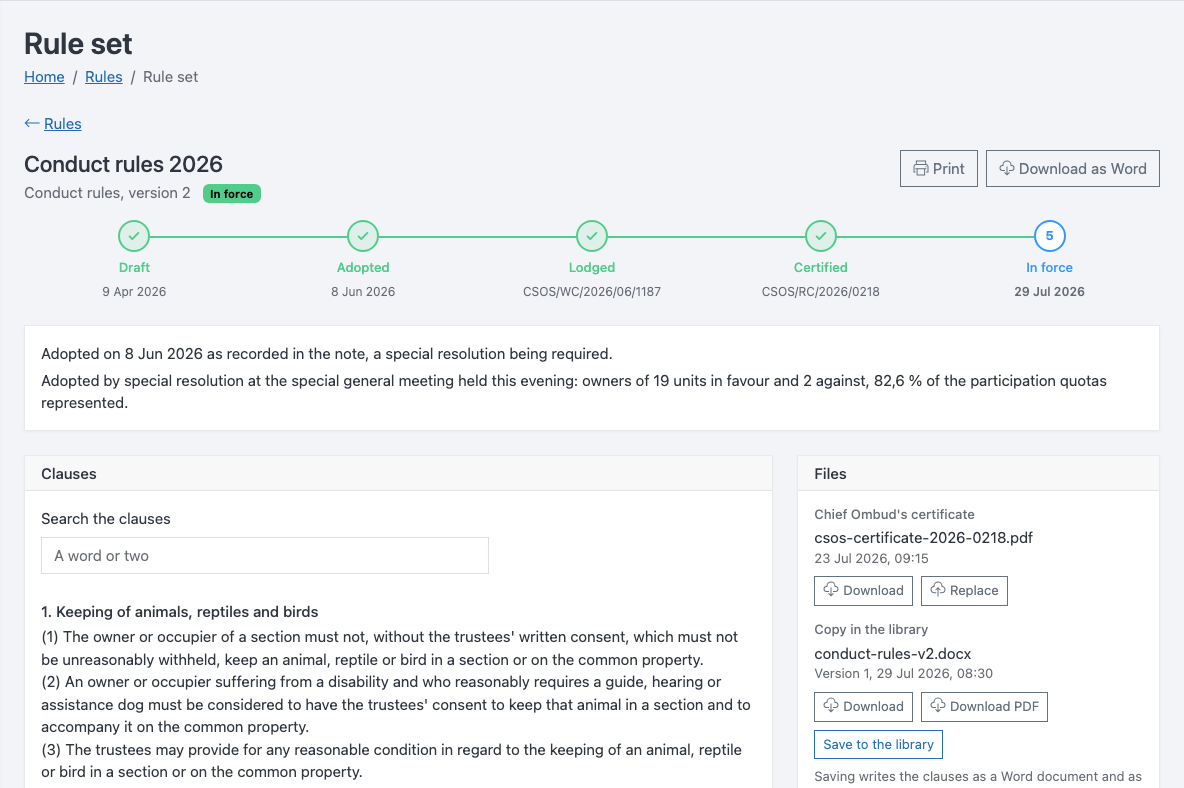
From draft to in force
A change adopted at a general meeting is not yet a rule. It comes into operation on the Chief Ombud's certificate. General information, not legal advice.
- Before the meeting
Draft and give notice
Have the scheme's attorney review the draft. A meeting that will take a special or unanimous resolution needs at least 30 days' written notice to all members, specifying the resolution, unless the rules provide for shorter notice.
Section 6(2) - At the general meeting
Adopt by the right resolution
Conduct rules change by special resolution, at least 75 per cent of the votes represented, in value and in number. Management rules need a unanimous resolution. Estate Manager links the adoption to that resolution.
Section 10(2) - Within 10 days
Lodge with CSOS
Form B, signed by two trustees and any managing agent, goes with the consolidated rules, the signed minutes, the resolution, the notice and the attendance register. Record the CSOS reference.
PMR 27(1)(a), CSOS directive 6.15 - After quality assurance
The certificate
CSOS checks the rules against the Act, the CSOS Act, the Constitution and municipal by-laws. The Chief Ombud approves a change only if it is reasonable and appropriate to the scheme. Record the number.
CSOS directive 6.19, section 10(5)(b) - On the certificate's date
In force
The change comes into operation. Estate Manager supersedes the earlier set, brings the complaints catalogue into step, files a Word copy and tells every member.
Section 10(5)(d) - Within 7 business days
Members told
The trustees tell the members of the approved changes, by email or on the notice board, within 7 business days of receiving the certificate.
CSOS directive 6.17
On the record
A dated record, and rules every member can find
Each step keeps its date: the resolution that adopted the set, the CSOS reference, the certificate's number and the day the rules apply from. The certificate is filed in the library, a Word copy is saved, and every step is in the audit trail.
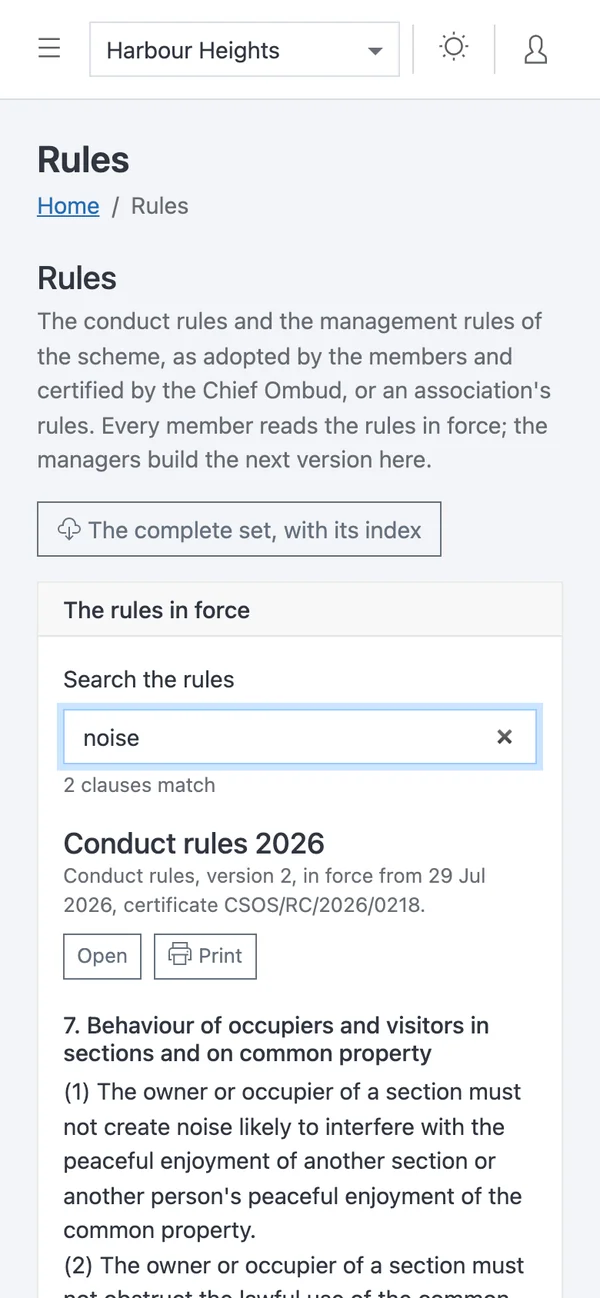
Owners and tenants search the rules in force by any word, such as pets or parking, and print them on A4 or download them in Word. Superseded versions stay readable, and drafts never show. Estate Manager emails the rules in force to each new owner the managers add and to each tenant who joins on an invitation. The body corporate gives a copy on paper to anyone without an email address.
What the law says
Body corporate rules and the law
What the Act, its 2016 regulations and the 2025 CSOS practice directive say.
General information, not legal advice.
Rules that bind everyone
A scheme is managed by its management and conduct rules. They must be reasonable, apply equally to all owners, and bind the body corporate, the owners and anyone occupying a section, tenants included. Conduct rules may not be irreconcilable with a prescribed management rule.
Members change them, not trustees
Conduct rules change by special resolution of the body corporate, management rules by unanimous resolution. A special resolution cannot be passed at a trustees' meeting, the directive notes, where only ordinary resolutions are taken.
No certificate, no rule
A change is lodged with the Chief Ombud, who approves it only if it is reasonable and appropriate to the scheme. It comes into operation on the certificate's date, and rules without a section 10 certificate are not enforceable against the members.
Fines need a fair procedure
A first written notice explains the breach, sets a time to stop and lets the person dispute it and meet the trustees, with no fine. Only a second notice may bring a fine, which must be reasonable, apply equally and stay below the monthly levy. Trustees cannot decide fines on their own.
Nothing debited without a basis
The body corporate may not debit a member's account with anything other than a contribution or a charge under the Act or the rules, unless the member consents or a judge, adjudicator or arbitrator orders it.
Rules CSOS treats as undesirable
Among them: private arbitration instead of CSOS, towing vehicles, withholding votes or access over unpaid levies, and forcing an owner to evict a tenant. A scheme may prohibit pets, but must allow guide, hearing and assistance animals, and pets kept before the rule.
Pets, noise, parking and fines
The questions owners ask most.
| Topic | What the rules or CSOS say | In the builder |
|---|---|---|
| Pets | The trustees' written consent, not unreasonably withheld. A person with a disability who reasonably needs a guide, hearing or assistance dog is considered to have it (rule 1). | Rule 1, word for word |
| Noise | No noise likely to interfere with another's peaceful enjoyment (rule 7(1)). | Template: noise and quiet hours |
| Parking | Only in allocated or visitors' bays, unless the trustees consent in writing (rule 3). | Template: vehicles |
| Fines | No prescribed rule. A certified rule with the two-notice procedure (CSOS directive, Annexure B, item 1). | Template: breaches and fines |
Rule numbers refer to the prescribed conduct rules in Annexure 2. General information, not legal advice.
Free template
The prescribed rules, in Word and PDF
The 39 rules that govern every sectional title scheme unless it has changed them, as an editable Word document from the rules builder or a PDF from its print view. Read them, answer an owner who asks, or start a revision for the scheme's attorney.
The 31 prescribed management rules of Annexure 1 The 8 prescribed conduct rules of Annexure 2 Each rule word for word, as gazetted in GN R1231 on 7 October 2016 A Word file to edit and a PDF laid out for A4
Questions
Questions about body corporate rules
Anything else: ask us when you book a demo, or write to info@nanotech-computers.com.
Can the trustees change the conduct rules on their own?
Can a body corporate fine an owner?
Do the rules bind tenants?
Does Estate Manager lodge the rules with CSOS?
Does the builder work for a homeowners' association?
What the rules builder does not do
- The drafted templates are for the scheme's attorney to review before adoption, and the checks are a reading aid, not a ruling.
- It does not lodge rules with CSOS or give legal advice. Decisions remain the body corporate's.
See the rules builder at work
A demo takes a revision of the conduct rules on a fictional scheme through the checks, the adoption and the certificate.