
Documents and records
Body corporate records, kept in one place
Estate Manager gives every scheme a document library with folders, versions and the right readers for each, and produces the records that meetings and decisions leave behind: minutes drafts, results certificates, proxy forms, appointment letters and rules documents. When a member asks to inspect the records, they are in one place.
The library
Folders for the records a body corporate keeps
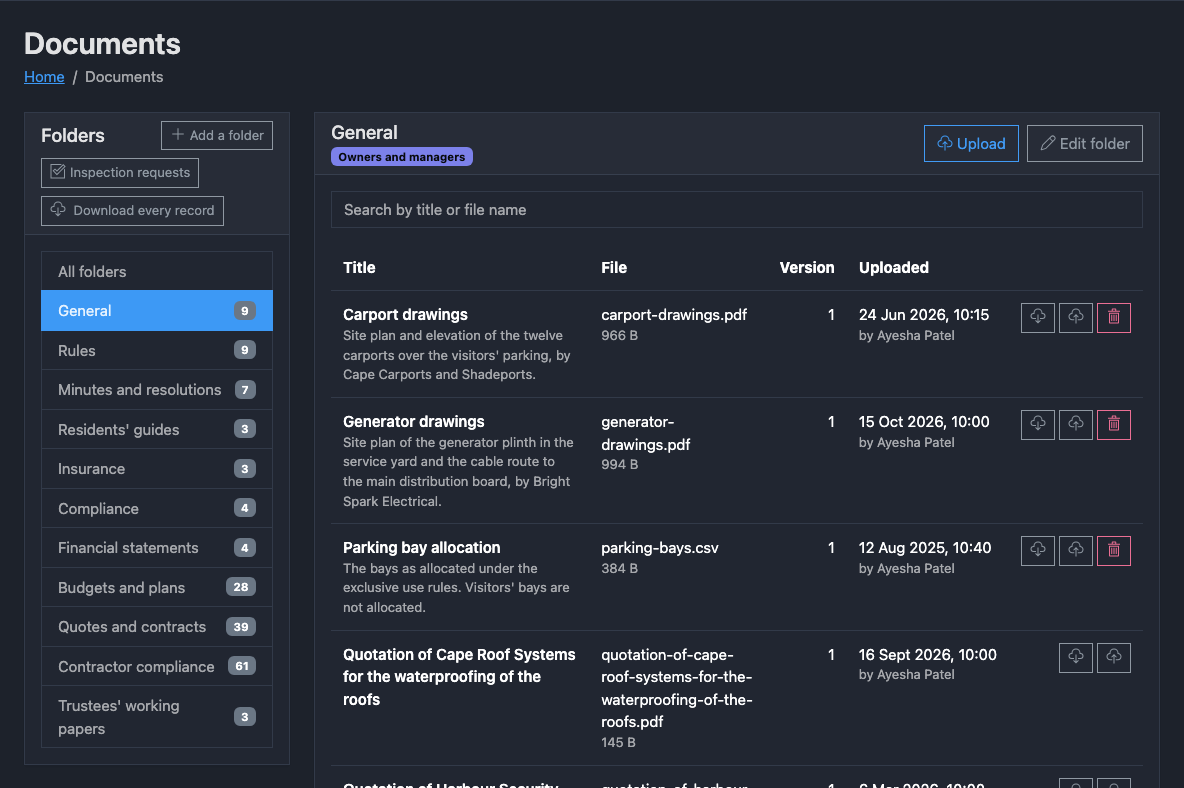
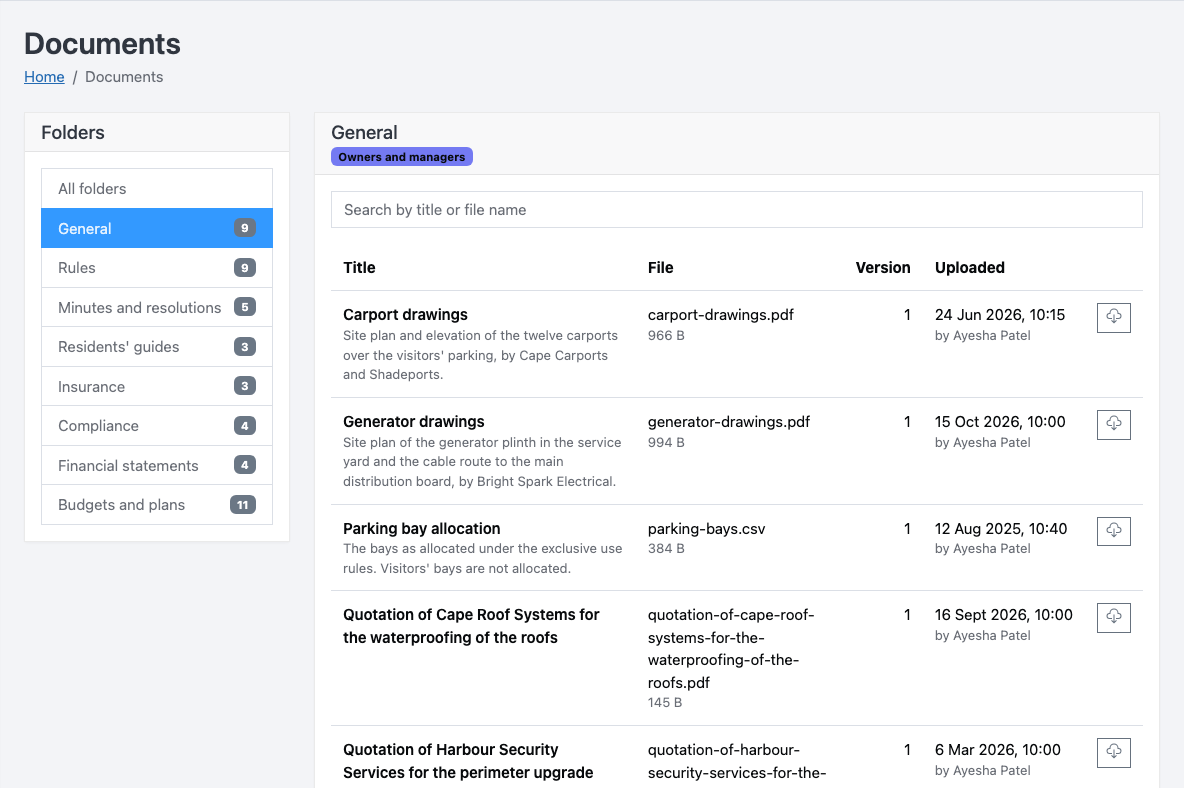
Every scheme starts with nine folders: general, rules, minutes and resolutions, insurance, compliance, financial statements, budgets and plans, quotes and contracts, and contractor compliance. The managers add their own, such as lifts, and set who reads each folder: everyone in the estate, the owners, or the managers alone.
Owners never see the managers' folders, and tenants see only what is meant for everyone, such as the rules. Quotes and contractors' papers always stay with the managers, and the audit trail records each download of a managers' document.
PDF, Word, Excel, CSV, PNG and JPEG files up to 25 MB Files checked by their content, not their name Search by title or file name, in one folder or all of them
Versions
Every version kept, so last year's certificate stays at hand
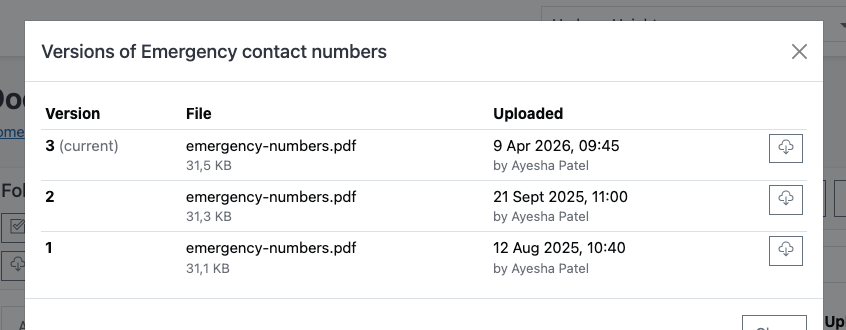
Replacing a document uploads a new version and keeps the earlier ones downloadable, each with its file, size, uploader and date, so the scheme can show what it held at the time. Deleting a document hides every version, and the files are kept for five years, or longer for financial and company records, which leaves time to ask for one back.
Quotes, signed appointment letters, the trustees' signed resolutions, budgets and certified rules file themselves into their folders and stay with the records they belong to.
Produced from the record
Minutes, certificates and letters written from the record
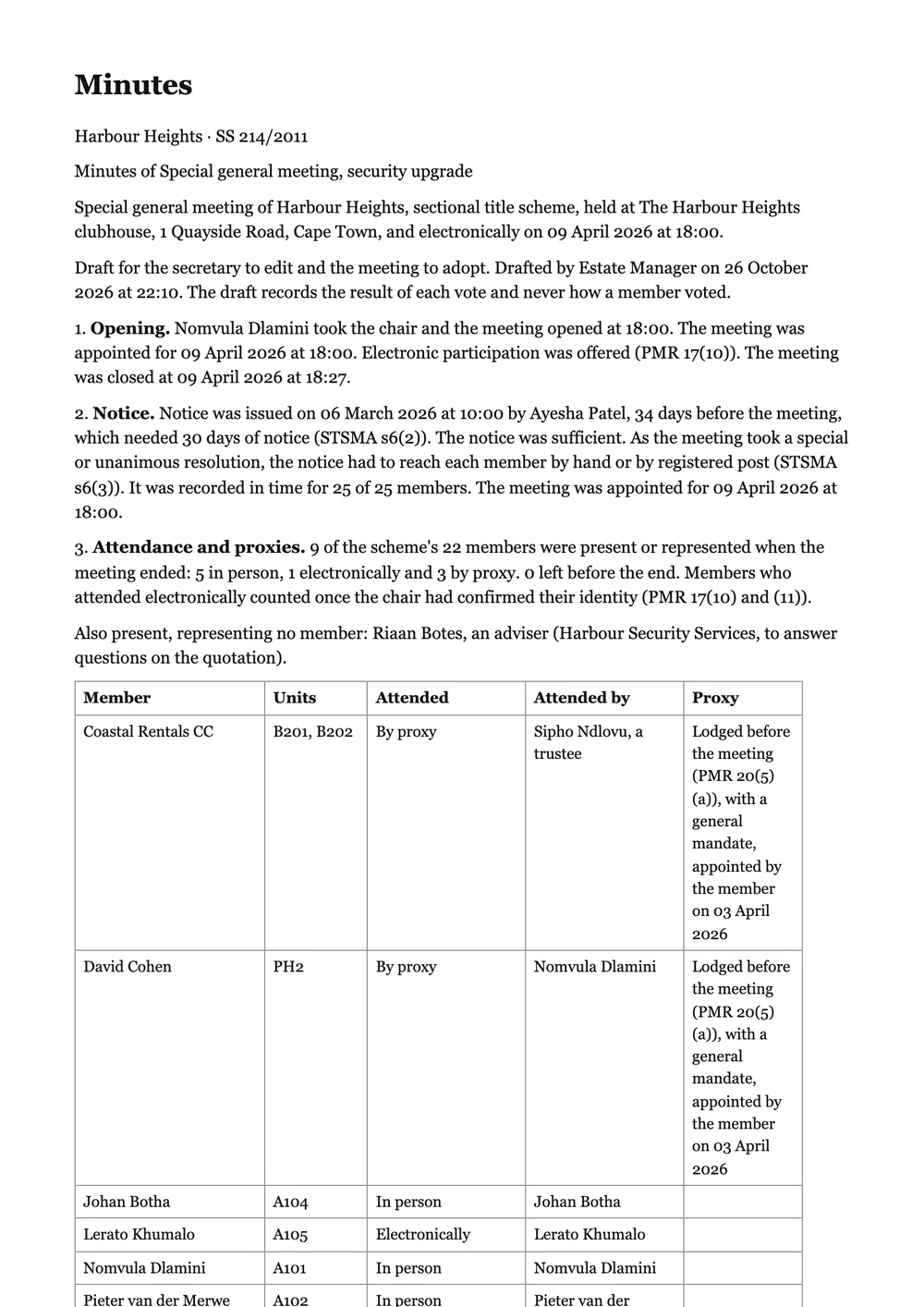
Once a general meeting ends, Estate Manager drafts its minutes as a Word document from the record: the notice and the days it gave, the attendance with how each proxy was lodged, the quorum, and each resolution with its text and result in value and in number. The secretary edits the draft, and the next meeting adopts it. It never says how a member voted.
Issuing a meeting's notice emails the pack to every owner and the managing agent: the notice, the agenda with each resolution's wording and the prescribed proxy form, Form C, prefilled for each owner. A delivery report records each email, and each notice handed over or sent by registered post.
Results certificates on A4, with a line for the chair's signature Appointment letters in Word, from the approved quote The rules in force as a Word copy and a print view Budgets and the ten-year plan in Excel or CSV
What the law says
What records a body corporate must keep, and who may see them
Rule 27 of the prescribed management rules lists the governance records, rule 26 adds the books of account, and rule 9 sets the deadline for minutes.
General information, not legal advice.
Minutes
Minutes of general and trustee meetings, with the date, time and place, the names and roles of those present, how proxies were authorised, the text of all resolutions and the results of the voting on all motions.
Registers
Lists of trustees, members and tenants with their full names, identity or passport numbers, addresses, telephone numbers and email addresses, and lists of the sections with their participation quotas and owners, exclusive use areas, registered bondholders and future development rights.
The rules
A complete set of the management and conduct rules with an index, and a consolidated set prepared whenever they are amended.
Records it may keep
Copies of the sectional plans, the Act and regulations, resolutions changing the common property, consents and waivers, contracts, decisions and legal opinions, budgets and financial statements, tax returns, insurance policies and claims, and correspondence.
Inspection and copies
On a written request from a member, a registered bondholder or someone either authorises in writing, the records must be made available within 10 days, or 5 for the rules. A fee for copies, other than of the rules, may not exceed the reasonable cost of making them, and the body corporate may refuse to supply a copy until the fee is paid.
Books of account
A member, a registered bondholder or the managing agent may inspect and copy the books of account and records, which are kept for 6 years after the transactions they relate to.
Deadlines and form
Minutes go to everyone entitled to notice of the meeting as soon as reasonably possible, and within 7 days. A managing agent or an employee whose contract the body corporate ends hands over all the records within 10 days. Records are in writing or in a form easily converted to writing.
Papers for the CSOS annual return
The practice directive of the Community Schemes Ombud Service (CSOS) lists the supporting documents of a sectional title scheme's annual return, filed within 4 months of the financial year end. They include these (Annexure F).
Form CS2, with a signed declaration Audited financial statements Minutes of the most recent annual general meeting, signed (Annexure F) or in draft (paragraph 14.3) An up-to-date levy schedule Details of the executive committee The rules, resolutions and other governance documents The maintenance, repair and replacement plan A valuation schedule of the common property Judgments for or against the scheme
Free template
Minutes template for a general meeting
A minutes draft as Estate Manager writes it from a meeting's record, in Word, laid out with what rule 27(2)(a) asks minutes to record.
The scheme, the meeting, the chair, and when it opened and ended The notice: when it was issued, the days it gave and the rule that applied The attendance, with how each proxy was authorised The quorum in force, and whether it was present Each resolution with its text and the votes for, against and abstaining, in value and in number A line for the chair's signature
Questions
Questions about body corporate records
Anything else: ask us when you book a demo, or write to info@nanotech-computers.com.
How long must a body corporate keep its records?
Who may inspect body corporate records?
Can a buyer or an estate agent see the records?
When must the minutes be sent out?
What happens to the records when the managing agent changes?
Can owners see every document?
Related
Related
AGMs and general meetings
The meeting record that the minutes draft and the certificates come from.
Read moreRules: prescribed, drafted, adopted
The rules in force with their certificate, filed in the library.
Read morePrivacy, POPIA and security
Retention periods, the audit trail and who may read personal information.
Read moreSee the records a meeting leaves behind
A demo runs a general meeting on a fictional scheme, then opens the minutes draft, a results certificate and the document library.