
AGMs and general meetings
The body corporate AGM, from notice to minutes
A body corporate's annual general meeting (AGM) runs on a clock and a checklist set by the Sectional Titles Schemes Management Act and its 2016 regulations. Estate Manager follows both: the notice period checked, the notice pack sent, the register and the quorum kept live, and the minutes drafted from the record.
Notice
The AGM notice period, checked before the notice goes out
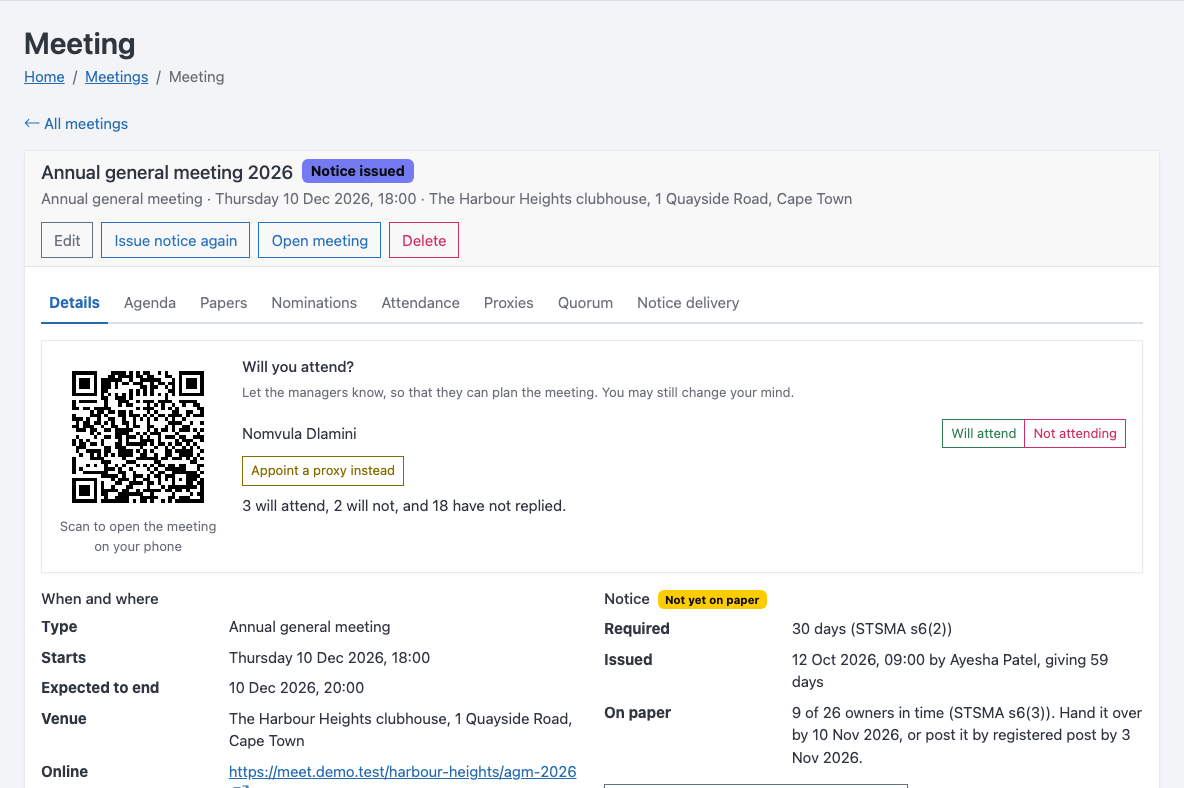
A general meeting needs at least 14 days' written notice, or 30 when a special or unanimous resolution is on the agenda, unless the scheme's rules provide for shorter notice. Estate Manager reads the agenda, sets the period and shows the last day to issue the notice. A meeting called short is marked, and the chair's reason stays in its record.
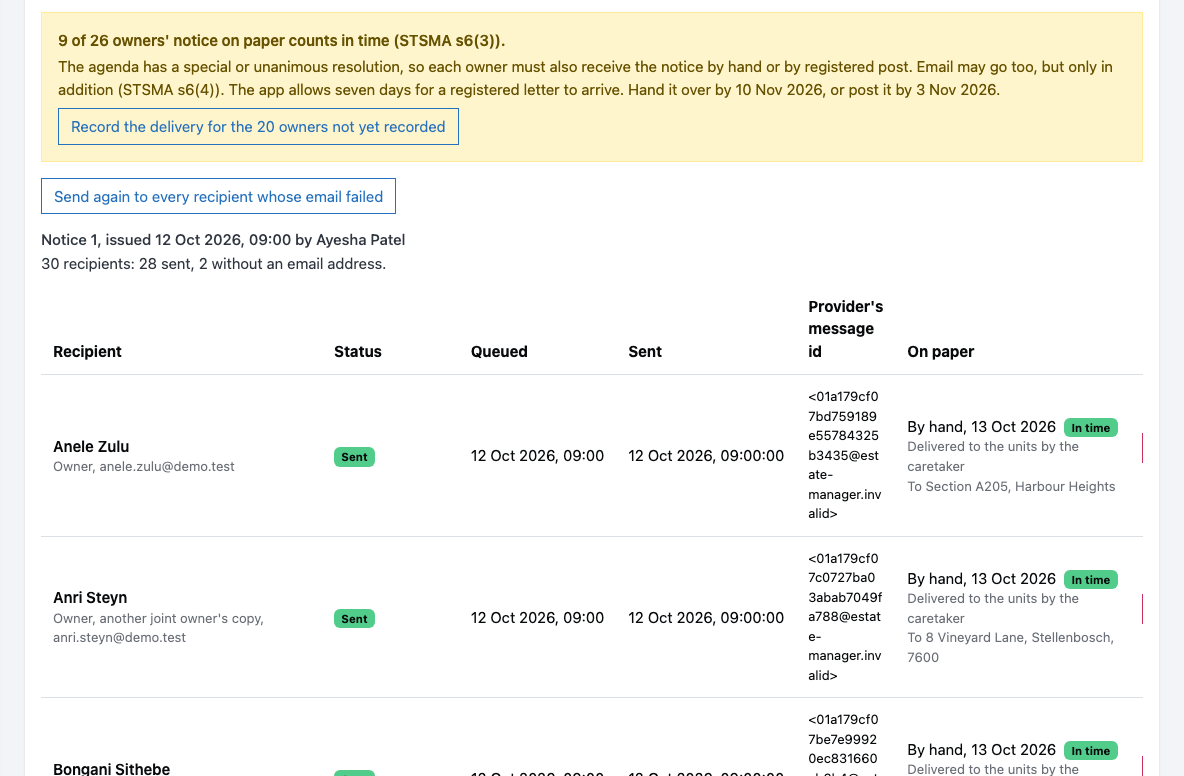
The notice pack goes by email to every owner and the managing agent, with the agenda and Form C prefilled for each owner. The delivery report shows each recipient, the address used and when the email went, with a resend for failures. When a special or unanimous resolution is on the agenda, the notice must also reach each owner by hand or by registered post, so the report records each delivery on paper and allows seven days for a registered letter to arrive.
A change after the notice marks it stale until an amended notice goes out Owners without an email address are listed, and their notice by hand or by post is recorded Bondholders and holders of future development rights in the register receive the notice too, and their notice on paper is recorded
Agenda
An agenda that knows each resolution's type
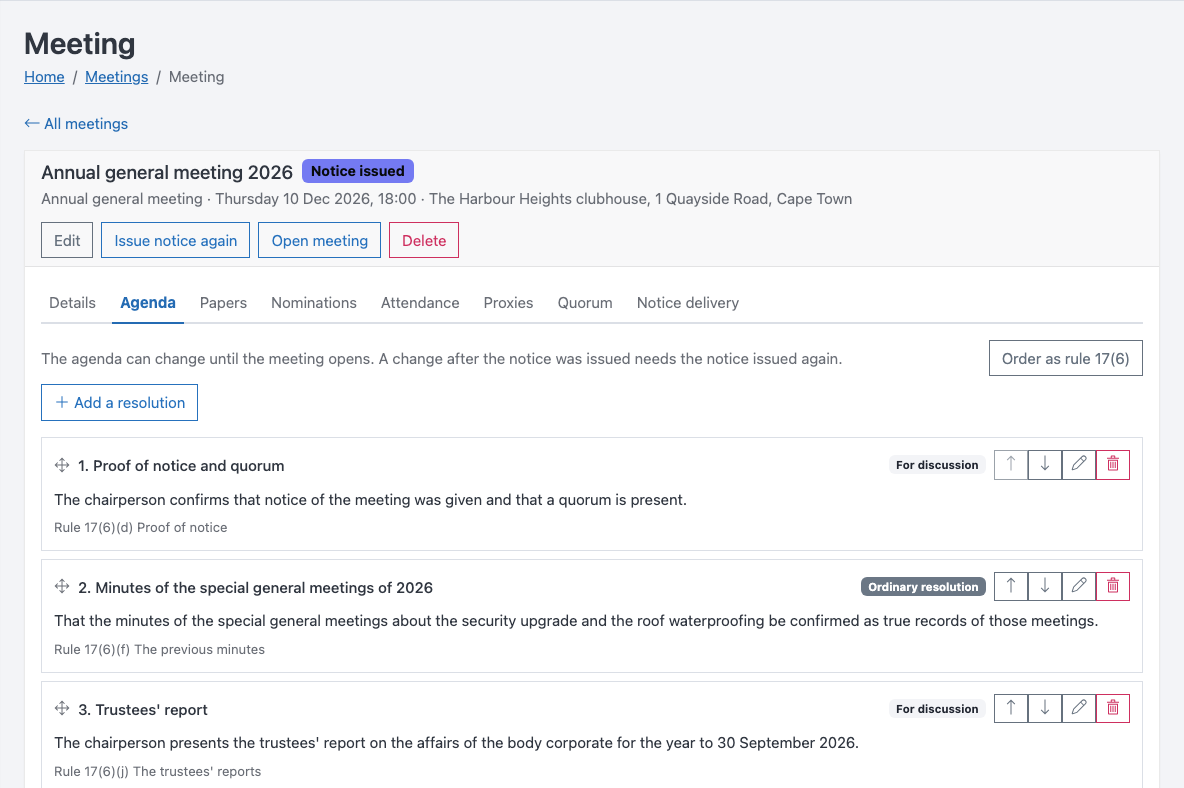
Rule 17(7) asks the agenda to describe all the business, with the proposed wording of any special or unanimous resolution. Estate Manager's agenda holds the business that takes no vote, such as the trustees' report, beside the matters to be voted on, and puts it in the order of business of rule 17(6). Each resolution carries a title, its wording, its type and its proposer, with a seconder only where there is one, since a motion needs none. Drag them into order until the meeting opens.
The type sets the notice period, tells owners on the ballot what passes the resolution and decides the count. A budget tabled at the AGM is approved, or not, when its resolution's poll closes.
Attendance, quorum and adjournment
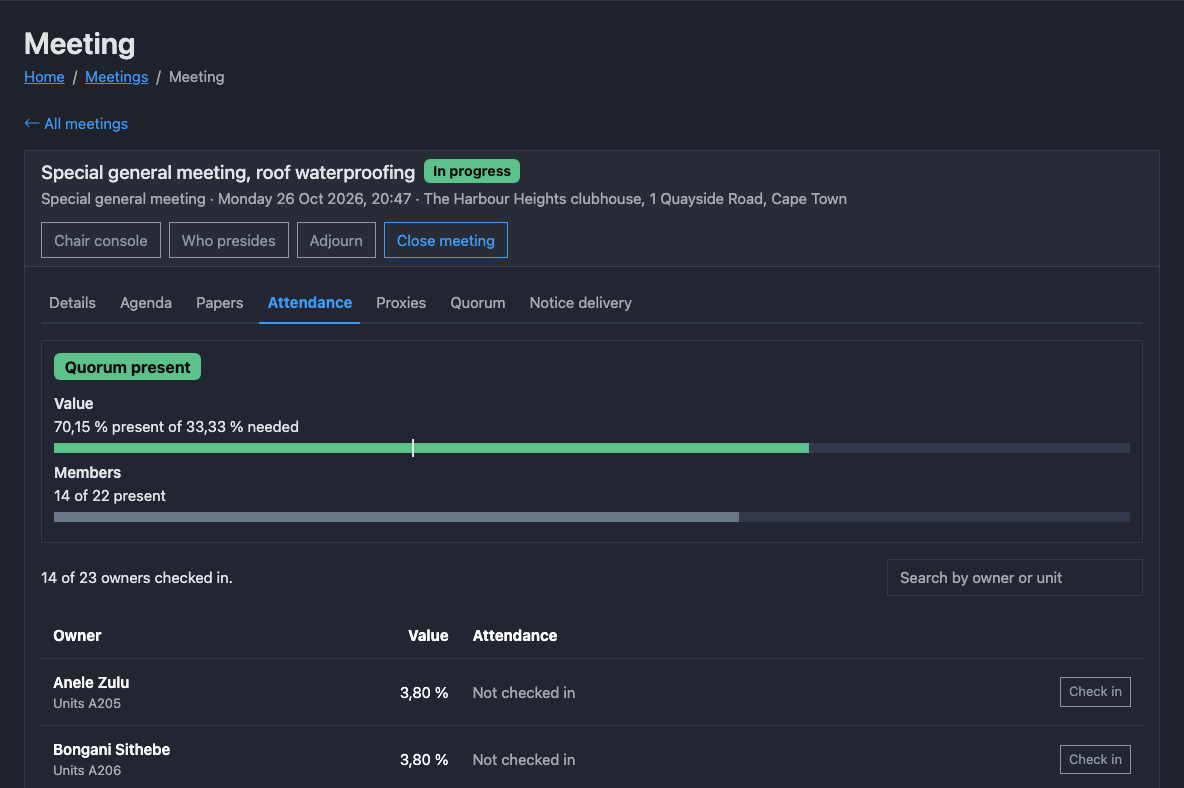
An attendance register with a live quorum
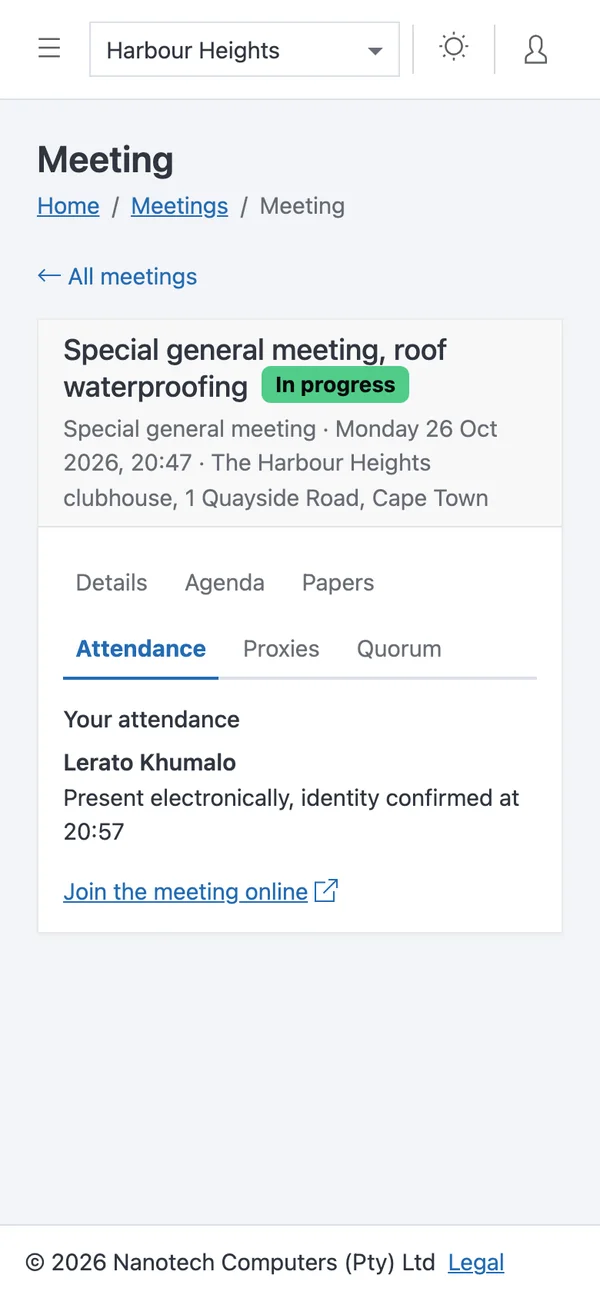
The chair checks owners in as they arrive, in person, online or by proxy, including a signed proxy form handed in before or at the start. Owners attending online check in for their own units and the proxies they hold, and count once the chair confirms who they are. The register decides who votes for each owner.
The quorum meter moves with every check-in, in value and in persons. Without a quorum, or when the business cannot be finished, the chair adjourns. By default the follow-on meeting falls on the same day of the next week, needs no notice of its own and carries over the undecided business with its proxies.
Estate Manager does not host the call: owners join your scheme's call and vote beside it
Results and minutes
Minutes drafted from the record
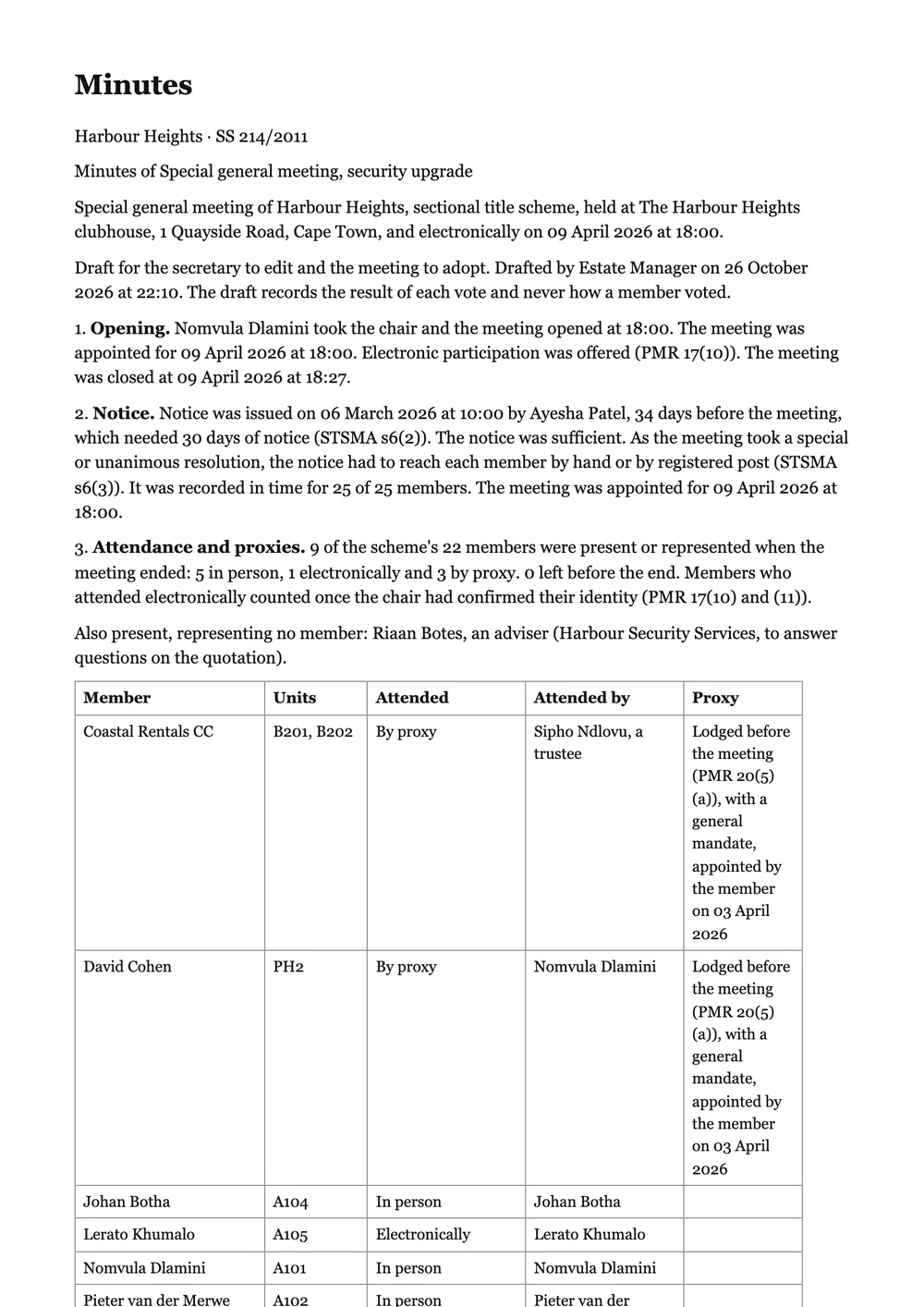
Each result is recorded as its poll closes, with a results certificate to print and sign. When the meeting ends, Estate Manager drafts the minutes in Word: the notice, the attendance with how each proxy was lodged, the quorum, and each resolution with its result in value and in number.
The draft never says how a member voted, and it keeps the register of the day, so a later transfer does not change who attended. The secretary edits it, and the next general meeting approves it.
On the clock
A body corporate AGM, on the clock
The dates the Act and the prescribed management rules set, from year end to an adjourned meeting.
- Year end
Four months to hold the AGM
The AGM must be held within four months of the end of the financial year. Estate Manager shows the current financial year above the budgets, with the date by which the AGM after it is due.
PMR 17(1) - 30 days before
Notice of a special resolution
Written notice specifying a special or unanimous resolution, unless the rules provide for shorter notice. Estate Manager raises the period as soon as one is added to the agenda.
Section 6(2) - 14 days before
Notice of the meeting
The last day for notice of a meeting with ordinary business only. The dashboard flags a notice due within seven days, or late.
PMR 15(1) - 48 hours before
Proxies and nominations close
Proxy appointments and acceptances reach the body corporate, as do trustee nominations with the nominee's written consent. Estate Manager closes online appointments then.
PMR 20(5), PMR 7(2) - 30 minutes after the start
A quorum, or an adjournment
Without a quorum, the meeting stands adjourned to the same day of the next week. If the quorum is still short 30 minutes into that meeting, the members present in person or by proxy form it.
PMR 19(4)
What the law says
Body corporate AGM requirements
General meetings follow section 6 of the Sectional Titles Schemes Management Act and prescribed management rules 15 to 20 of its 2016 regulations. A scheme's own rules may differ where the law allows.
General information, not legal advice.
One AGM a year
Within four months of the end of each financial year. Every other general meeting is a special general meeting (SGM).
Who receives notice
At least 14 days' written notice of the place, date and time, to the members, the registered bondholders, the holders of future development rights and the managing agent.
Notice of a special or unanimous resolution
At least 30 days' written notice, handed to each member or sent by pre-paid registered post to their section or to an address they chose in writing. Email may go too, but only in addition.
What the AGM decides
The trustees' report, the insurance replacement values and cover, the administrative and reserve fund budgets, the financial statements, the auditor and the election of trustees, in the order the rule sets.
Online and hybrid meetings
Attendance by telephone or another method counts as present in person, if everyone entitled to attend can use it, all can communicate and the chair can confirm identities with reasonable certainty.
Quorum
Members holding one third of all the votes in value, with at least two persons present, or two thirds in a scheme with fewer than four primary sections or members. Without a quorum after 30 minutes, the meeting stands adjourned for a week.
The minutes
The date, time and place, who was present and in what role, how proxies were authorised, the text of every resolution and the result of every vote, which the chair announces.
What goes out with the AGM notice
Rule 15(3) sets the minimum: an agenda, the papers to be considered or approved, and a proxy form. At an AGM, rule 17(6) decides which papers those are. Estate Manager's notice pack carries the place, date and time, the resolutions with their wording, Form C, a list of the papers that the managers add to the meeting with the link to them, and at an AGM how to nominate a trustee, with a nomination form. The managers send the rest of the agenda with it.
The place, date and time, and any online link The agenda, in the order of business of rule 17(6) The wording of each special or unanimous resolution The minutes of the last general meeting The trustees' report The insurance replacement value schedule The administrative and reserve fund budgets The annual financial statements Form C, with the 48-hour cut-off for proxies How to nominate a trustee, 48 hours ahead
Free template
AGM agenda and notice checklist
An editable AGM agenda in the order of business of rule 17(6), with a checklist of what the notice carries, who receives it and when, and which of those Estate Manager's notice pack carries itself.
The AGM's order of business, item by item A resolution block: type, wording, proposer and seconder The notice periods of 14, 30 and 7 days The 48-hour cut-offs for proxies and nominations
Free tools
Work out the dates and the count
Three small calculators count notice, the quorum and the vote the way Estate Manager does.
AGM notice date calculator
The last day to send the notice, when proxies close and when the AGM is due.
PMR 15(1)Work it outQuorum calculator
Whether the members present or represented make a quorum, in value and in persons.
PMR 19(2)Check a quorumResolution calculator
Whether an ordinary, special or unanimous resolution passed, in value and in number.
STSMA s1Check a voteQuestions
Questions about body corporate AGMs
Anything else: ask us when you book a demo, or write to info@nanotech-computers.com.
What is a body corporate AGM, and what is it for?
How much notice is needed for a body corporate AGM?
How do you call an AGM at shorter notice?
Is an AGM a legal requirement?
Who can call a special or extraordinary general meeting?
Who may attend a body corporate AGM?
Can a body corporate hold a virtual or hybrid AGM?
Related
More on meetings and votes
See a meeting run, from notice to minutes
A demo walks through a general meeting on a fictional scheme, from the notice and the proxies to the vote and the paperwork that follows.